Overview of Steroid Hormone Analysis
Steroid hormone analysis represents one of the most challenging yet essential applications in clinical chemistry, pharmaceutical research, and forensic toxicology. These lipophilic compounds, derived from cholesterol, play critical roles in physiological regulation, including metabolism, immune function, and reproductive health. The analytical challenge stems from their structural diversity, low physiological concentrations (often in the ng/mL to pg/mL range), and extensive metabolism leading to conjugated forms.
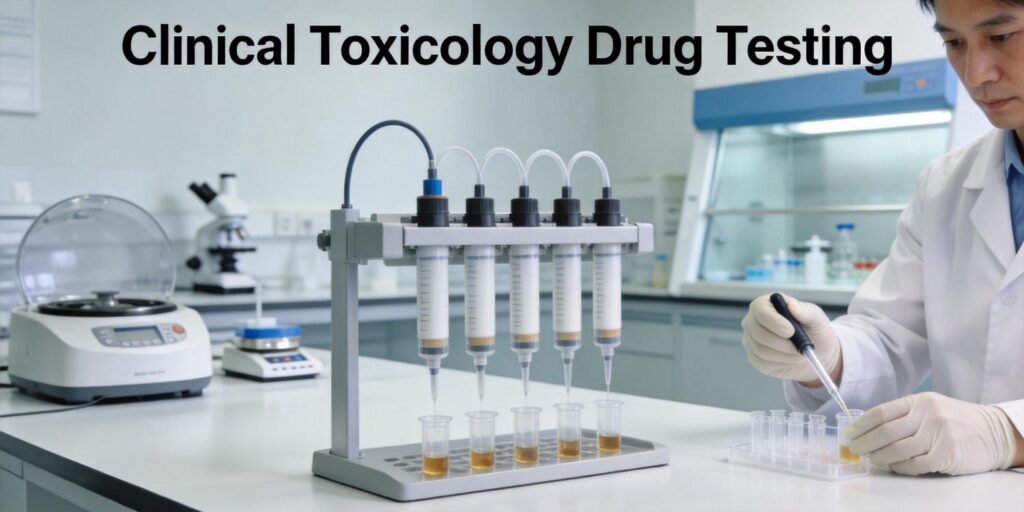
Modern steroid analysis relies heavily on chromatographic separation coupled with mass spectrometric detection. As noted in forensic applications, “the detection of drug metabolites has become more important following the realization that they allow positives to be called when no parent drug is excreted, thereby establishing that administration of the drug has occurred.” This principle applies equally to endogenous steroid monitoring, where metabolite profiles provide crucial diagnostic information.
Key Steroid Classes in Biological Fluids
Biological fluids typically contain multiple steroid classes:
- Glucocorticoids (cortisol, cortisone) – involved in stress response and metabolism
- Mineralocorticoids (aldosterone) – regulate electrolyte balance
- Sex hormones (testosterone, estradiol, progesterone) – reproductive functions
- Anabolic steroids – synthetic derivatives used therapeutically or abused
Each class presents unique extraction challenges due to varying polarity, functional groups, and conjugation patterns. As research indicates, “the functionality of the anabolic steroids is quite diverse. Some, such as testosterone, are relatively non-polar while others, such as stanozolol and its metabolites, are more highly functionalized and more water-soluble.”
Challenges in Plasma and Urine Matrices
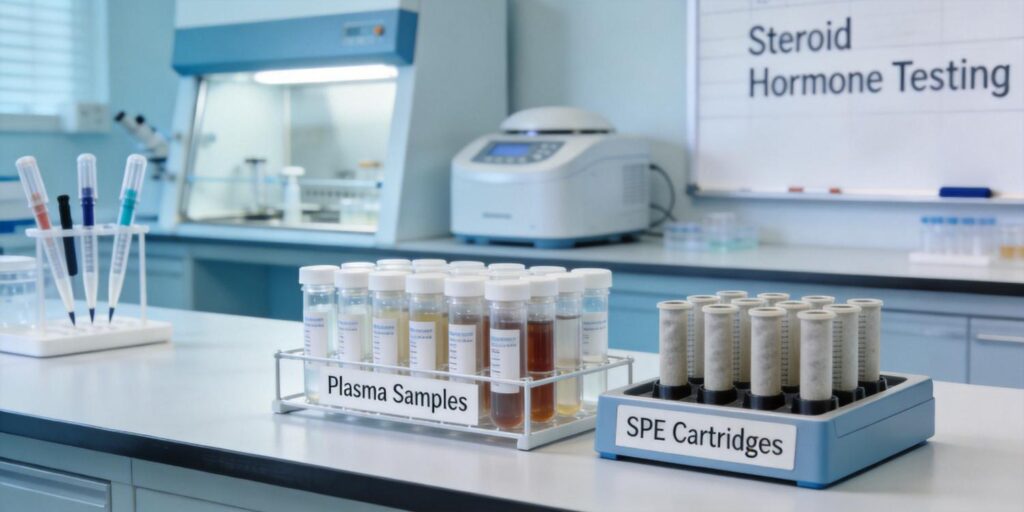
Biological matrices present formidable obstacles for steroid analysis. Plasma and serum contain high protein concentrations that can bind steroids, while urine exhibits variable pH and electrolyte content. According to SPE methodology guidelines, “plasma or blood samples may develop protein clots, and urine samples may form precipitates if stored for long periods or subjected to repeated freeze-thaw cycles.”
Plasma/Serum Specific Challenges
Protein binding represents the primary challenge in plasma analysis. Steroids bind extensively to albumin and sex hormone-binding globulin (SHBG), requiring disruption for accurate quantification. The extraction objectives for biological samples include “elimination of protein binding” as a critical step. Additionally, plasma contains phospholipids that can cause matrix effects in LC-MS/MS analysis, necessitating effective cleanup.
Urine Matrix Complications
Urine presents different challenges: “Urine is characterized by a low protein content and by a less well defined sample matrix than plasma. For instance, urine pH varies between 4.5 and 8 in normal subjects and the content of electrolytes also varies considerably, depending on the diet and the rate of urine production.” Furthermore, most steroids are excreted as conjugates (glucuronides and sulfates), requiring hydrolysis prior to analysis.
For equine urine specifically, researchers note that “horse urine typically contains compounds that will extract into most SPE fractions. Many dietary components or their metabolites are structurally similar to target analytes and it is therefore important when preparing extracts for broad based screening that these compounds be co-extracted and resolved in a later chromatographic step.”
SPE Sorbent Selection for Steroid Hormones
Proper sorbent selection is paramount for successful steroid extraction. The choice depends on steroid polarity, functional groups, and matrix composition.
C18 and Mixed-Mode Sorbents
Reversed-phase C18 sorbents remain the workhorse for steroid extraction. As documented in veterinary applications, “most methods for the separation of anabolic steroids therefore employ a C18 phase SPE cartridge for desalting and crude extraction of the steroidal fraction.” These sorbents effectively retain steroids through hydrophobic interactions while allowing removal of polar interferences.
Mixed-mode sorbents combining hydrophobic and ion-exchange functionalities offer enhanced selectivity. Research demonstrates that “the strategy of a mixed-mode cartridge providing hydrophobic and cation exchange interactions, combined with a pH-dependent sample application and extraction, can give high recoveries of analytes from plasma, urine, whole blood, and tissues.”
Specialized Sorbents for Specific Applications
For corticosteroids with specific functional groups, alternative approaches exist: “An alternative SPE method using a silica cartridge allows the more selective retention of the corticosteroids, which are eluted by varying the ratio of dichloromethane (a wash solvent) and ethyl acetate (an elution solvent).”
Immunoaffinity columns provide exceptional selectivity for specific steroid classes. Studies report that “immuno-affinity column chromatography has been reported as a method suitable for the recovery of corticosteroids prior to chromatographic analysis.”
Sorbent Selection Guidelines
| Steroid Class | Recommended Sorbent | Key Considerations |
|---|---|---|
| Non-polar steroids (testosterone) | C18, C8 | High hydrophobic retention |
| Polar steroids (cortisol) | Mixed-mode (C18/SCX) | Additional ion-exchange capability |
| Conjugated steroids | Mixed-mode (C18/SAX) | Anion exchange for glucuronides/sulfates |
| Multiple steroid classes | HLB (hydrophilic-lipophilic balance) | Broad-spectrum retention |
Example Extraction and Cleanup Workflow
A comprehensive steroid extraction protocol typically follows these steps:
Sample Pretreatment
For plasma/serum: Protein precipitation using organic solvents (acetonitrile, methanol) or acidification. For urine: Hydrolysis of conjugates using β-glucuronidase/sulfatase enzymes or acid hydrolysis. Research notes that “a common feature of urine extraction is a hydrolysis step, since many drugs are excreted as sulfates, glucuronides or other conjugates forms.”
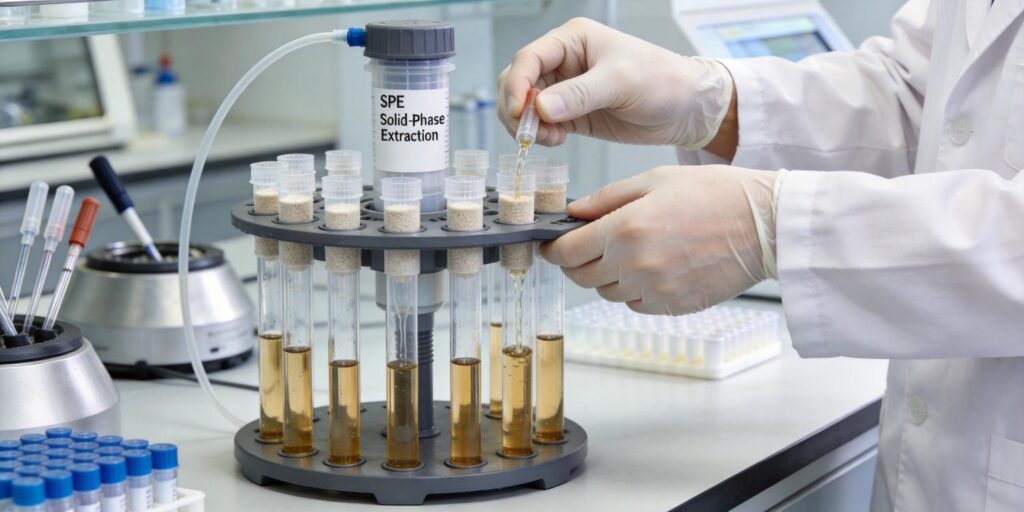
SPE Procedure
- Conditioning: Typically with methanol followed by water or buffer
- Sample Loading: At optimal pH for retention (often pH 6-7 for mixed-mode)
- Washing: Remove interferences while retaining analytes
- Elution: Using organic solvents with appropriate modifiers
A documented protocol for anabolic steroids specifies: “Condition CLEAN SCREEN extraction column: 1× 3 mL of CH₃OH; aspirate. 1× 3 mL of DI H₂O; aspirate. 1× 1 mL of 0.1 M phosphate buffer, pH 6.0; aspirate.”
Post-SPE Processing
Evaporation and reconstitution in mobile phase compatible solvent. For GC-MS analysis, derivatization (typically silylation) enhances volatility and detection sensitivity.
LC-MS/MS Detection Methods
Liquid chromatography-tandem mass spectrometry has become the gold standard for steroid analysis due to its specificity, sensitivity, and ability to analyze multiple steroids simultaneously.
Chromatographic Separation
Reversed-phase chromatography using C18 or C8 columns with gradient elution provides optimal separation. Mobile phases typically consist of water and methanol or acetonitrile, often with additives like ammonium acetate or formic acid to enhance ionization.
Mass Spectrometric Detection
Electrospray ionization (ESI) in positive or negative mode, depending on steroid structure. Multiple reaction monitoring (MRM) provides the necessary sensitivity and specificity for low-level detection. As noted in analytical validations, “each analyte gave precise and consistent results with a less than 6.5% relative standard deviation (RSD) for both the interday and intraday variability.”
Method Optimization Considerations
- Ionization efficiency: Steroids with keto groups often ionize better in positive mode
- Matrix effects: Require careful evaluation and compensation using internal standards
- Chromatographic resolution: Critical for isobaric steroids (e.g., testosterone/epitestosterone)
Validation and Reproducibility Considerations
Method validation according to regulatory guidelines (FDA, EMA, CLSI) ensures reliable steroid quantification.
Key Validation Parameters
Accuracy and Recovery: Typically 85-115% for biological matrices. Studies report recoveries “ranging from 85.7 to 114.8%” for well-optimized methods.
Precision: Both within-run and between-run variability should be <15% RSD. Documented methods achieve "relative standard deviations of less than 7.3%" for basic drug recoveries.
Linearity: Over the clinically relevant concentration range. Validation data shows “all analytes gave linear curves from 50–2000 ng/mL” with correlation coefficients >0.995.
Limit of Quantification: Sufficient for physiological concentrations. Methods demonstrate “LOD ranged from 0.24 to 0.32 ng g⁻¹ and the LOQ from 0.80 to 1.05 ng g⁻¹.”
Quality Control Measures
Implementation of internal standards (preferably stable isotope-labeled analogs) corrects for extraction variability and matrix effects. Regular analysis of quality control samples at multiple concentrations ensures ongoing method performance.
Reproducibility Across Laboratories
Standardized protocols, consistent sorbent lots, and proper training are essential for inter-laboratory reproducibility. Automated SPE systems can enhance reproducibility by reducing manual variability.
Conclusion
SPE sample preparation for steroid analysis in biological fluids requires careful consideration of matrix effects, steroid chemistry, and analytical objectives. Proper sorbent selection, method optimization, and rigorous validation ensure accurate, reproducible results. The evolution of mixed-mode sorbents and advanced LC-MS/MS technology continues to push detection limits lower while improving specificity. For laboratories seeking reliable steroid analysis, investing in optimized SPE protocols represents a critical step toward achieving consistent, defensible results in clinical, research, and forensic applications.
For comprehensive SPE solutions tailored to steroid analysis, explore our HLB SPE cartridges, MCX mixed-mode cartridges, and 96-well SPE plates for high-throughput applications.