Environmental Importance of Sediment Pollutant Monitoring
Sediments serve as critical environmental archives, accumulating organic pollutants from industrial, agricultural, and urban sources over extended periods. As reservoirs for persistent organic pollutants (POPs), sediments can act as both sinks and secondary sources of contamination, releasing accumulated toxins back into aquatic ecosystems during sediment resuspension events. The monitoring of sediment-bound pollutants is essential for assessing historical contamination patterns, evaluating ecological risks, and implementing effective remediation strategies. Regulatory frameworks worldwide recognize sediment quality as a key indicator of ecosystem health, with sediment analysis forming the foundation of environmental impact assessments and compliance monitoring programs.
Extraction of Organic Contaminants from Sediments
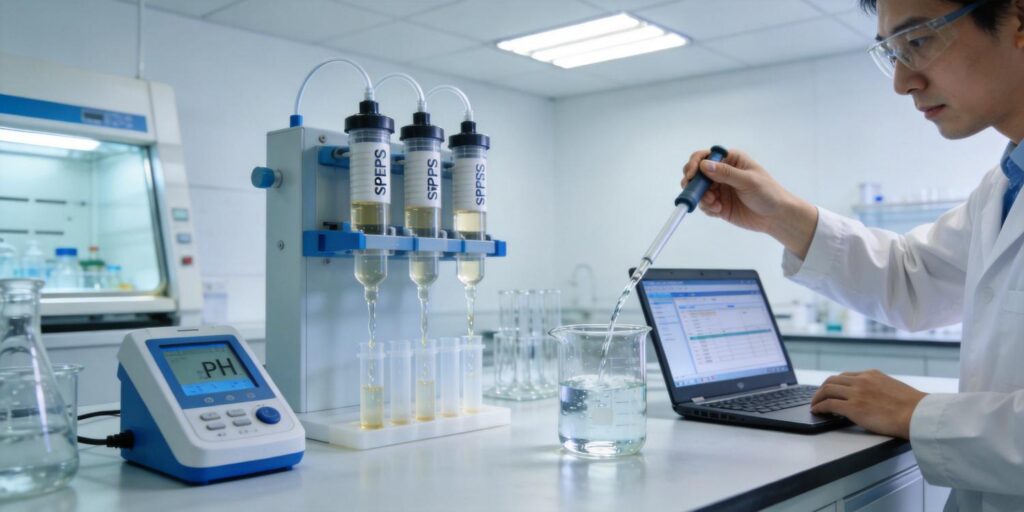
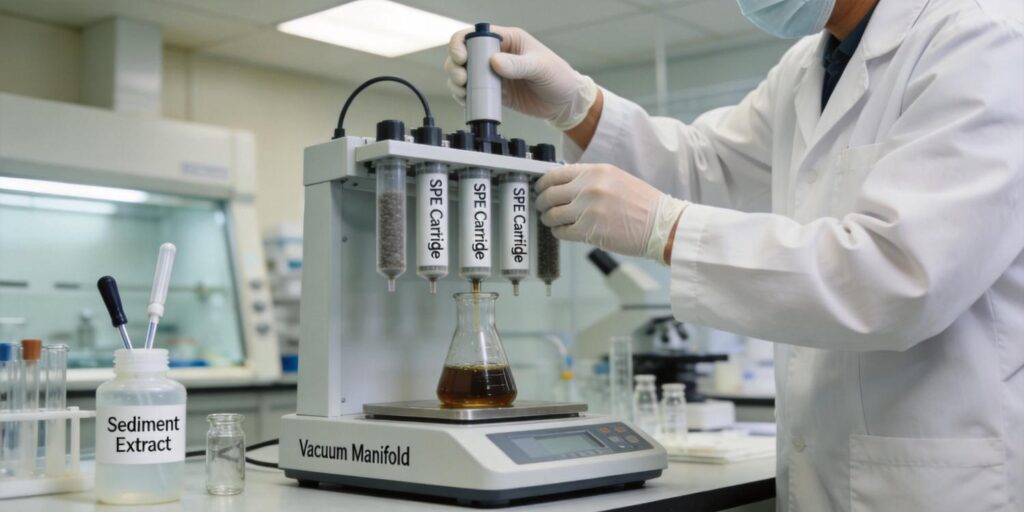
The extraction of organic pollutants from sediment matrices presents unique challenges due to the complex nature of sediment composition. Unlike aqueous samples that can be directly processed through SPE, sediments require preliminary extraction to liberate analytes from the solid matrix. Traditional approaches include Soxhlet extraction, ultrasonic-assisted extraction, and pressurized liquid extraction, which effectively disrupt sediment architecture and release bound contaminants. As noted in environmental SPE literature, “samples having too great a viscosity or that contain a moderate to heavy particulate content cannot be extracted by SPE without a dilution step, filtration, centrifugation, or some other manipulation.” Following initial extraction, the resulting liquid extract must be appropriately diluted to reduce eluotropic strength before SPE processing.
SPE Sorbent Selection for PAHs and PCBs
Reversed-Phase Sorbents for Non-Polar Compounds
For polycyclic aromatic hydrocarbons (PAHs) and polychlorinated biphenyls (PCBs), reversed-phase sorbents represent the primary choice due to their excellent retention of non-polar compounds. C18-bonded silica sorbents have demonstrated exceptional performance for these hydrophobic contaminants, with studies showing that “C18 to be the most commonly used phase, which together with the other non-polar phases, consistently account for between 50 and 80% of all reported applications.” The high surface area and controlled pore structure of modern C18 sorbents provide optimal retention for PAHs with varying ring structures and PCBs with different chlorination patterns.
Alternative Sorbent Considerations
While C18 remains the workhorse for PAH and PCB extraction, alternative sorbents offer advantages in specific scenarios. Florisil cartridges have been historically used for cleanup of chlorinated organic species in sludge and soil samples, as referenced in U.S. EPA methodologies. Polymer-based sorbents, such as polystyrene-divinylbenzene (PS-DVB), provide enhanced retention for highly hydrophobic compounds and exhibit greater resistance to pH extremes compared to silica-based materials. Graphitized carbon black offers unique selectivity for planar molecules, making it particularly effective for certain PAH isomers.
Conditioning Steps Prior to Loading Extracts
Proper conditioning of SPE cartridges is critical for achieving reproducible and quantitative recovery of sediment-extracted pollutants. The conditioning process serves two primary functions: activation of the sorbent surface and creation of a compatible environment for analyte retention. Standard conditioning protocols typically involve sequential treatment with 3-5 mL of methanol or acetonitrile followed by 3-5 mL of water or a weak aqueous buffer. This sequence ensures that the sorbent bed is fully wetted and that residual silanol groups are properly solvated, minimizing secondary interactions that could compromise recovery.
For sediment extracts containing residual organic solvents from preliminary extraction steps, conditioning must account for the eluotropic strength of the sample matrix. As environmental SPE research indicates, “when soil samples are extracted with water-miscible organic/buffer mixtures, several milliliters of sample may result. This volume, in turn, is further diluted with water to reduce the eluotropic strength of the sample.” Failure to properly condition cartridges or adjust sample composition can lead to breakthrough and reduced recovery of target analytes.
Washing Procedures Removing Sediment Matrix Components
Selective Removal of Interferences
Washing steps represent a critical opportunity to remove sediment-derived interferences while retaining target analytes on the sorbent bed. For PAH and PCB analysis, typical washing protocols employ 3-5 mL of water or dilute aqueous solutions (5-20% methanol or acetonitrile in water) to elute polar matrix components while maintaining strong retention of hydrophobic target compounds. The washing solvent strength must be carefully optimized to maximize removal of interfering compounds without prematurely eluting analytes of interest.
Addressing Sediment-Specific Challenges
Sediment extracts often contain dissolved organic matter (DOM), including humic and fulvic acids, which can interfere with SPE efficiency. Research has shown that “organic pollutants and metals are known to bind to DOM such as humic or fulvic acids,” potentially affecting both extraction efficiency and analytical accuracy. Washing protocols may incorporate specific additives or pH adjustments to disrupt these associations and improve cleanup efficiency. Additionally, residual particulate matter from sediment extracts can be addressed through pre-filtration or centrifugation steps before SPE loading, as “when the sample matrix is a sediment or soil extract, centrifugation and/or centrifugation followed by filtration reduced plugging SPE discs.”
Elution Solvents for Organic Pollutants
Optimizing Elution Efficiency
The selection of elution solvents for PAHs and PCBs must balance complete analyte recovery with minimal co-elution of interfering compounds. Non-polar organic solvents, particularly dichloromethane, toluene, and hexane, have demonstrated excellent elution efficiency for these hydrophobic contaminants. Mixed solvent systems, such as dichloromethane:acetone (1:1) or hexane:ethyl acetate (9:1), often provide enhanced elution power while maintaining selectivity against polar interferences.
Volume and Flow Rate Considerations
Elution volume and flow rate significantly impact both recovery and final extract concentration. Typical protocols employ 2-5 mL of elution solvent, delivered at controlled flow rates (1-3 mL/min) to ensure complete displacement of retained analytes. Multiple small-volume elutions (e.g., 2 × 2 mL) often prove more efficient than single large-volume elutions, particularly for strongly retained compounds. The collected eluate is typically concentrated under gentle nitrogen evaporation to achieve the necessary detection limits for trace-level sediment analysis.
GC-MS Detection Workflow
Instrument Configuration and Parameters
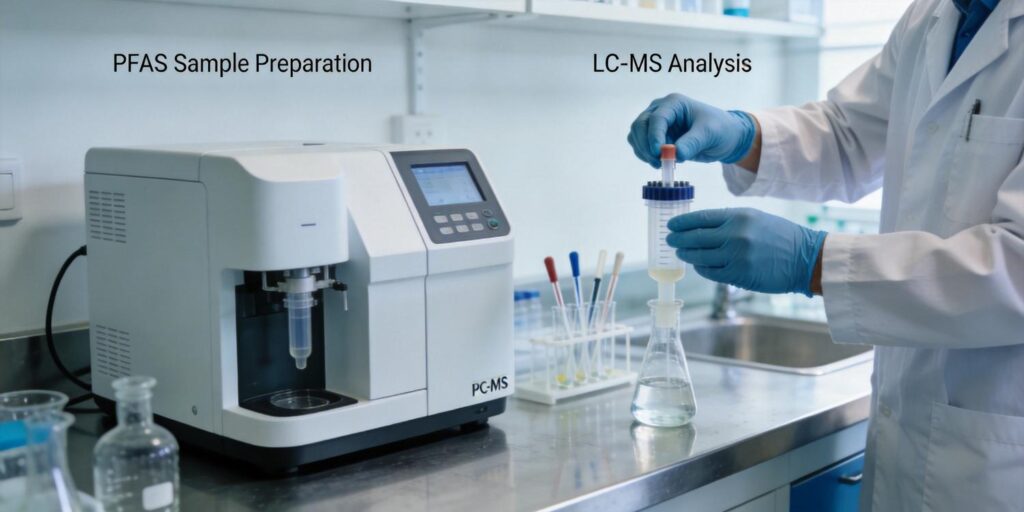
Following SPE cleanup and concentration, sediment extracts are typically analyzed by gas chromatography-mass spectrometry (GC-MS) for PAH and PCB determination. Optimal GC conditions include non-polar or low-polarity stationary phases (5% phenyl methylpolysiloxane) with temperature programming from 50-60°C to 300-320°C. Mass spectrometric detection in selected ion monitoring (SIM) mode provides the sensitivity and selectivity required for trace-level sediment analysis, with characteristic ions monitored for each target compound class.
Quality Control Measures
The GC-MS workflow incorporates multiple quality control elements, including internal standards (deuterated PAHs or PCBs), matrix-matched calibration standards, and procedural blanks. Retention time locking and ion ratio verification ensure proper compound identification, while continuing calibration verification samples monitor instrument performance throughout analytical sequences. The integration of SPE with GC-MS analysis represents a powerful combination for sediment contaminant analysis, as evidenced by numerous environmental monitoring studies.
Method Validation and Quality Assurance
Comprehensive Validation Parameters
Validation of SPE methods for sediment analysis must address multiple performance characteristics, including recovery efficiency, precision, method detection limits (MDLs), and matrix effects. Recovery studies typically employ fortified sediment samples or certified reference materials, with acceptable recovery ranges of 70-120% for most regulatory applications. Precision, expressed as relative standard deviation (RSD), should generally not exceed 15-20% for replicate analyses.
Addressing Matrix Effects
Sediment matrix effects represent a significant challenge in method validation, requiring careful evaluation through matrix-matched calibration and standard addition approaches. The presence of co-extracted compounds can influence both SPE efficiency and instrumental response, necessitating the use of isotope-labeled internal standards for accurate quantification. Method robustness should be evaluated across different sediment types (varying organic carbon content, particle size distribution) to ensure broad applicability.
Quality Assurance Protocols
Comprehensive quality assurance programs for sediment SPE analysis include laboratory control samples, duplicate analyses, and participation in proficiency testing programs. Documentation of all method parameters—including sorbent lot numbers, conditioning details, and elution conditions—ensures method traceability and reproducibility. Regular performance verification through analysis of certified reference materials maintains method validity over time and across different sediment matrices.
For laboratories seeking optimized SPE solutions for sediment analysis, Poseidon Scientific offers a comprehensive range of HLB SPE cartridges, MAX SPE cartridges, and MCX SPE cartridges suitable for various sediment contaminant classes. Our 96-well SPE plates provide high-throughput capabilities for large-scale sediment monitoring programs, while WAX and WCX SPE cartridges address specific analytical challenges in sediment contaminant analysis.