Why Caffeine in Wastewater Matters
Caffeine is one of the most widely consumed psychoactive substances globally, and its presence in wastewater serves as a reliable anthropogenic marker. Unlike many pharmaceuticals that undergo extensive metabolism, a significant fraction of ingested caffeine is excreted unchanged or as primary metabolites like paraxanthine. Monitoring these compounds in influent wastewater provides a non-invasive, real-time snapshot of community-level caffeine consumption and can indicate wastewater contamination from human sources. This approach is increasingly adopted in environmental epidemiology and water quality surveillance programs.
Target Analytes: Caffeine and Paraxanthine
The primary analytes for this method are caffeine (1,3,7-trimethylxanthine) and paraxanthine (1,7-dimethylxanthine), the major demethylated metabolite. Paraxanthine is particularly significant because it is not naturally produced by plants or microorganisms, making its detection a strong indicator of human excreted caffeine. Other minor metabolites such as theobromine and theophylline may also be monitored depending on research objectives. Accurate quantification of these compounds requires robust sample preparation to remove interfering matrix components common in wastewater.
Wastewater Sampling and Filtration
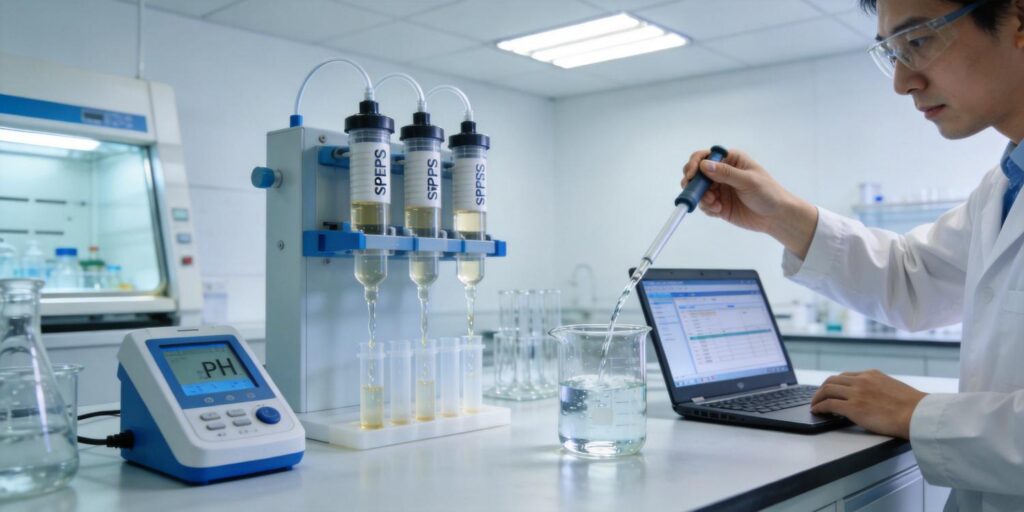
Representative sampling is critical. Typically, 24-hour composite samples are collected from wastewater treatment plant influents using flow-proportional autosamplers. Samples are transported on ice and processed within 24 hours. Filtration through 0.45-µm or 0.22-µm glass fiber filters removes suspended solids, microbial cells, and particulate organic matter that could clog the SPE cartridge or interfere with downstream analysis. The filtrate is then acidified to pH 2–3 using hydrochloric acid to stabilize the analytes and enhance retention on the HLB sorbent.
HLB SPE Cartridge Conditioning and Loading
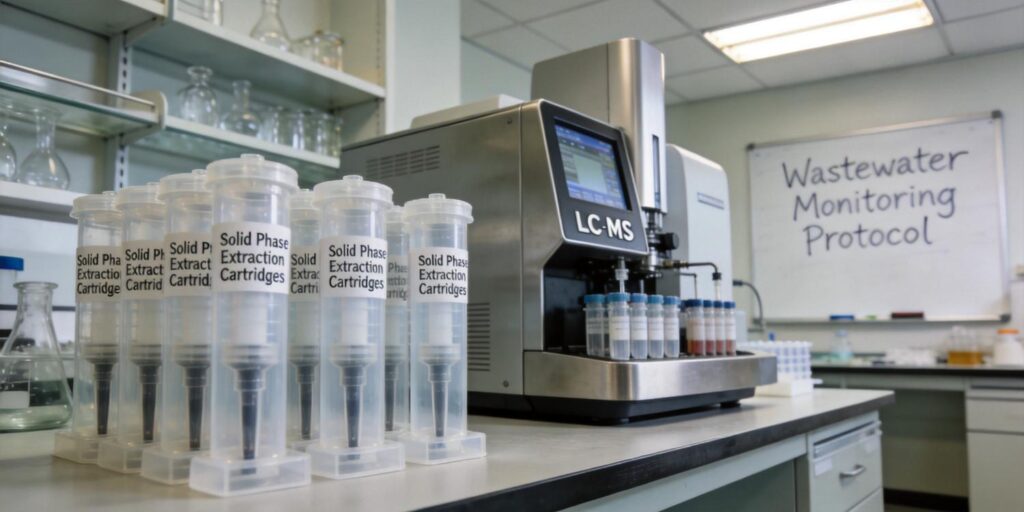
Poseidon HLB SPE cartridges (Hydrophilic-Lipophilic Balance) are ideal for this application due to their balanced retention of polar and non-polar compounds. The cartridge is first conditioned with 3 mL of methanol followed by 3 mL of deionized water to wet the sorbent bed. The acidified sample (typically 50–200 mL) is then passed through the cartridge at a flow rate of 1–2 mL/min using a vacuum manifold. HLB sorbent retains caffeine and paraxanthine via reversed-phase and weak cation-exchange mechanisms, while many polar interferences pass through.
Washing Steps to Remove Organic Matter
After sample loading, a washing step is essential to remove co-adsorbed organic matter such as humic acids, detergents, and other wastewater constituents. A typical wash uses 3 mL of 5% methanol in water (v/v) or 2 mL of 0.1 M acetic acid. This step preserves analyte integrity while flushing out weakly retained interferences. Care must be taken not to use too high an organic percentage, which could prematurely elute the analytes. The cartridge is then dried under vacuum for 5–10 minutes to remove residual water before elution.
Elution with Methanol
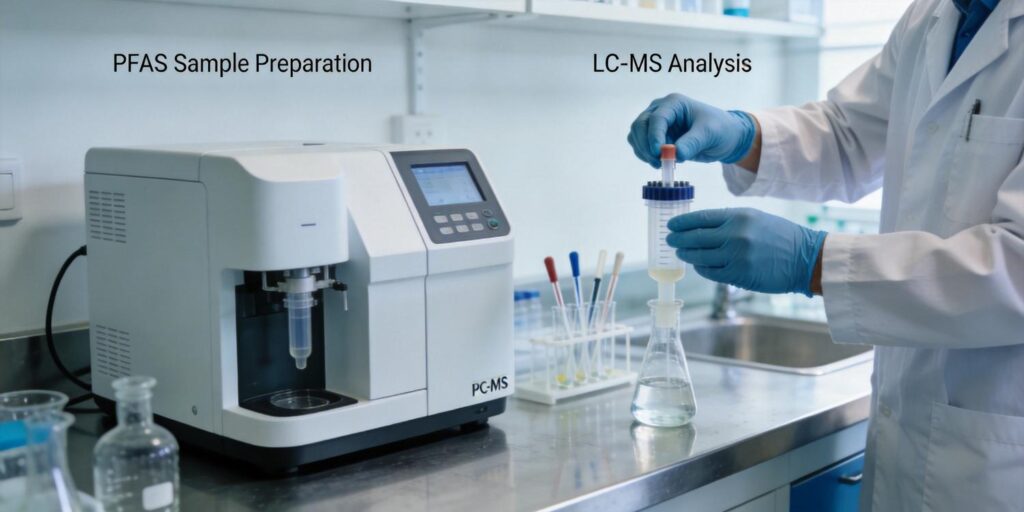
Analytes are eluted using 2 × 2 mL of pure methanol. Methanol efficiently disrupts the hydrophobic and polar interactions between the HLB sorbent and the analytes, providing high recovery. The eluate is collected in a glass tube and evaporated to dryness under a gentle nitrogen stream at 40°C. The residue is reconstituted in 200–500 µL of mobile phase (e.g., 90:10 water:methanol with 0.1% formic acid) and transferred to an autosampler vial for LC-MS/MS analysis.
LC-MS/MS Detection Workflow
Analysis is performed using liquid chromatography-tandem mass spectrometry (LC-MS/MS) in positive electrospray ionization mode. A reversed-phase C18 column (e.g., 2.1 × 100 mm, 1.7 µm) is commonly used with a gradient elution of water and methanol, both containing 0.1% formic acid. The mass spectrometer is operated in multiple reaction monitoring (MRM) mode. For caffeine, the precursor-to-product ion transitions are typically m/z 195.1 → 138.1 (quantifier) and 195.1 → 110.1 (qualifier). Paraxanthine is monitored at m/z 181.1 → 124.1 and 181.1 → 96.1. Quantification is based on isotope-dilution using deuterated internal standards (e.g., caffeine-13C3), which corrects for matrix effects and recovery losses.
Environmental Monitoring Interpretation
The measured concentrations of caffeine and paraxanthine in wastewater are used to back-calculate community consumption rates via wastewater-based epidemiology (WBE) models. These data can reveal spatial and temporal trends in caffeine use, identify illicit discharge events, and serve as a normalizing biomarker for other contaminants. For example, the paraxanthine-to-caffeine ratio can indicate recent consumption patterns. Regular monitoring with robust SPE methods like the HLB workflow ensures high-quality data for environmental scientists and policymakers.
For laboratories looking to adopt or optimize this method, Poseidon Scientific HLB SPE cartridges offer consistent lot-to-lot performance and high recoveries for trace organic contaminants in complex matrices. Visit our product pages for detailed specifications and ordering information.