Why SPE is Essential for Preservative Analysis in Fruit Jam
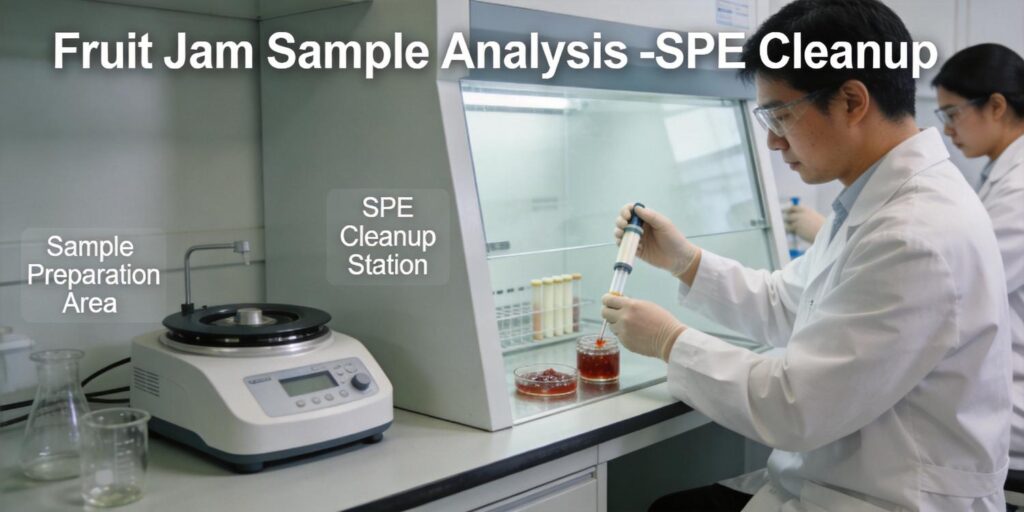
Preservatives such as benzoic acid, sorbic acid, and parabens are commonly added to fruit jams to extend shelf life and prevent microbial growth. However, the complex jam matrix—rich in sugars, pectins, natural pigments (e.g., anthocyanins), and fruit fibers—poses significant challenges for direct chromatographic analysis. Without proper cleanup, these co-extractives can cause column fouling, ion suppression in mass spectrometry, and inaccurate quantitation. Solid-phase extraction (SPE) offers a robust, reproducible cleanup strategy that isolates preservatives while removing sugars and pigments.
Common Preservatives in Jam Products
The most frequently used preservatives in fruit jams include benzoic acid (E210), sorbic acid (E200), and their sodium/potassium salts. Parabens such as methylparaben and propylparaben are also encountered in some formulations. These compounds are polar to moderately polar, making reversed-phase SPE an ideal choice for their isolation. Regulatory limits vary by region, typically ranging from 500 to 1000 mg/kg for sorbic and benzoic acids.
Matrix Complexity from Sugars and Fruit Pigments
Fruit jam typically contains 40–60% sugar (sucrose, glucose, fructose), along with pectin, organic acids, and pigments like anthocyanins (in berry jams) or carotenoids (in apricot jam). These matrix components can co-elute with preservatives, leading to poor peak shape, overlapping peaks, and baseline drift in HPLC-UV analysis. Sugars, in particular, are highly water-soluble and can interfere with the retention of target analytes on SPE sorbents if not properly removed.
Sample Dilution and Extraction Procedures
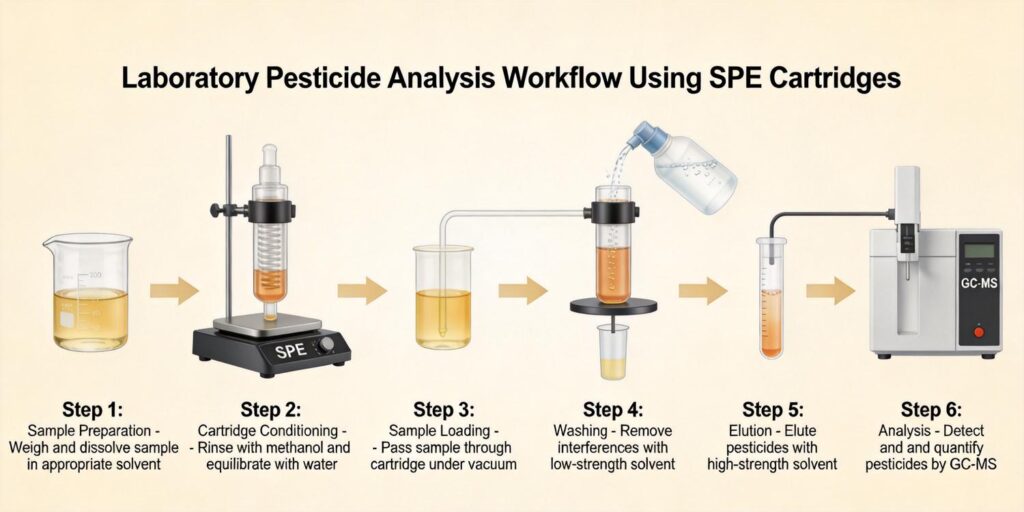
A typical workflow begins with homogenizing the jam sample. Weigh 2–5 g of jam into a centrifuge tube, add 10 mL of deionized water, vortex until fully dispersed, and adjust pH to ~4.5 using dilute phosphoric acid (to ensure preservatives remain in their unionized form). Centrifuge at 4000 rpm for 10 minutes and collect the supernatant. This aqueous extract is then diluted further with water or buffer to reduce viscosity and sugar concentration before SPE loading.
SPE Cartridge Conditioning and Loading
For reversed-phase SPE, HLB cartridges (hydrophilic-lipophilic balanced) are recommended due to their excellent retention of both polar and nonpolar preservatives. Condition the cartridge with 3 mL of methanol, followed by 3 mL of water. Load the diluted jam extract (typically 5–10 mL) at a flow rate of 1 mL/min. The sorbent retains preservatives via hydrophobic and hydrogen-bonding interactions, while sugars and most pigments pass through.
Washing Steps Removing Sugars
After loading, wash the cartridge with 5 mL of 5% methanol in water to elute residual sugars and highly polar co-extractives. For jam with high pectin content, a wash with 5 mL of 0.1 M phosphate buffer (pH 4.5) may further reduce matrix interference. Avoid using high organic content in the wash, as it could prematurely elute target analytes. The wash step is critical for achieving clean chromatograms.
Elution Optimization
Elute preservatives with 3 mL of methanol or acetonitrile (ACN). For improved recovery of sorbic acid, 0.1% formic acid in methanol can be used. Collect the eluate in a clean tube, evaporate under nitrogen at 40°C, and reconstitute in 1 mL of mobile phase (e.g., 20 mM ammonium acetate, pH 4.5). Recovery rates typically exceed 90% for benzoic and sorbic acids when optimized.
HPLC Detection Workflow
Analyze the reconstituted extract by HPLC-UV or HPLC-MS. A C18 column (150 × 4.6 mm, 5 µm) with a mobile phase of 20 mM ammonium acetate (pH 4.5) and methanol gradient (from 20% to 100% methanol in 15 min) provides good separation. UV detection at 230 nm (benzoic acid) and 254 nm (sorbic acid) yields LODs of ~1 mg/L. For parabens, 254 nm is also suitable. Ensure system suitability with calibration standards.
Food Safety Validation Requirements
According to regulatory guidelines (e.g., EU 2023/915, FDA 21 CFR 150), methods must be validated for linearity (R² > 0.999), precision (RSD < 10%), recovery (80–110%), and LOD/LOQ. Matrix-matched calibration is recommended to compensate for any residual matrix effects. Proficiency testing using certified reference materials ensures accuracy. For labs handling high sample volumes, 96-well SPE plates can increase throughput while maintaining reproducibility.
Implementing a robust SPE cleanup strategy not only meets regulatory demands but also protects analytical instrumentation and ensures reliable data for food safety decisions. For alternative sorbent choices, MAX (mixed-mode anion exchange) or MCX (mixed-mode cation exchange) cartridges can be employed depending on the preservative class and desired selectivity. Always verify sorbent performance with your specific jam matrix.