Matrix Complexity of Leafy Vegetables
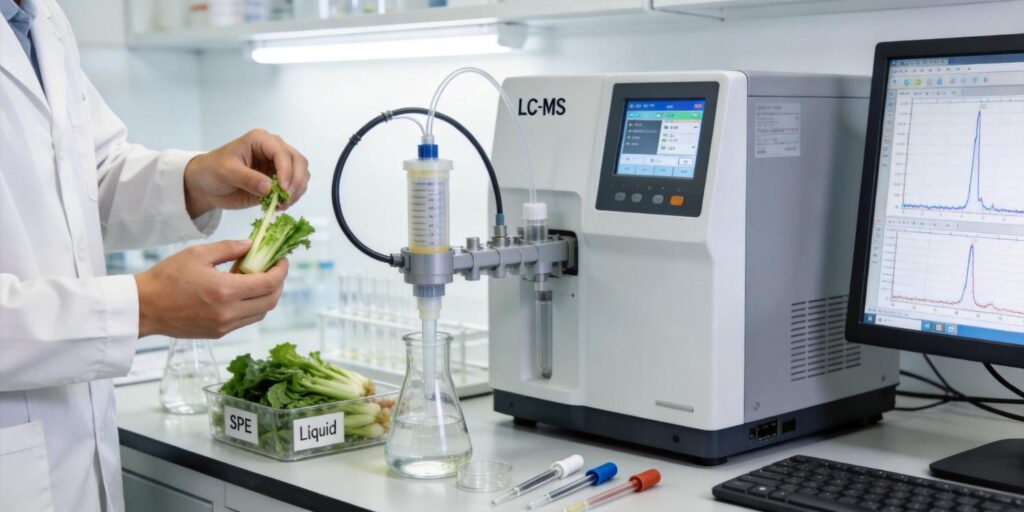
Leafy vegetables present one of the most challenging matrices for pesticide residue analysis due to their complex biochemical composition. These vegetables contain high concentrations of chlorophyll, carotenoids, flavonoids, and other pigments that can interfere with LC-MS detection. Additionally, they contain significant amounts of sugars (fructose, glucose, sucrose), organic acids (citric, malic, oxalic), and various plant secondary metabolites that can co-extract with target pesticides.
According to comprehensive studies on fruit and vegetable matrices, the high or variable water and fat contents of these samples can present capacity problems for SPE cartridges. The Luke method (1995) explores extraction of a large range of pesticides from these matrices, indicating considerable sample manipulation is required. The method originated as a liquid-liquid extraction to which other preparation steps and SPE extractions have been added as method goals became more stringent.
Extraction of Pesticides Using Acetonitrile
Acetonitrile has emerged as the solvent of choice for pesticide extraction from vegetable matrices due to its excellent extraction efficiency for a wide range of pesticide classes while minimizing co-extraction of lipids and pigments. The QuEChERS (Quick, Easy, Cheap, Effective, Rugged, and Safe) method has revolutionized pesticide residue analysis, with studies demonstrating analysis of 229 pesticides in lettuce and orange matrices with recoveries of 90-110% and RSDs < 5%.
Acetonitrile extraction typically involves homogenizing the vegetable sample with acetonitrile, followed by salting out with magnesium sulfate and sodium chloride. This process partitions water and water-soluble matrix components into the aqueous phase while pesticides remain in the acetonitrile layer. The resulting extract contains target analytes along with co-extracted matrix components that require further cleanup.
SPE Cartridge Selection for Cleanup
Selecting the appropriate SPE cartridge is critical for effective cleanup of vegetable extracts. For pesticide residue analysis, several sorbent types have proven effective:
Primary Sorbent Options
- PSA (Primary Secondary Amine): Excellent for removing sugars, organic acids, and fatty acids through anion exchange mechanisms
- C18: Effective for removing non-polar interferences like chlorophyll and carotenoids
- Florisil: Particularly useful for organochlorine pesticide cleanup, with certified Sep-Pak Florisil cartridges showing superior performance in removing interferences
- Graphitized Carbon Black: Effective for pigment removal
Many methods employ stacked cartridge systems, such as SAX/PSA combinations, where plant sugars and acids are retained on SAX and PSA sorbents while analytes pass through unretained. Note that chlorphenoxyacids must be methylated before passage through SAX/PSA combination cartridges or they will be retained.
Conditioning and Loading Protocols
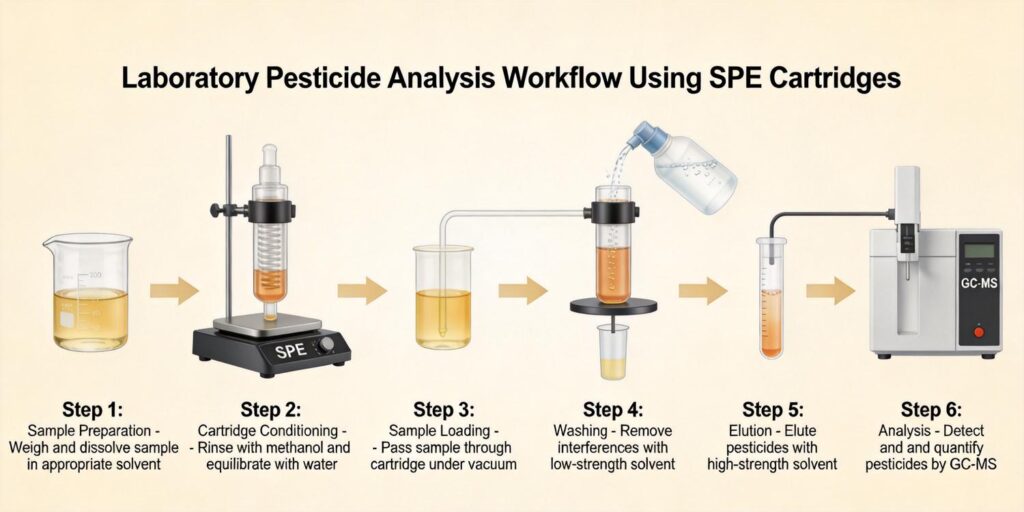
Proper conditioning of SPE cartridges is essential for reproducible results. The standard conditioning protocol involves:
- Solvent Activation: Typically 5-10 mL of methanol or acetonitrile to solvate the sorbent and remove any impurities
- Equilibration: 5-10 mL of water or buffer solution matching the sample matrix to prepare the sorbent for sample loading
- Sample Loading: The acetonitrile extract is diluted with water to reduce solvent strength (typically 1:1 or 1:2 dilution) and loaded at controlled flow rates (1-3 drops/second)
For C18 cartridges, typical conditioning involves 10 mL methanol followed by 6 mL deionized water. Sample loading should maintain the column wet throughout the process to prevent channeling and ensure consistent recovery.
Washing Steps Removing Pigments and Sugars
Effective washing protocols are crucial for removing matrix interferences while retaining target pesticides. Common washing strategies include:
For PSA Cartridges
- 5-10 mL of acetonitrile:toluene (3:1) to remove pigments
- 5 mL of acetonitrile to remove residual washing solvent
For C18 Cartridges
- 5-10 mL of water or 5% methanol in water to remove polar interferences
- 5 mL of hexane or hexane:dichloromethane mixtures for non-polar cleanup
The Luke procedure demonstrates that SPE steps contribute cleanup of matrix components while analytes pass through unretained. This approach allows for removal of plant sugars and acids that would otherwise interfere with LC-MS analysis.
Elution Solvents Compatible with LC-MS Analysis
Elution solvent selection must balance complete analyte recovery with compatibility with LC-MS systems. Common elution solvents include:
Preferred Elution Solvents
- Acetonitrile: Excellent LC-MS compatibility, low background, good elution strength for most pesticides
- Methanol: Strong elution power, compatible with LC-MS, but may extract more matrix components
- Acetone: Effective for pesticide elution but may require evaporation and reconstitution in LC-MS compatible solvent
- Mixtures: Acetonitrile:methanol (1:1) or acetonitrile:acetone mixtures for challenging analytes
For Florisil cartridges, elution with 5 mL of 90:10 hexane:acetone (v/v) has been demonstrated effective. The eluate is typically concentrated to near dryness under gentle nitrogen stream and reconstituted in initial mobile phase composition for LC-MS analysis.
Calibration and Recovery Studies
Method validation requires comprehensive calibration and recovery studies to ensure accuracy and precision. Key considerations include:
Calibration Strategy
- Matrix-matched calibration standards to account for matrix effects
- Internal standard addition for improved precision
- Calibration range covering expected residue levels (typically 0.01-1.0 mg/kg)
Recovery Assessment
- Fortification at multiple concentration levels (e.g., 0.01, 0.05, 0.1 mg/kg)
- Minimum of six replicates per fortification level
- Acceptance criteria: 70-120% recovery with RSD < 20%
Studies have shown that SPE methods can achieve recoveries exceeding 90% with RSDs < 5% for multi-residue pesticide analysis in vegetable matrices. The QuEChERS approach combined with SPE cleanup has demonstrated particularly impressive performance with recoveries of 90-110% for 229 pesticides.
Application in Food Safety Monitoring
SPE cleanup methods for pesticide residue analysis in vegetables play a critical role in food safety monitoring programs worldwide. Regulatory agencies including the FDA, EFSA, and Codex Alimentarius Commission rely on validated SPE-based methods for:
Regulatory Compliance
- Monitoring Maximum Residue Limits (MRLs)
- Import/export testing
- Organic certification verification
Risk Assessment
- Dietary exposure assessment
- Cumulative risk evaluation
- Monitoring pesticide degradation products
Quality Control
- Good Agricultural Practice (GAP) compliance
- Supply chain monitoring
- Consumer protection programs
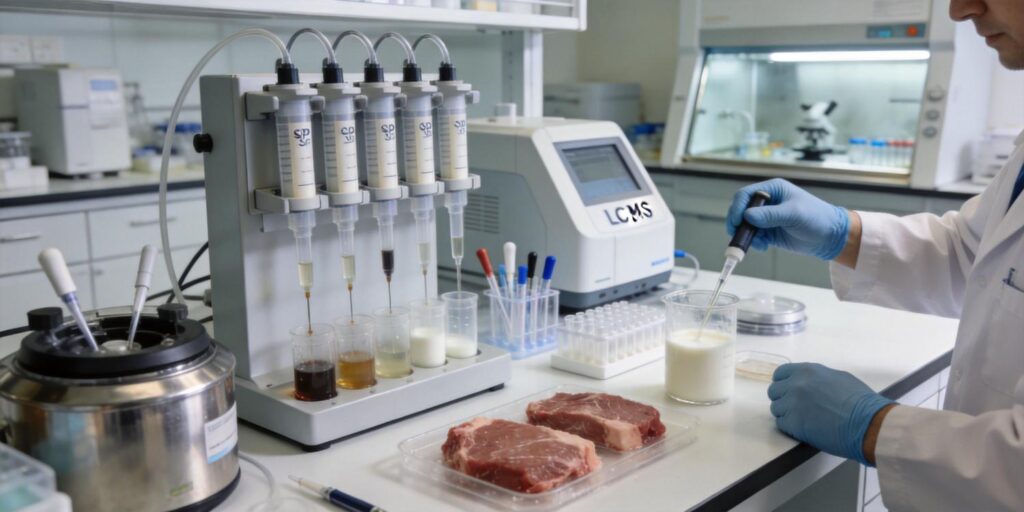
The integration of SPE with LC-MS/MS has enabled laboratories to achieve detection limits as low as 0.001 mg/kg, providing the sensitivity required for modern food safety standards. Automated SPE systems further enhance throughput and reproducibility, making large-scale monitoring programs feasible.
For laboratories seeking reliable SPE solutions for vegetable pesticide analysis, Poseidon Scientific’s HLB SPE cartridges offer excellent performance for a wide range of pesticide classes. Our MCX cartridges provide superior cleanup for basic pesticides, while WAX cartridges excel in acidic pesticide analysis. For high-throughput applications, our 96-well SPE plates enable automation and improved productivity.
Proper method development, considering the specific matrix characteristics and target analyte properties, remains essential for successful implementation of SPE cleanup in vegetable pesticide analysis. Consultation with experienced analytical chemists and reference to validated methods can significantly reduce development time and ensure regulatory compliance.