Chemical Properties of Basic Pharmaceuticals
Basic drug compounds represent a significant portion of pharmaceutical analytes, characterized by their nitrogen-containing functional groups that can accept protons under acidic conditions. These compounds typically contain amine groups (primary, secondary, tertiary, or quaternary) with pKa values ranging from 2 to 10 for weak bases, and above 10 for strong bases. The protonation state of these compounds is pH-dependent, which becomes the cornerstone of effective SPE method development.
According to research on pharmaceutical cream analysis, basic drugs like promethazine, chlorhexidine, and benzydamine demonstrate varying hydrophobic and hydrophilic properties that influence their retention behavior. For instance, promethazine exhibits hydrophobic characteristics that favor reversed-phase retention, while chlorhexidine and benzydamine are comparatively hydrophilic and respond better to ion-exchange mechanisms.
Selecting MCX Sorbents for Mixed-Mode Retention
Mixed-mode cation exchange (MCX) sorbents represent the optimal choice for basic drug extraction due to their dual retention mechanism. These sorbents combine reversed-phase hydrophobic interactions with strong cation exchange functionality, typically through sulfonic acid groups. This combination provides superior selectivity and cleaner extracts compared to single-mode sorbents.
The Waters Oasis MCX sorbent, for example, offers a tightly controlled ion-exchange capacity that ensures reproducible SPE protocols. Research indicates that mixed-mode sorbents are prevalent in drug extractions because they offer multiple binding mechanisms for improved sensitivity and excellent sample cleanup. When using mixed-mode extractions, the elution solvent must be able to reverse or disrupt all bonding mechanisms simultaneously, requiring careful consideration of pH, polarity, and solubility parameters.
Why MCX Outperforms Traditional C18
While traditional C18 sorbents can retain basic compounds through hydrophobic interactions, they often suffer from poor selectivity and matrix interference. MCX sorbents provide enhanced retention through ionic interactions when the analyte is protonated, allowing for stronger wash steps to remove neutral interferences without losing the target compounds. This is particularly valuable for pharmaceutical assays where matrix components like excipients, preservatives, and formulation additives can interfere with detection.
Optimization of Sample pH for Protonated Analytes
The cornerstone of successful basic drug extraction lies in pH optimization to ensure complete protonation of target analytes. The general rule dictates that sample pH should be at least 2 units below the pKa of the basic compound to ensure >99% protonation. For basic drugs with pKa values between 2-10, this typically means working in the pH range of 0-8.
Research demonstrates that for basic drugs like chlorhexidine, optimal retention occurs at pH 4.5 where the protonated drug is retained by cation exchange sorbents while uncharged excipients pass through. A systematic approach to pH optimization involves screening buffers with pH values of 2, 3, 4, 5, 6, 7, 8, and 9 to identify the optimal retention window. Common buffer systems include phosphoric acid (pH 2.1), sodium formate/triethylamine (pH 2.5-4), sodium acetate (pH 4.5-5.5), and phosphate buffers (pH 6-8).
pH Profiling Strategy
A practical pH profiling experiment involves mixing 1.5-2 mL of various buffer solutions with 0.5 mL of sample matrix before application to the cartridge. The results are conveniently evaluated by plotting recovery against pH for each sorbent tested, which immediately yields an impression of which pH value(s) will give optimal combinations of recovery and selectivity.
Conditioning and Loading Strategies
Proper conditioning of MCX sorbents is critical for reproducible results. The standard conditioning protocol involves:
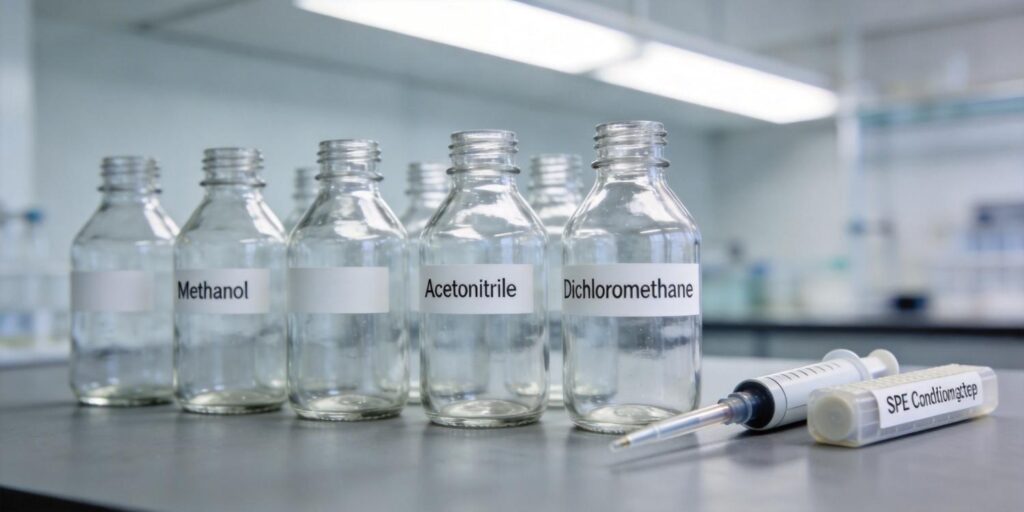
- 1.5 mL of methanol per 100 mg of sorbent to solvate the hydrophobic phase
- 1 mL of deionized water per 100 mg to remove excess organic solvent
- 1 mL of conditioning buffer to establish the optimal pH environment
Research emphasizes that columns with hydrophobic character need to be solvated to interact efficiently and reproducibly with aqueous matrices, as sample capacity is severely reduced on a dry column. For ion-exchange columns, applying buffer after flushing ensures that the sorbent pH is optimal for the desired sorbent-analyte interaction.
Sample Loading Considerations
During sample application, the analyte binds by displacing counter ions on the sorbent. The sample should be applied at a rate of approximately 1 mL/min, with careful attention to maintaining the optimal pH throughout the loading process. For viscous matrices like creams or plasma, dilution with water or buffer may be necessary to ensure proper flow characteristics and interaction efficiency.
Selective Washing to Remove Neutral Compounds
The washing step represents a critical opportunity to remove neutral interferences while retaining protonated basic compounds. For MCX sorbents, effective wash solvents typically contain 5-20% methanol in water, often acidified with 2% formic acid to maintain the protonated state of basic analytes.
Research on pharmaceutical cream analysis demonstrates that washing with appropriate solvent systems can effectively remove excipients and preservatives while retaining target drugs. For example, in the analysis of basic drugs from cream formulations, washing with buffer solutions at the same pH as the loading buffer effectively removes uncharged matrix components.
Wash Optimization Strategy
The ideal washing step removes as many interferences as possible while retaining the analyte(s). This requires identifying the strongest wash solvent that will not elute the analyte. Systematic testing of wash solvents with increasing organic content and varying pH can identify the optimal balance between cleanliness and recovery.
Elution Using Ammoniated Organic Solvents
Elution of basic compounds from MCX sorbents requires disruption of both hydrophobic and ionic interactions. The standard elution protocol involves:
- Initial elution with 100% methanol to disrupt hydrophobic interactions
- Secondary elution with 5% ammonium hydroxide in methanol to neutralize the ionic interactions
This two-step elution strategy ensures complete recovery of basic compounds. The ammoniated methanol (typically 2-5% concentrated ammonium hydroxide) raises the pH above the pKa of the basic compound, converting it to its neutral form and releasing it from the cation exchange sites.
Elution Volume Optimization
Research indicates that elution with two 1.5-mL portions of ammoniated methanol typically provides quantitative recovery. The exact volume should be optimized for each application, with the goal of eluting the analyte in the smallest possible volume to maximize concentration factor.
LC-MS Detection Optimization
Following SPE cleanup, LC-MS detection of basic pharmaceuticals requires careful optimization of chromatographic and mass spectrometric parameters. Basic compounds typically exhibit better retention and peak shape on stationary phases designed for basic analytes, such as those with embedded polar groups or charged surface hybrids.
Mobile Phase Considerations
For LC-MS analysis of basic drugs, mobile phases containing volatile buffers like ammonium formate or ammonium acetate are preferred. The pH should be optimized to ensure the compound is in a single ionic form throughout the chromatographic run, typically using formic acid or ammonium hydroxide for pH adjustment.
Mass Spectrometric Optimization
Basic compounds often ionize efficiently in positive electrospray ionization (ESI+) mode. Optimization of cone voltage and collision energy should focus on maximizing the response of precursor and product ions while minimizing in-source fragmentation.
Validation Metrics for Pharmaceutical Assays
Comprehensive validation of SPE methods for basic drug compounds should address several critical parameters:
Recovery and Precision
Method validation should demonstrate consistent recovery (typically >70% for SPE methods) with acceptable precision (RSD <15%). Recovery experiments should be conducted at multiple concentration levels across the expected analytical range.
Selectivity and Specificity
Selectivity should be demonstrated by analyzing blank matrices and matrices fortified with potentially interfering compounds. The method should show no significant interference at the retention time of the target analytes.
Linearity and Range
Linear calibration curves should be established across the expected concentration range, typically spanning 2-3 orders of magnitude for pharmaceutical applications.
Robustness
Robustness testing should evaluate the method’s sensitivity to variations in critical parameters such as sample pH, wash solvent composition, elution volume, and flow rates.
Stability
Analyte stability should be assessed in the loading solvent, during the extraction process, and in the final extract to ensure reliable quantification.
By systematically addressing each of these development areas, analytical scientists can establish robust, reproducible SPE methods for basic pharmaceutical compounds that meet the stringent requirements of modern pharmaceutical analysis while providing the sensitivity and selectivity needed for accurate quantification in complex matrices.