PFAS Contamination Sources in Drinking Water Systems
Per- and polyfluoroalkyl substances (PFAS) represent a significant challenge in drinking water safety due to their persistence and widespread contamination. These synthetic chemicals originate from multiple industrial and consumer sources, including firefighting foams used at military bases and airports, industrial manufacturing processes (particularly fluoropolymer production), and consumer products like non-stick cookware, stain-resistant fabrics, and food packaging materials. The environmental persistence of PFAS compounds, particularly perfluorooctanoic acid (PFOA) and perfluorooctanesulfonic acid (PFOS), means they can migrate through soil and groundwater systems, eventually reaching drinking water supplies. Municipal water treatment facilities often struggle to remove these compounds using conventional treatment methods, making source identification and specialized extraction techniques essential for accurate monitoring and regulatory compliance.
Sample Collection and Contamination Prevention Strategies
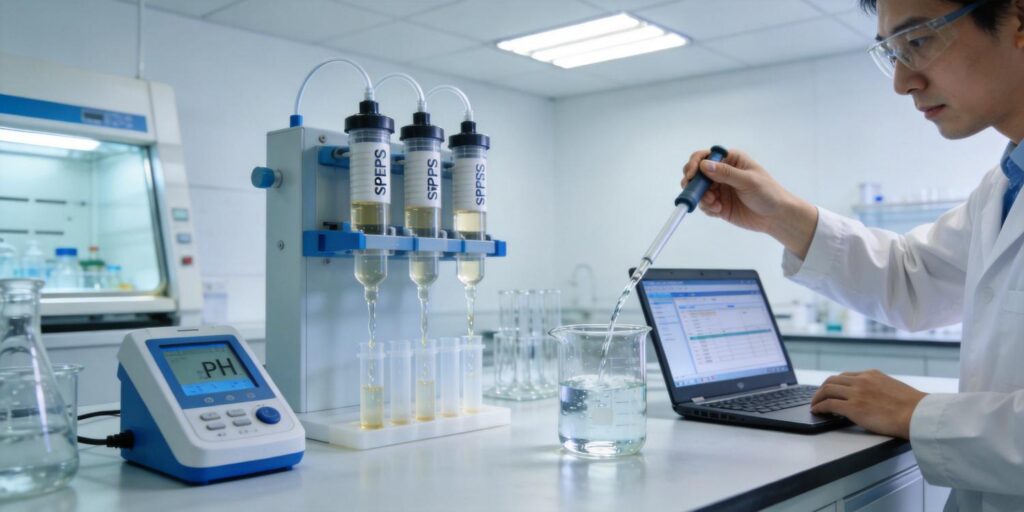
Proper sample collection is critical for accurate PFAS analysis in drinking water. Samples should be collected in pre-cleaned high-density polyethylene or polypropylene containers that have been tested for PFAS background contamination. Glass containers should generally be avoided due to potential PFAS adsorption issues. Field blanks and trip blanks must accompany all sampling events to monitor for potential contamination during collection, transport, and storage. According to established protocols, samples should be collected without headspace and preserved with hydrochloric acid to pH <2 if not analyzed immediately. All sampling equipment, including tubing and pumps, must be PFAS-free, and personnel should avoid using waterproof clothing or products containing PFAS during sampling activities. The importance of contamination control cannot be overstated, as PFAS are ubiquitous in laboratory environments and can easily contaminate samples at trace levels.
SPE Sorbent Chemistry for PFAS Retention
Solid-phase extraction (SPE) for PFAS analysis requires specialized sorbent chemistries that can effectively retain both anionic and neutral PFAS compounds while minimizing matrix interferences. Polymeric sorbents, particularly hydrophilic-lipophilic balanced (HLB) phases, have demonstrated superior performance for PFAS extraction compared to traditional C18 silica-based materials. The HLB chemistry combines hydrophilic N-vinylpyrrolidone and lipophilic divinylbenzene monomers, creating a balanced retention mechanism that effectively captures PFAS compounds across a wide polarity range. For enhanced selectivity, weak anion exchange (WAX) and mixed-mode anion exchange (MAX) sorbents are particularly effective for retaining anionic PFAS through both hydrophobic interactions and anion exchange mechanisms. These sorbents provide strong retention of sulfonated and carboxylated PFAS while allowing effective removal of neutral interferences during washing steps.
Conditioning Protocols for Polymeric Cartridges
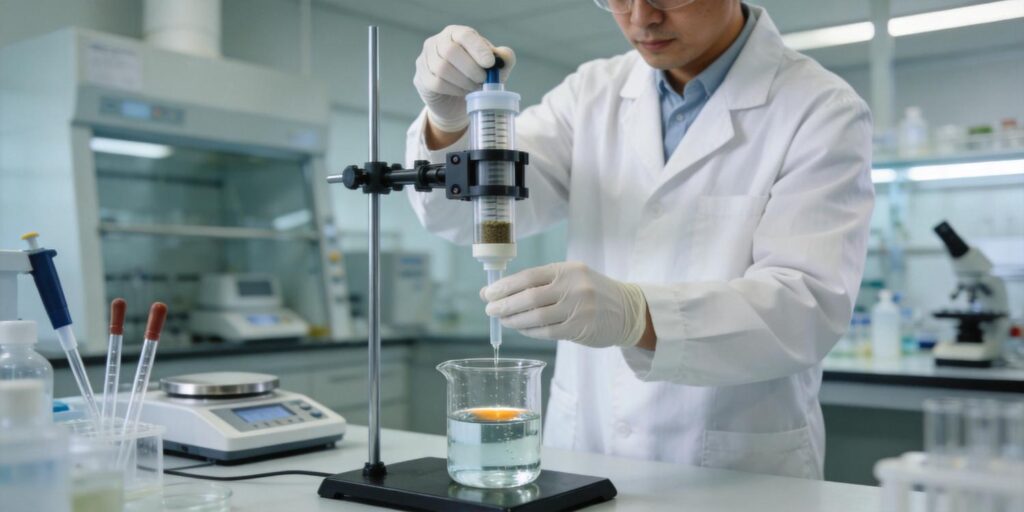
Proper conditioning of SPE cartridges is essential for achieving optimal PFAS recovery and reproducibility. For polymeric HLB cartridges, the conditioning sequence typically begins with 5-10 mL of methanol to wet the hydrophobic surface and penetrate the bonded phase, followed by 5-10 mL of reagent water or buffer to remove excess organic solvent and prepare the sorbent for aqueous sample loading. The conditioning step ensures that the sorbent surface is properly activated and that water molecules can efficiently diffuse into the bonded phase, facilitating analyte retention. It’s crucial to maintain a consistent flow rate during conditioning (typically 1-5 mL/min) and to avoid allowing the sorbent bed to dry between conditioning and sample loading steps. For WAX and MAX cartridges, additional conditioning with pH-adjusted buffers may be necessary to ensure proper ionization of the anion exchange sites.
Loading Large-Volume Water Samples
PFAS analysis often requires processing large sample volumes (typically 250-1000 mL) to achieve the necessary sensitivity for regulatory compliance monitoring. When loading large volumes, several critical factors must be considered: cartridge capacity, flow rate control, and breakthrough prevention. Research indicates that a ratio of approximately 1 g of sorbent per liter of water provides adequate capacity for most PFAS compounds at typical environmental concentrations. Flow rates should be maintained below 10 mL/min to ensure sufficient contact time between analytes and sorbent, with slower flow rates generally yielding better recovery for more hydrophilic PFAS compounds. The use of sample reservoirs attached to SPE cartridges facilitates handling of large volumes, and maintaining approximately 1/4 to 1/2 of the reservoir volume above the sorbent bed during loading helps ensure consistent flow and complete sample processing.
Washing Steps to Remove Salts and Organic Matter
Effective washing protocols are essential for removing matrix interferences while retaining target PFAS compounds. For HLB cartridges, a typical washing sequence includes 5-10 mL of reagent water containing 5-25% methanol to remove salts and polar organic compounds without eluting PFAS analytes. For WAX and MAX cartridges, additional washing with pH-adjusted buffers or dilute acid solutions may be employed to remove weakly retained anions and organic acids. The washing step should be optimized to maximize removal of matrix interferences while minimizing PFAS loss. After washing, a drying step (typically 5-30 minutes under vacuum or centrifugation) is often necessary to remove residual water, particularly when using organic elution solvents that are immiscible with water. Proper drying improves elution efficiency and reduces final extract volume requirements.
Elution Solvents Optimized for PFAS Recovery
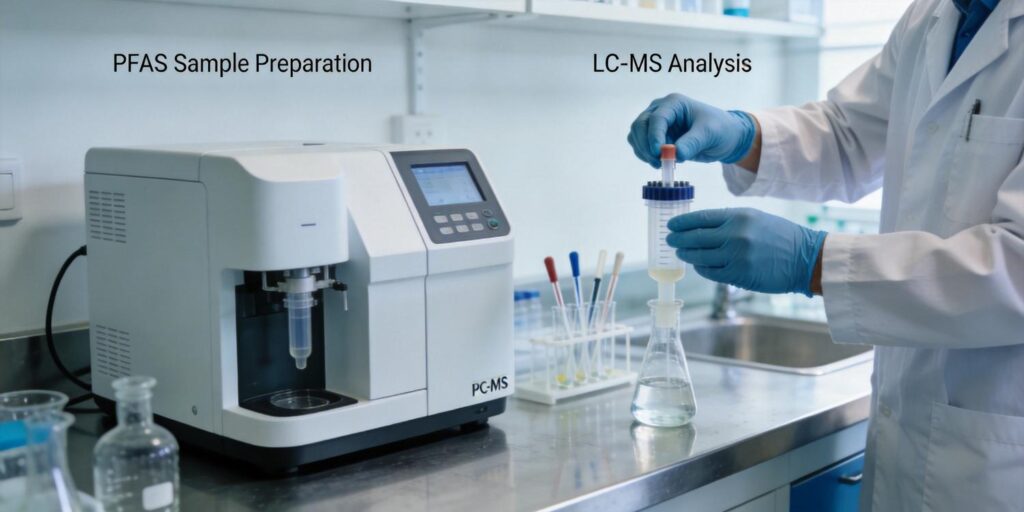
Elution solvent selection significantly impacts PFAS recovery and method sensitivity. For HLB cartridges, methanol and acetonitrile, often with added ammonium hydroxide or formic acid, provide effective elution for most PFAS compounds. Typical protocols use 5-10 mL of elution solvent, with multiple aliquots sometimes employed to improve recovery. For WAX and MAX cartridges, elution typically requires stronger solvents containing 2-5% ammonium hydroxide in methanol or acetonitrile to disrupt the anion exchange interactions. Allowing the cartridge to soak with elution solvent for 0.5-1 minute before applying vacuum or pressure can significantly improve recovery by ensuring adequate contact time. The collected eluate is often concentrated under gentle nitrogen evaporation to achieve the necessary sensitivity for LC-MS/MS analysis, though care must be taken to avoid complete dryness, which can lead to PFAS adsorption to container walls.
LC-MS/MS Quantification and Regulatory Guidelines
Liquid chromatography coupled with tandem mass spectrometry (LC-MS/MS) represents the gold standard for PFAS quantification in drinking water extracts. The method typically employs reversed-phase chromatography with C18 or similar columns, using methanol/water or acetonitrile/water gradients with ammonium acetate or formate buffers to enhance ionization. Multiple reaction monitoring (MRM) transitions provide the necessary selectivity and sensitivity for trace-level detection, with typical method detection limits in the low ng/L (ppt) range. Regulatory frameworks, including the US EPA’s Health Advisory Levels (currently 70 ppt for PFOA and PFOS combined) and various state-specific regulations, drive the need for robust, sensitive analytical methods. Quality control measures, including matrix spikes, laboratory control samples, and continuing calibration verification, are essential for demonstrating method performance and ensuring data quality for regulatory compliance purposes.
The integration of optimized SPE extraction with sensitive LC-MS/MS detection provides laboratories with a powerful tool for monitoring PFAS in drinking water. As regulatory scrutiny intensifies and additional PFAS compounds come under evaluation, continued method refinement and validation will remain critical for protecting public health and ensuring drinking water safety.