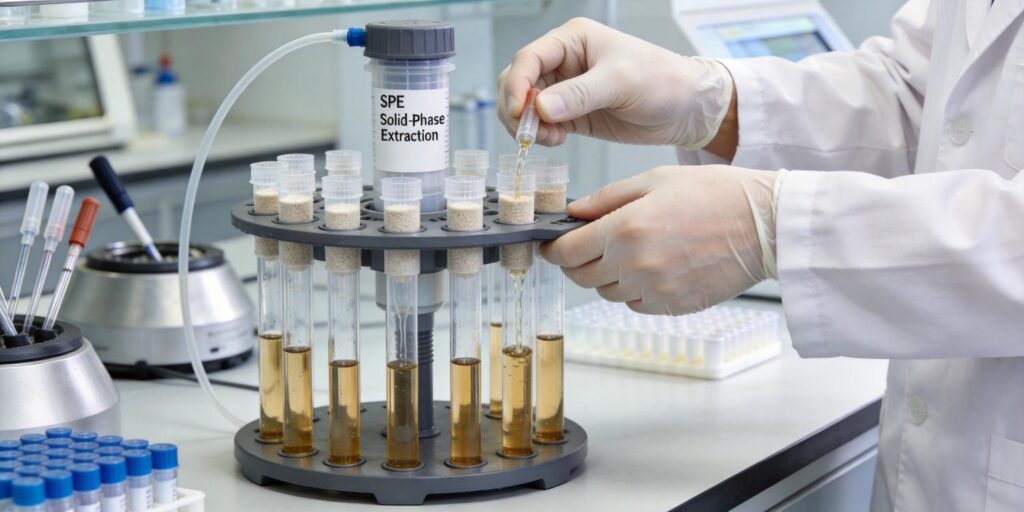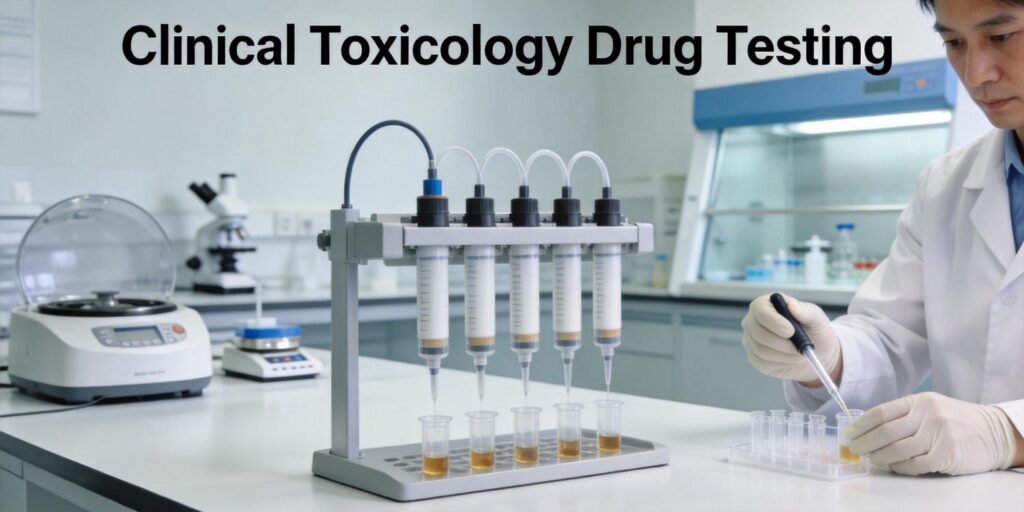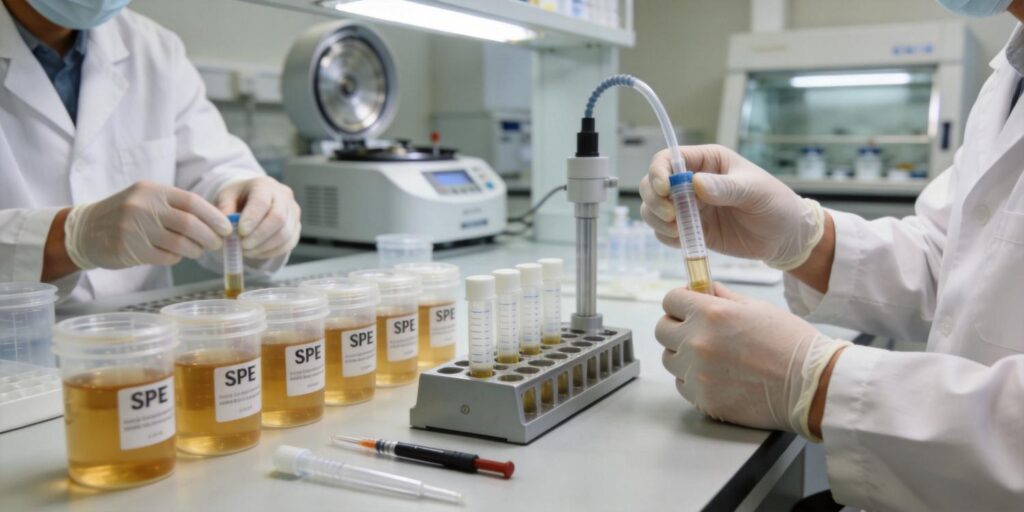
Urine Matrix Challenges in Drug Testing
Urine presents one of the most complex biological matrices for trace drug detection, characterized by high variability in composition and significant interference potential. According to forensic literature, human urine is approximately 95% water, with the remaining 5% comprising sugars, amino acids, creatinine, urea, and other metabolic products. The composition varies considerably with diet, hydration status, metabolic rate, and clinical abnormalities, creating analytical challenges for trace-level drug detection.
The primary urine matrix challenges include:
- High and Variable Salt Content: Urine contains significant levels of inorganic electrolytes including chloride, phosphate, bicarbonate, sulfate, sodium, potassium, calcium, and magnesium. These salts can interfere with both SPE retention mechanisms and subsequent LC-MS/MS analysis.
- Endogenous Organic Compounds: Creatinine, urea, uric acid, hippuric acid, and various pigments create substantial background interference that must be removed during sample preparation.
- Drug Conjugates: Many drugs undergo hepatic metabolism and are excreted as glucuronide or sulfate conjugates, requiring hydrolysis steps before extraction.
- Variable pH: Normal urine pH ranges from 4.5 to 8.0, significantly affecting drug ionization states and SPE retention characteristics.
- Protein and Particulate Matter: While urine has lower protein content than plasma, it can contain mucus, lipids, and cellular debris that may clog SPE cartridges.
Sample Dilution and pH Adjustment
Proper sample pretreatment is critical for successful SPE extraction from urine. Most protocols begin with dilution using appropriate buffers to reduce matrix effects and ensure consistent pH conditions. A typical approach involves diluting 5 mL of urine with 2 mL of 0.1 M phosphate buffer (pH 6.0), which serves multiple purposes:
- Reduces Matrix Effects: Dilution decreases the concentration of interfering salts and endogenous compounds
- Controls pH: Buffering ensures consistent ionization states for target drugs
- Prevents Sorbent Drying: Maintains proper hydration of SPE sorbent during loading
- Facilitates Hydrolysis: For conjugated drugs, enzymatic or acid hydrolysis may be required before SPE
For basic drugs, pH adjustment to 6.0 ± 0.5 is commonly recommended, as this pH range ensures protonation of basic functional groups while maintaining neutral or acidic compounds in their non-ionized forms. The choice between phosphate and acetate buffers depends on the target analytes and their pKa values.
SPE Sorbent Selection Based on Drug Properties
Selecting the appropriate SPE sorbent is the most critical decision in method development for urine drug testing. The choice depends on the chemical properties of target drugs, particularly their pKa values and functional groups.
Mixed-Mode Sorbents for Enhanced Selectivity
Mixed-mode sorbents, which combine reversed-phase and ion-exchange mechanisms, have become the gold standard for urine drug extraction. These materials offer superior selectivity and cleaner extracts compared to traditional single-mode sorbents.
Poseidon Scientific SPE Sorbent Selection Guide:
| Drug Class | pKa Range | Recommended Sorbent | Primary Mechanism |
|---|---|---|---|
| Basic Drugs (amphetamines, opioids, cocaine) | pKa 2-10 | MCX (Mixed-mode Cation Exchange) | Cation exchange + reversed-phase |
| Acidic Drugs (NSAIDs, barbiturates) | pKa 2-8 | MAX (Mixed-mode Anion Exchange) | Anion exchange + reversed-phase |
| Strong Bases (quaternary amines) | pKa >10 | WCX (Weak Cation Exchange) | Weak cation exchange + reversed-phase |
| Strong Acids | pKa <1 | WAX (Weak Anion Exchange) | Weak anion exchange + reversed-phase |
| Broad Spectrum Screening | All classes | HLB (Hydrophilic-Lipophilic Balance) | Reversed-phase with polar retention |
For forensic applications requiring simultaneous extraction of multiple drug classes, mixed-mode sorbents like MCX and MAX provide the cleanest extracts by allowing stringent wash steps that remove interfering compounds while retaining target analytes through dual retention mechanisms.
Conditioning and Loading Urine Samples
Proper SPE cartridge conditioning is essential for reproducible extraction efficiency. The standard conditioning protocol for mixed-mode sorbents involves:
- Methanol Activation: 3 mL methanol to solvate the sorbent and remove any residual contaminants
- Water Rinse: 3 mL deionized water to remove methanol and prepare the sorbent for aqueous sample loading
- Buffer Equilibration: 1 mL of appropriate buffer (typically pH 6.0 phosphate buffer) to establish the correct ionic environment
Critical considerations during conditioning include:
- Flow Rate Control: Maintain flow rates of 1-2 mL/min to ensure proper sorbent activation
- Avoid Sorbent Drying: Never allow the sorbent bed to dry completely between conditioning and sample loading
- Vacuum Pressure: Use moderate vacuum (3-5 in. Hg) to prevent sorbent channeling
Sample loading should be performed at controlled flow rates (1-2 mL/min) to ensure optimal analyte retention. For automated systems, 96-well SPE plates offer significant throughput advantages while maintaining extraction consistency.
Washing Strategies to Remove Salts and Interferences
Effective wash steps are crucial for removing urine matrix components while retaining target drugs. The wash strategy depends on the sorbent type and drug properties:
For Mixed-Mode Cation Exchange (MCX) Sorbents:
- Water Wash: 2-3 mL deionized water to remove unretained salts and polar compounds
- Acidic Wash: 1-2 mL of 0.1 M acetic acid or formic acid to remove weakly retained acidic and neutral compounds
- Organic Wash: 2-3 mL methanol or acetonitrile to remove hydrophobic interferences
- Drying Step: 5 minutes under vacuum to remove residual water before elution
For Mixed-Mode Anion Exchange (MAX) Sorbents:
- Water Wash: 2-3 mL deionized water
- Basic Wash: 1-2 mL of 5% ammonium hydroxide to remove basic interferences
- Organic Wash: 2-3 mL methanol
The wash solvent strength should be optimized to maximize interference removal without eluting target analytes. For complex urine matrices, additional wash steps with 20% acetonitrile in buffer or hexane may be necessary to remove specific interferences.
Elution Solvent Optimization
Elution solvent selection must disrupt all retention mechanisms simultaneously while maintaining analyte stability. For mixed-mode sorbents, this typically requires solvents with appropriate pH, ionic strength, and organic composition.
Recommended Elution Solvents:
| Sorbent Type | Primary Elution Solvent | Alternative Options | Volume |
|---|---|---|---|
| MCX | 5% NH₄OH in methanol | 2% formic acid in methanol Methylene chloride:isopropanol:NH₄OH (78:20:2) | 3 mL |
| MAX | 2% formic acid in methanol | Acetic acid in methanol Acetonitrile with acid modifier | 3 mL |
| HLB | Methanol or acetonitrile | Methanol:water mixtures Acetonitrile with acid/base | 2-3 mL |
Elution should be performed at controlled flow rates (1-2 mL/min) to ensure complete analyte recovery. For trace-level detection, elution in the smallest possible volume (typically 1-3 mL) maximizes concentration factors. Post-elution, samples are typically evaporated to dryness and reconstituted in mobile phase-compatible solvents for LC-MS/MS analysis.
LC-MS/MS Detection of Trace Drugs
Following SPE cleanup, urine extracts are analyzed by LC-MS/MS for sensitive and specific drug detection. The combination of selective SPE and MS/MS detection provides the necessary sensitivity for trace-level quantification.
LC Conditions for Urine Drug Analysis:
- Column: C8 or C18 columns (15 cm × 4.6 mm) are commonly used
- Mobile Phase: Typically 0.25 M potassium phosphate (pH 2.7) with 30% acetonitrile, or gradient systems with methanol/water containing ammonium formate
- Flow Rate: 2 mL/min for conventional columns, lower for UPLC systems
- Detection: Multiple reaction monitoring (MRM) for maximum specificity
MS/MS Parameters for Common Drugs:
| Drug | Primary Ion (m/z) | Secondary Ion | Tertiary Ion |
|---|---|---|---|
| Cocaine | 182* | 303 | 198 |
| Benzoylecgonine | 240* | 361 | 256 |
| Morphine | 429* | 324 | 430 |
| Codeine | 371* | 234 | 343 |
| Amphetamine | 136* | 91 | 119 |
*Quantitation ion
LC-MS/MS provides detection limits in the low ng/mL range, essential for compliance with cutoff concentrations established by regulatory agencies.
Quality Control and Reproducibility
Ensuring method reliability requires comprehensive quality control measures throughout the SPE and analysis process.
Critical QC Parameters:
- Process Controls: Include negative urine blanks, positive controls at cutoff concentrations, and calibration standards covering the analytical range
- Internal Standards: Use stable isotope-labeled analogs of target drugs to correct for extraction variability and matrix effects
- Recovery Assessment: Calculate absolute recovery using Equation: % Recovery = (ratio of extracted sample / ratio of unextracted calibrator) × 100
- Precision: Determine within-run and between-run precision with relative standard deviations typically <10%
- Carryover Evaluation: Analyze blank samples after high-concentration standards to assess carryover
Automation for Enhanced Reproducibility:
Automated SPE systems using 96-well plates significantly improve reproducibility by standardizing:
- Solvent delivery volumes and flow rates
- Incubation and drying times
- Elution collection consistency
- Reduced manual handling errors
Lot-to-Lot Consistency:
For reliable long-term performance, SPE sorbents must demonstrate consistent:
- Ion-exchange capacity (meq/g)
- Carbon loading percentage
- Particle size distribution
- Extractable levels
Poseidon Scientific SPE products undergo rigorous quality testing to ensure batch-to-batch consistency, with performance certificates included in each package.
Conclusion
Successful trace drug detection in urine requires a systematic approach to SPE sample preparation, addressing the unique challenges of the urine matrix. By implementing proper dilution and pH adjustment, selecting appropriate mixed-mode sorbents based on drug properties, optimizing wash and elution conditions, and maintaining rigorous quality control, laboratories can achieve sensitive, specific, and reproducible results. The combination of selective SPE cleanup with sensitive LC-MS/MS detection provides the gold standard for urine drug testing in forensic, clinical, and workplace settings.
For laboratories seeking to optimize their urine drug testing methods, Poseidon Scientific offers a comprehensive range of SPE products specifically designed for challenging biological matrices, supported by technical expertise in method development and validation.