Types of Marine Biotoxins Affecting Seafood Safety
Marine biotoxins represent a significant threat to seafood safety worldwide, with several major classes requiring specialized analytical approaches. These toxins accumulate in filter-feeding shellfish such as mussels, clams, oysters, and scallops, posing serious health risks to consumers. The primary toxin groups include:
Paralytic Shellfish Poisoning (PSP) Toxins
This group comprises saxitoxin and its derivatives, which block voltage-gated sodium channels in nerve cells. PSP toxins are heat-stable and water-soluble, making them particularly challenging to remove through conventional cooking methods.
Diarrhetic Shellfish Poisoning (DSP) Toxins
Okadaic acid and its derivatives dominate this category, causing gastrointestinal distress through inhibition of protein phosphatases. These lipophilic compounds accumulate in fatty tissues and require specific extraction protocols.
Amnesic Shellfish Poisoning (ASP) Toxins
Domoic acid and its isomers represent this neurotoxic group, targeting glutamate receptors in the brain. Their polar nature necessitates different SPE strategies compared to lipophilic toxins.
Neurotoxic Shellfish Poisoning (NSP) Toxins
Brevetoxins and their metabolites comprise this category, causing neurological symptoms through sodium channel activation. These compounds present intermediate polarity characteristics.
Azaspiracid Shellfish Poisoning (AZP) Toxins
Azaspiracids represent a relatively newer class of lipophilic toxins with complex polyether structures requiring sophisticated analytical approaches.
Extraction of Toxins from Shellfish Tissues
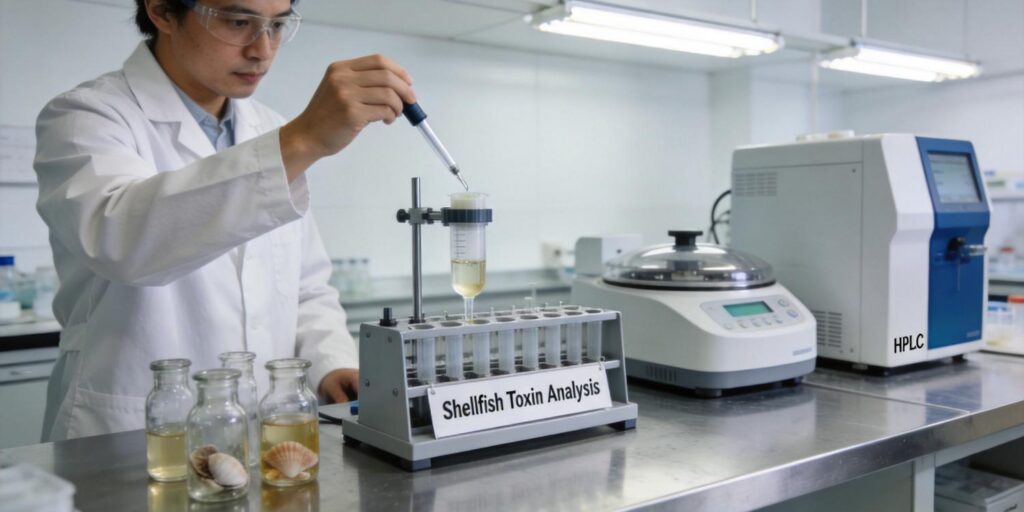
Effective toxin extraction forms the foundation of reliable marine biotoxin analysis. Shellfish tissues present complex matrices containing proteins, lipids, carbohydrates, and pigments that can interfere with subsequent analysis. The extraction process typically involves:
Homogenization and Tissue Disruption
Fresh or frozen shellfish tissues require thorough homogenization to ensure complete toxin release. Mechanical disruption using blenders or homogenizers in appropriate solvents (typically aqueous methanol or acetonitrile) facilitates toxin extraction while minimizing degradation.
Solvent Selection Considerations
The choice of extraction solvent depends on toxin polarity:
- Polar toxins (PSP, ASP): Aqueous solvents (water, acidified water, or aqueous methanol)
- Lipophilic toxins (DSP, NSP, AZP): Organic-rich solvents (methanol, acetonitrile, or acetone)
- Mixed toxin analysis: Compromise solvents like aqueous methanol or acetonitrile
Matrix Solid-Phase Dispersion (MSPD) Approaches
For particularly challenging matrices, MSPD techniques offer advantages by combining sample disruption and cleanup in a single step. As noted in extraction literature, “MSPD allows extraction under mild conditions of pH, thereby limiting the incidence of decomposition or rearrangement of labile compounds.” This approach proves valuable for lipophilic toxins in fatty tissues.
SPE Sorbent Selection for Toxin Classes
Proper sorbent selection represents the most critical decision in SPE method development for marine biotoxins. The diverse chemical properties of different toxin classes necessitate tailored approaches:
Reversed-Phase Sorbents for Lipophilic Toxins
C18 and C8 phases effectively retain lipophilic toxins like okadaic acid, dinophysistoxins, and azaspiracids. These sorbents exploit hydrophobic interactions, with C18 providing stronger retention for highly lipophilic compounds. As demonstrated in forensic applications, “An extraction of opiates from urine using C18 SPE column” shows cleaner extracts compared to liquid-liquid extraction.
Mixed-Mode Sorbents for Comprehensive Cleanup
HLB (Hydrophilic-Lipophilic Balance) polymers offer unique advantages for marine biotoxin analysis. Their balanced retention characteristics allow effective capture of both polar and moderately lipophilic toxins, making them particularly suitable for multi-toxin screening approaches.
Ion-Exchange Sorbents for Polar Toxins
Strong cation exchange (SCX) and weak cation exchange (WCX) sorbents prove valuable for PSP toxins, which exist as cations at physiological pH. Similarly, strong anion exchange (SAX) and weak anion exchange (WAX) sorbents effectively retain anionic toxins like domoic acid.
Specialized Sorbents for Specific Applications
MAX (Mixed-mode Anion Exchange) and MCX (Mixed-mode Cation Exchange) sorbents combine reversed-phase and ion-exchange mechanisms, offering enhanced selectivity for challenging toxin mixtures. These prove particularly valuable when analyzing complex shellfish extracts containing multiple toxin classes.
Conditioning and Loading Procedures
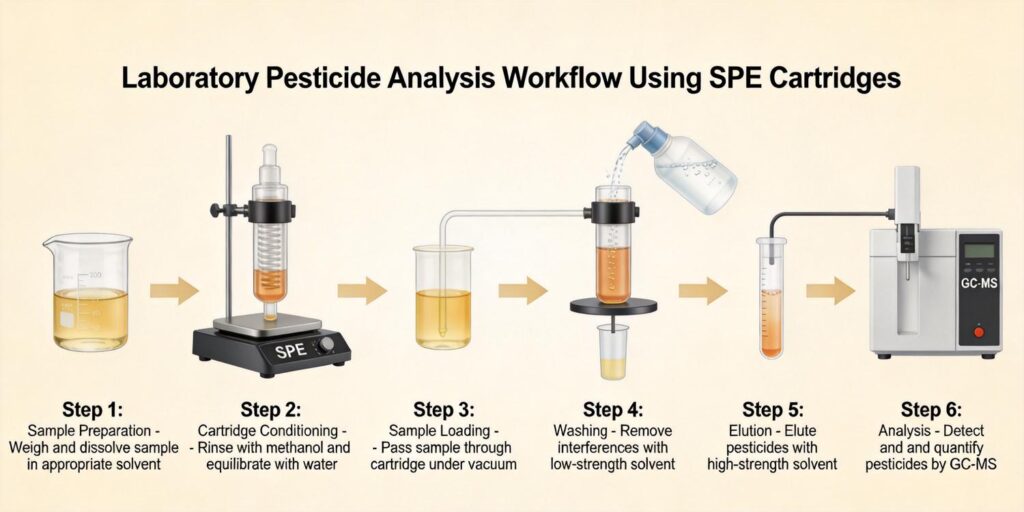
Proper SPE cartridge preparation ensures optimal performance and reproducible recoveries. The conditioning process activates the sorbent surface and creates an environment conducive to analyte retention.
Conditioning Solvent Selection
Conditioning typically involves sequential solvent washes:
- Organic solvent (methanol or acetonitrile): Activates the sorbent surface and removes any residual contaminants
- Water or aqueous buffer: Creates a compatible environment for sample loading without premature elution
Sample Loading Considerations
Several factors influence loading efficiency:
- pH adjustment: Critical for ionizable toxins to ensure proper charge state for retention
- Flow rate control: Typically 1-3 mL/min to maximize interaction time while maintaining throughput
- Sample volume: Must not exceed cartridge capacity while ensuring sufficient analyte mass for detection
Matrix Effects Management
Shellfish extracts contain numerous interfering compounds that can affect SPE performance. As noted in analytical literature, “The goal is to ensure the safety of the consumer” through effective matrix removal. Proper conditioning and loading protocols minimize these interferences while maintaining toxin recoveries.
Washing Steps Removing Proteins and Lipids
Effective washing represents the key to obtaining clean extracts suitable for sensitive detection methods like LC-MS/MS. The washing strategy must remove interfering compounds while retaining target toxins.
Aqueous Washes for Polar Interferences
Water or dilute aqueous buffers (typically 5-10% methanol in water) effectively remove salts, sugars, and highly polar matrix components without eluting retained toxins. For lipophilic toxin analysis, these washes prove particularly important for removing water-soluble interferences.
Organic Washes for Lipid Removal
Moderately polar organic solvents (10-30% methanol or acetonitrile in water) effectively elute lipids and moderately polar interferences while retaining target toxins. The exact composition depends on toxin lipophilicity and sorbent characteristics.
Specialized Wash Solutions
For particularly challenging matrices, specialized wash solutions may include:
- Acidified organic solutions: For removing basic interferences while retaining acidic toxins
- Alkaline organic solutions: For removing acidic interferences while retaining basic toxins
- Surfactant-containing solutions: For disrupting protein-matrix interactions (used cautiously to avoid sorbent damage)
Drying Steps for Solvent Compatibility
After washing, cartridge drying (typically under vacuum or with nitrogen gas) removes residual water that could interfere with subsequent elution using organic solvents. This step proves particularly critical for lipophilic toxin analysis where water in the eluate could cause precipitation or poor chromatography.
Elution Solvents Compatible with LC-MS/MS
Elution solvent selection must balance complete toxin recovery with compatibility with subsequent LC-MS/MS analysis. The ideal eluent quantitatively removes toxins while minimizing introduction of compounds that could suppress ionization or contaminate the mass spectrometer.
Organic Solvents for Lipophilic Toxins
For reversed-phase SPE of lipophilic toxins, elution typically employs:
- Methanol: Excellent elution strength with good MS compatibility
- Acetonitrile: Superior elution for highly retained compounds with excellent MS performance
- Acetone: Strong elution power but potential for increased chemical noise in MS
Acidified or Basified Solvents for Ionizable Toxins
For ion-exchange SPE or mixed-mode applications, pH-adjusted eluents prove necessary:
- Acidified methanol (1-5% formic or acetic acid): For eluting basic toxins from cation exchangers
- Basified methanol (1-5% ammonium hydroxide): For eluting acidic toxins from anion exchangers
- Buffer-containing eluents: For maintaining specific charge states during elution
Solvent Strength Optimization
Elution solvent strength must be sufficient for complete toxin recovery while minimizing co-elution of highly retained matrix components. As noted in SPE literature, “Elution using a pure organic solvent, without modifiers or buffer ions is desirable” for optimal MS performance, though practical considerations often require modifiers for complete elution.
Elution Volume Considerations
Minimizing elution volume enhances detection sensitivity through preconcentration. Typical elution volumes range from 1-5 mL, with careful optimization required to balance complete elution against excessive dilution. Multiple small-volume elutions often prove more effective than single large-volume elutions.
Quantification Methods and Detection Limits
Modern marine biotoxin analysis relies heavily on LC-MS/MS for sensitive and specific quantification. The SPE cleanup directly impacts method performance through matrix effect reduction and analyte enrichment.
LC-MS/MS Method Development
Successful quantification requires:
- Multiple reaction monitoring (MRM): For specific detection of target toxins and their isomers
- Internal standardization: Using stable isotope-labeled analogs or structural analogs to correct for recovery variations
- Matrix-matched calibration: Essential for accurate quantification due to residual matrix effects
Detection Limit Considerations
SPE significantly enhances detection limits through:
- Analyte concentration: Typically 10-100 fold enrichment factors
- Matrix effect reduction: Minimizing ionization suppression in ESI sources
- Noise reduction: Removing compounds that contribute to chemical noise
Typical detection limits for marine biotoxins after SPE cleanup range from 0.1-10 μg/kg tissue, well below regulatory limits in most jurisdictions.
Method Validation Parameters
Comprehensive validation includes assessment of:
- Recovery: Typically 70-120% for most toxin classes
- Precision: Both intra-day and inter-day variability
- Linearity: Over the relevant concentration range
- Specificity: Confirmation through retention time and ion ratio consistency
- Robustness: Performance under slight variations in SPE conditions
Monitoring Programs for Seafood Safety
Effective seafood safety monitoring relies on robust analytical methods incorporating SPE cleanup. Regulatory programs worldwide have established comprehensive frameworks for marine biotoxin control.
Regulatory Limits and Action Levels
International standards define maximum permitted levels for various toxin classes:
- PSP toxins: 800 μg saxitoxin equivalents/kg
- DSP toxins: 160 μg okadaic acid equivalents/kg
- ASP toxins: 20 mg domoic acid/kg
- NSP toxins: 20 mouse units/100g (brevetoxin-2 equivalents)
- AZP toxins: 160 μg azaspiracid equivalents/kg
Monitoring Program Design
Effective monitoring programs incorporate:
- Risk-based sampling: Focusing on high-risk areas and seasons
- Rapid screening methods: For initial assessment and timely decision-making
- Confirmatory methods: LC-MS/MS with SPE cleanup for definitive quantification
- Data management systems: For tracking results and implementing control measures
Emerging Challenges and Future Directions
The field of marine biotoxin analysis continues to evolve with several important trends:
- New toxin discovery: Requiring method adaptation and validation
- Climate change impacts: Altering toxin distribution and prevalence patterns
- Automation and high-throughput: 96-well SPE plates enabling increased sample throughput
- Method harmonization: International efforts to standardize analytical approaches
Quality Assurance Considerations
Reliable monitoring requires comprehensive quality assurance including:
- Proficiency testing: Regular participation in interlaboratory comparisons
- Reference materials: Use of certified reference materials for method validation
- Method verification: Regular confirmation of method performance characteristics
- Staff training: Ensuring technical competence in SPE procedures and LC-MS/MS operation
The integration of SPE cleanup into marine biotoxin analysis represents a critical advancement in seafood safety monitoring. By effectively removing matrix interferences while concentrating target analytes, SPE enables sensitive and reliable quantification using modern LC-MS/MS platforms. As monitoring programs expand to address emerging threats and regulatory requirements become more stringent, optimized SPE methodologies will continue to play a central role in protecting public health while supporting sustainable seafood industries.