Role of Flavonoids in Plant Biochemistry
Flavonoids represent a diverse class of polyphenolic compounds that play crucial roles in plant physiology and biochemistry. These secondary metabolites serve as pigments, contributing to the vibrant colors of flowers and fruits, while also functioning as UV protectants, signaling molecules, and defense compounds against pathogens and herbivores. The structural diversity of flavonoids—including flavones, flavonols, flavanones, isoflavones, and anthocyanins—enables their participation in various biochemical pathways and interactions with other plant constituents.
From a human health perspective, flavonoids have gained significant attention due to their antioxidant properties, anti-inflammatory effects, and potential cardiovascular benefits. Their extraction and analysis from plant materials have become essential for phytochemical research, nutraceutical development, and quality control in herbal medicine production. The complex nature of plant matrices, containing sugars, proteins, lipids, and other phenolic compounds, necessitates efficient isolation techniques to obtain pure flavonoid fractions for accurate characterization and quantification.
Extraction from Plant Tissues Using Ethanol/Water Mixtures
The initial extraction of flavonoids from plant materials typically employs solvent systems that balance polarity and efficiency. Ethanol/water mixtures have emerged as the preferred extraction medium due to their ability to solubilize a wide range of flavonoid glycosides and aglycones while minimizing the co-extraction of undesirable matrix components. Research by Buszewski et al. (1992, 1993) demonstrated the effectiveness of ethanol/water systems for extracting rutin and other flavonoids from plant materials, establishing the foundation for modern extraction protocols.
The optimal ethanol concentration typically ranges from 50-80% (v/v), depending on the specific flavonoid classes targeted and the plant matrix characteristics. Higher ethanol concentrations favor the extraction of less polar flavonoids, while aqueous-rich mixtures better extract glycosylated forms. Extraction parameters including temperature (typically 40-60°C), time (30-120 minutes), and solid-to-solvent ratio (1:10 to 1:20) significantly impact yield and should be optimized for each plant species. Following extraction, filtration or centrifugation removes particulate matter, yielding a crude extract ready for further purification.
SPE Sorbent Selection for Flavonoid Enrichment
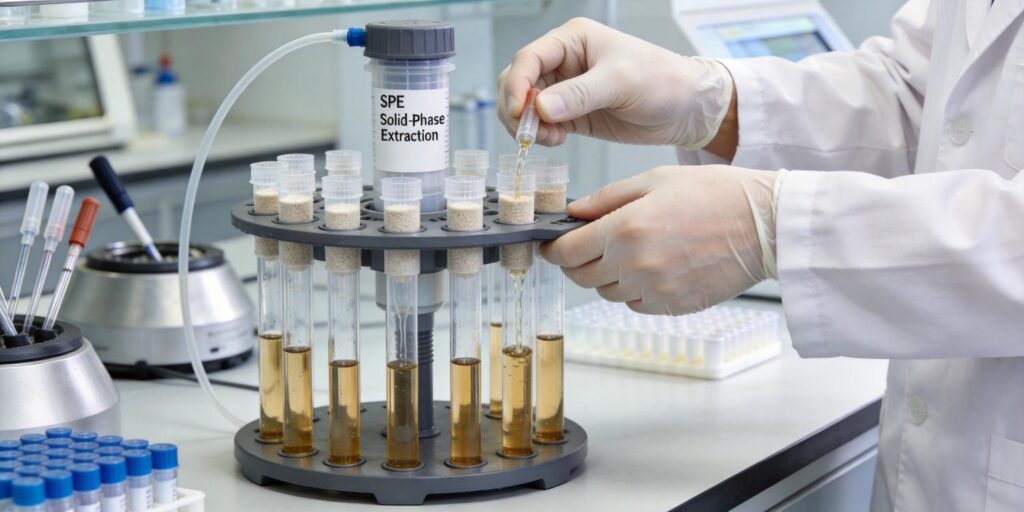
Selecting the appropriate solid-phase extraction sorbent is critical for successful flavonoid isolation. The choice depends on the specific flavonoid characteristics, particularly their polarity and functional groups. According to research documented in Simpson and Wynne’s comprehensive work (2000), several sorbent types have proven effective for flavonoid enrichment:
C18 (Octadecylsilane) Sorbents
C18 phases represent the most commonly used sorbents for flavonoid isolation due to their strong hydrophobic interactions with flavonoid aglycones and moderately polar glycosides. Studies by Katalinic (1997) successfully employed C18 sorbents for flavan fingerprinting in plant extracts, demonstrating their versatility across different flavonoid classes.
Mixed-Mode Sorbents
For complex plant matrices containing flavonoids with varying polarities and functional groups, mixed-mode sorbents combining reversed-phase and ion-exchange mechanisms offer superior selectivity. These sorbents can simultaneously retain flavonoids through hydrophobic interactions and ionic interactions with phenolic hydroxyl groups.
Polymeric Sorbents
Styrene-divinylbenzene copolymers provide alternative retention mechanisms through π-π interactions with flavonoid aromatic systems, making them particularly effective for flavonoid aglycones with extensive conjugation.
For laboratories requiring high-throughput processing, 96-well SPE plates offer efficient parallel processing capabilities, while traditional HLB cartridges provide reliable performance for standard applications.
Conditioning and Loading Extracts
Proper conditioning of SPE sorbents is essential for reproducible flavonoid recovery. The standard conditioning sequence involves:
- Solvent Activation: Typically 3-6 mL of methanol to wet the sorbent surface and remove any trapped air
- Equilibration: 3-6 mL of water or dilute aqueous buffer matching the extract composition to create optimal retention conditions
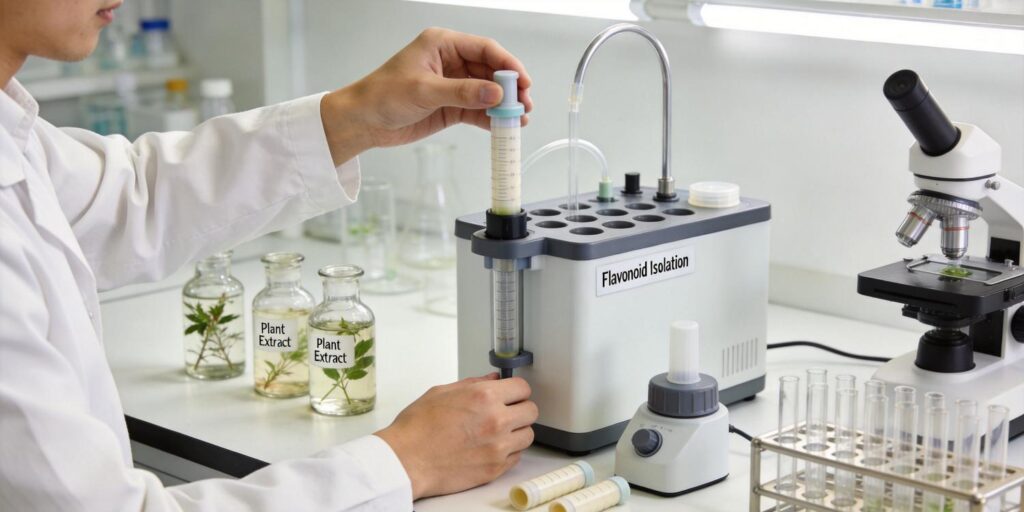
Sample loading conditions significantly impact flavonoid retention efficiency. The crude ethanol/water extract should be diluted with water to reduce the organic solvent content to 10-20%, enhancing flavonoid retention on reversed-phase sorbents. Loading flow rates should be controlled (typically 1-3 mL/min) to ensure adequate contact time between flavonoids and sorbent particles. For flavonoid glycosides with higher water solubility, acidification of the loading solution (pH 2-3) can improve retention by suppressing ionization of phenolic hydroxyl groups.
Washing to Remove Sugars and Chlorophyll
Effective washing steps eliminate matrix interferences while retaining target flavonoids. The washing strategy depends on the specific sorbent and flavonoid characteristics:
Sugar Removal
Sugars, being highly polar and water-soluble, are efficiently removed using 5-10% aqueous methanol or ethanol. This mild wash elutes sugars while retaining most flavonoids on reversed-phase sorbents. For C18 phases, 10-15% methanol in water typically provides optimal sugar removal with minimal flavonoid loss.
Chlorophyll Elimination
Chlorophyll presents a significant challenge due to its strong retention on hydrophobic sorbents. Research by Tsuji et al. (1995) demonstrated that zinc acetate coagulation effectively removes pigments from plant extracts. Alternatively, intermediate polarity solvents like ethyl acetate or dichloromethane:methanol mixtures (90:10 to 80:20) can selectively elute chlorophyll while retaining flavonoids on C18 sorbents.
Additional Interferences
Other plant matrix components including organic acids, amino acids, and some alkaloids can be removed using appropriate wash solvents. For mixed-mode sorbents, buffer solutions at controlled pH values can selectively elute acidic or basic interferences while retaining flavonoids.
Elution Solvents for Flavonoids
Flavonoid elution requires solvents with sufficient elution strength to overcome retention interactions while maintaining compound stability. The optimal elution solvent depends on flavonoid polarity and sorbent characteristics:
Standard Elution Systems
For most flavonoid applications, methanol or acetonitrile containing 0.1-1% formic or acetic acid provides effective elution. The acid component suppresses ionization and improves recovery of phenolic flavonoids. Typical elution volumes range from 3-10 mL, with fraction collection recommended to monitor elution profiles.
Gradient Elution Approaches
For extracts containing flavonoids with wide polarity ranges, stepwise or gradient elution using increasing concentrations of organic solvent (methanol or acetonitrile) in water can fractionate flavonoids based on polarity. This approach is particularly valuable for obtaining purified flavonoid subclasses for further analysis.
Specialized Elution for Specific Flavonoids
Highly polar flavonoid glycosides may require elution with aqueous-rich solvents (60-80% methanol), while flavonoid aglycones typically elute with higher organic content (80-100% methanol). For laboratories working with diverse flavonoid classes, MCX cartridges and WAX cartridges offer specialized retention mechanisms for acidic and basic compounds, respectively.
HPLC Analysis Methods
Following SPE purification, high-performance liquid chromatography provides the primary analytical technique for flavonoid separation and quantification. The choice of HPLC conditions depends on the specific flavonoid classes of interest:
Chromatographic Columns
C18 reversed-phase columns (150-250 mm × 4.6 mm, 5 μm particle size) represent the standard choice for flavonoid separation. For complex flavonoid mixtures, C8 or phenyl-hexyl columns offer alternative selectivity. Research by Tomas-Barberan et al. (1993) demonstrated effective honey flavonoid separation using C18 columns with acidified mobile phases.
Mobile Phase Systems
Binary gradient systems combining water (with 0.1-1% formic or acetic acid) and acetonitrile or methanol provide optimal separation for most flavonoid applications. The acid component improves peak shape and enhances detection sensitivity for UV-absorbing flavonoids.
Detection Methods
UV-Vis detection at 280 nm (for flavones and flavonols) or 360 nm (for flavonols) represents the most common approach. Diode array detection enables spectral characterization and purity assessment. For enhanced sensitivity and specificity, mass spectrometric detection provides molecular weight information and structural characterization capabilities.
Method Reproducibility and Recovery
Ensuring method reproducibility and quantitative recovery is essential for reliable flavonoid analysis. Several factors contribute to method performance:
Recovery Optimization
Flavonoid recovery from SPE procedures typically ranges from 85-95% when optimized. Recovery should be validated using spiked samples or certified reference materials. Studies by Buszewski et al. (1993) reported simultaneous isolation of rutin and esculin with recoveries exceeding 90%, demonstrating the effectiveness of properly optimized SPE methods.
Reproducibility Considerations
Method reproducibility depends on consistent sorbent performance, standardized conditioning procedures, and controlled flow rates. Batch-to-batch consistency of SPE sorbents is critical, with products like MAX cartridges and WCX cartridges offering reliable performance for flavonoid applications.
Quality Control Measures
Implementing quality control measures including method blanks, replicate analyses, and recovery standards ensures data reliability. The inclusion of internal standards (such as flavone or naringenin) corrects for variations in sample processing and analysis.
Method Validation
Comprehensive method validation should address linearity (typically 1-100 μg/mL), limit of detection (0.1-1 μg/mL), limit of quantification (0.5-5 μg/mL), precision (RSD < 5% for replicates), and robustness to minor method variations.
The integration of efficient SPE purification with optimized HPLC analysis provides a robust framework for flavonoid isolation and characterization from plant extracts. This approach enables researchers to obtain reliable quantitative data while minimizing matrix interferences, supporting applications ranging from phytochemical screening to quality control in nutraceutical production.