SPE Workflow for Detecting Emerging Contaminants in Water
1. What Are Emerging Contaminants?
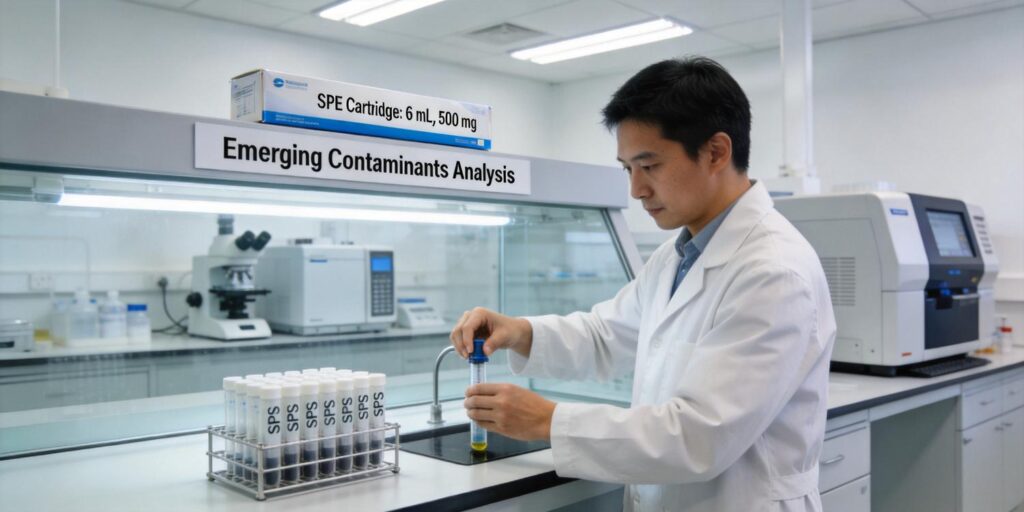
Emerging contaminants, including pharmaceuticals, personal care products (PPCPs), endocrine-disrupting compounds, and industrial chemicals, are increasingly detected in water sources at trace concentrations (ng/L to μg/L). These compounds are not routinely monitored but pose potential ecological and human health risks. Their diverse physicochemical properties — from polar (e.g., metformin, caffeine) to nonpolar (e.g., triclosan, steroids) — demand a robust and flexible sample preparation workflow.
2. Sample Collection and Preservation
Water samples (surface water, wastewater, groundwater) should be collected in pre-cleaned amber glass or HDPE bottles. Immediate filtration through 0.45 μm or 0.7 μm glass fiber filters removes suspended solids and prevents microbial degradation. Samples are preserved by acidification (e.g., pH 2 with HCl or H₂SO₄) for acidic analytes or addition of a biocide (e.g., 1% methanol) for broader stability. Store at 4°C and process within 48 hours to minimize losses.
3. SPE Sorbent Selection for Broad Analyte Classes
Choose the SPE sorbent based on target analyte polarity and ionic state. For multi-residue screening of neutral, acidic, and basic compounds, mixed-mode sorbents offer superior versatility:
- HLB (Hydrophilic-Lipophilic Balance): Ideal for a wide polarity range, from polar pharmaceuticals to nonpolar pesticides. Polymeric sorbent with hydrophilic N-vinylpyrrolidone and lipophilic divinylbenzene groups.
Poseidon HLB SPE Cartridges deliver high retention and reproducible recovery for multi-class contaminants. - MAX (Mixed-Mode Anion eXchange): Selectively retains acidic compounds (e.g., NSAIDs, sulfonamides).
Poseidon MAX SPE Cartridges provide strong anion exchange combined with reversed-phase retention. - MCX (Mixed-Mode Cation eXchange): Targets basic pharmaceuticals like beta-blockers and antidepressants.
Poseidon MCX SPE Cartridges offer both strong cation exchange and reversed-phase interactions. - WAX (Weak Anion eXchange): For strong acids at low pH; good for perfluoroalkyl substances (PFAS).
Poseidon WAX SPE Cartridges are recommended for anionic contaminants. - WCX (Weak Cation eXchange): Retains strong bases, useful for quaternary ammonium compounds.
Poseidon WCX SPE Cartridges complement the MCX for selectivity tuning.
4. Conditioning and Loading Large-Volume Water Samples
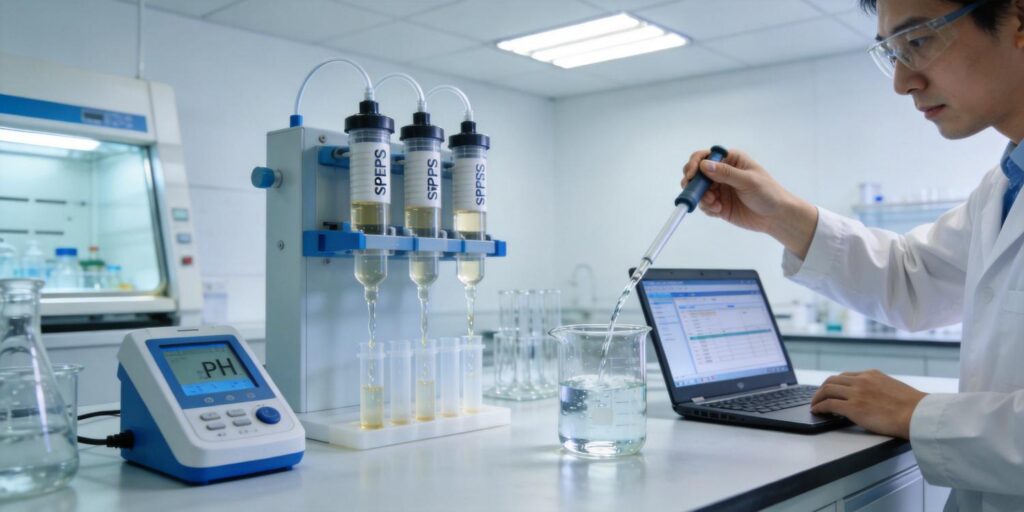
To achieve reproducible recovery, condition the sorbent with 3–5 bed volumes of methanol followed by water (or appropriate buffer). For large volumes (100–1000 mL), use a vacuum manifold or positive-pressure device. Flow rates should be ≤10 mL/min to ensure adequate contact time. Sample pH adjustment (e.g., pH 2 for acidic analytes, pH 7 for neutrals) can enhance retention. If dissolved organic matter is high (e.g., wastewater effluent), pre-dilution with deionized water may reduce competition for sorbent sites.
5. Washing Strategies to Reduce Matrix Interference
After loading, a wash step removes weakly retained matrix components. Common washes:
- 5% methanol in water for polar interferences (salts, sugars).
- pH-adjusted buffer (e.g., acetate buffer pH 5) to selectively wash while keeping target analytes bound.
- Methanol/water (e.g., 10:90) for moderate polarity interferences without eluting moderately polar analytes.
For mixed-mode sorbents, a sequential wash with aqueous buffer (pH 2 for MCX, pH 10 for MAX) removes residual matrix before elution.
6. Elution Solvent Combinations
Elution solvent choice dictates recovery and selectivity. Typical schemes:
- For HLB: Methanol → 2 mL, then 1:1 acetone/methanol or ethyl acetate/methanol for nonpolar compounds.
- For MCX: 5% ammonium hydroxide in methanol (basic condition) elutes basic compounds; acidified methanol elutes neutral ones.
- For MAX: 2% formic acid in methanol (acidic condition) elutes acidic analytes.
- For WAX: 0.1% ammonium hydroxide in methanol for strong acids.
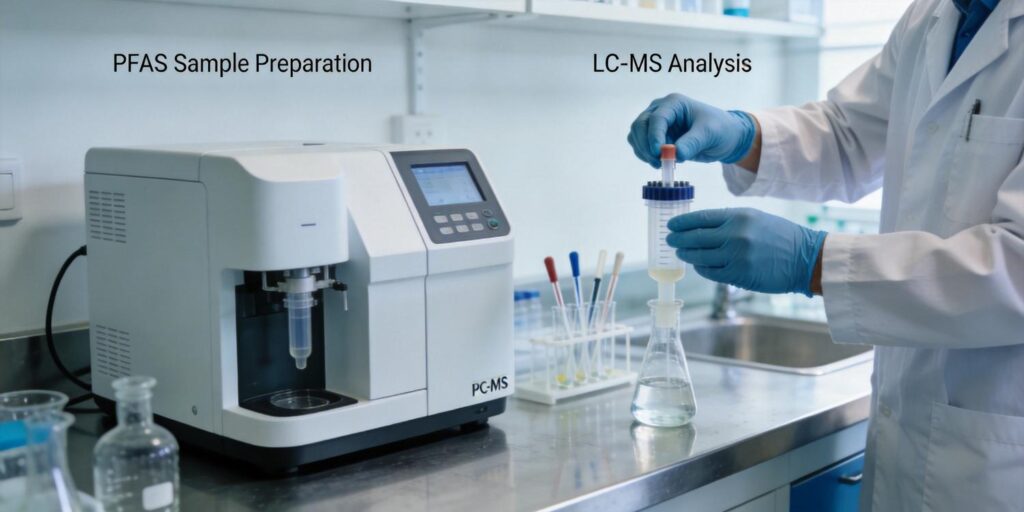
For polarity, combine methanol with ethyl acetate or acetonitrile. Evaporate eluate under nitrogen and reconstitute in LC-compatible solvent (e.g., 10:90 methanol/water).
7. LC-MS/MS Analysis Workflow
Inject reconstituted extract (5–20 μL) into a reversed-phase C18 column (2.1 × 100 mm, 1.7 μm). A binary gradient (water/methanol with 0.1% formic acid) at 0.3 mL/min gives good separation. ESI in positive and negative ionization modes covers most analytes. Multiple reaction monitoring (MRM) transitions for each target compound ensure high sensitivity and specificity. Use isotope-labeled internal standards (e.g., carbamazepine-d10, ibuprofen-d3) to correct for matrix effects. Limit of quantification (LOQ) typically ranges 0.1–10 ng/L.
8. Environmental Monitoring Implications
SPE-LC-MS/MS workflows enable comprehensive monitoring of emerging contaminants in water. Data inform risk assessments, regulatory decisions, and wastewater treatment optimization. For high-throughput screening, 96-well SPE plates allow parallel processing of many samples. Consistent method performance across labs requires rigorous quality control, including blanks, spikes, and field duplicates. As regulations evolve (e.g., EU Watch List, US EPA CCL5), robust SPE workflows remain the cornerstone for detecting trace-level pollutants in aquatic environments.