The Critical Role of Therapeutic Drug Monitoring
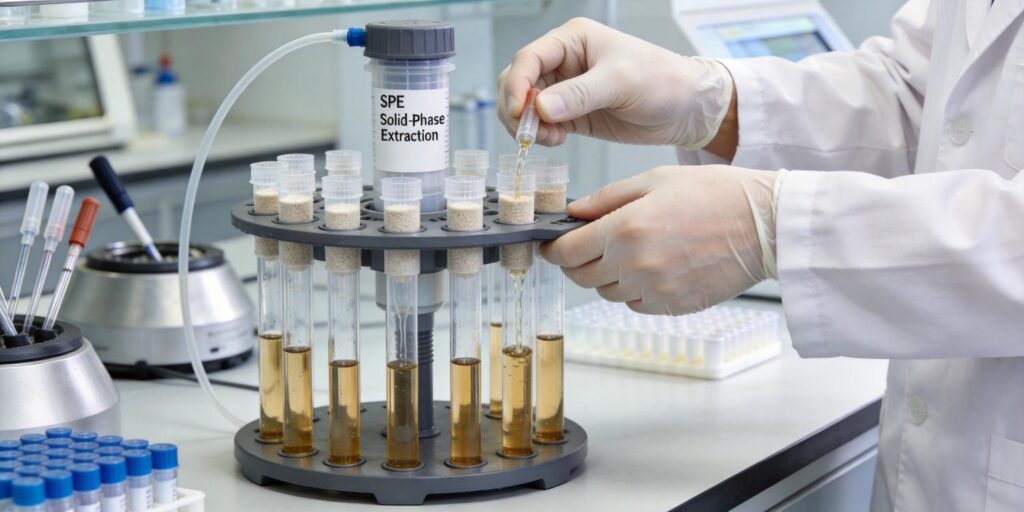
Therapeutic drug monitoring (TDM) is an essential clinical tool that optimizes medication dosing by measuring drug concentrations in blood. TDM ensures efficacy while minimizing toxicity, particularly for drugs with narrow therapeutic windows, such as immunosuppressants (tacrolimus, cyclosporine), antiepileptics (valproic acid, carbamazepine), and certain antibiotics (vancomycin). Accurate and reproducible quantification at low ng/mL levels demands robust sample preparation. Solid-phase extraction (SPE) has become the gold standard for TDM blood sample cleanup due to its ability to remove endogenous interferences while concentrating target analytes.
Blood Sample Pretreatment Steps
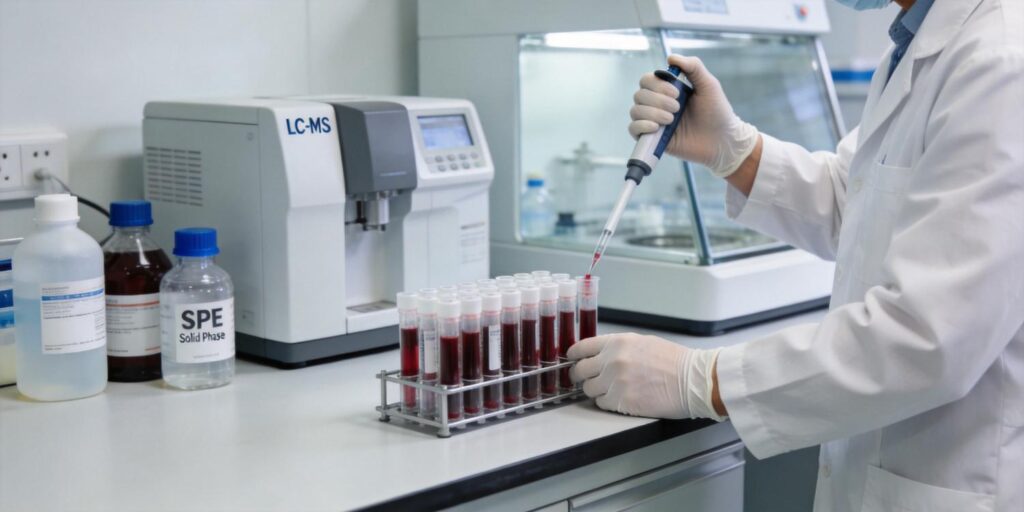
Whole blood or plasma is typically collected in EDTA or heparin tubes. The first step involves protein precipitation using organic solvents (acetonitrile or methanol) at a 3:1 or 4:1 solvent-to-sample ratio. After vortexing and centrifugation (10,000 × g, 10 min), the supernatant is diluted with water or buffer to reduce organic content below 10% (v/v). This dilution is critical to ensure proper analyte retention during SPE loading. For highly protein-bound drugs (>95%), enzymatic digestion with protease may be required before precipitation to release bound analytes.
SPE Sorbent Selection for Target Drug Classes
Sorbent chemistry dictates selectivity. The following commercial sorbents from Poseidon Scientific are recommended:
- HLB (Hydrophilic-Lipophilic Balanced): A universal reversed-phase sorbent ideal for acidic, basic, and neutral drugs. Excellent for broad-spectrum TDM panels (e.g., simultaneous analysis of tricyclic antidepressants). Learn more about HLB SPE cartridges.
- MAX (Mixed-Mode Strong Anion Exchange): Retains acidic drugs (e.g., NSAIDs, valproic acid) via anion exchange at pH > pKa+2. Compatible with high aqueous loading.
- MCX (Mixed-Mode Strong Cation Exchange): Selectively binds basic drugs (e.g., β-blockers, opioids) at pH < pKa-2, enabling efficient cleanup from phospholipid-rich matrices. See MCX SPE cartridges.
- WAX (Weak Anion Exchange): Suitable for strong acidic drugs requiring mild elution conditions (e.g., methotrexate).
- WCX (Weak Cation Exchange): Targets quaternary ammonium compounds or strongly basic drugs (e.g., neuromuscular blockers).
For high-throughput clinical labs, 96-well plate formats are available. Explore 96-well SPE plates to streamline batch processing.
Conditioning and Loading Diluted Blood Extracts
Standard conditioning for reversed-phase sorbents: 1 bed volume methanol, followed by 1 bed volume water or loading buffer. For mixed-mode sorbents, use appropriate pH-adjusted buffers: for MCX, condition with methanol then 0.1 M HCl; for MAX, condition with methanol then 0.1 M NH₄OH. Load the diluted blood extract at a flow rate of 1–2 mL/min, ensuring the sorbent does not dry out. The loading volume typically ranges from 1–5 mL, depending on cartridge capacity (e.g., 30–60 mg sorbent per 3 mL cartridge). Monitor breakthrough by collecting the flow-through for pilot studies.
Washing to Remove Proteins and Lipids
A two-step wash is recommended. First wash: 5% methanol in water (1–2 bed volumes) to remove salts and polar interferences. Second wash: 50% methanol in water (1 bed volume) to elute weakly retained phospholipids and residual proteins. For mixed-mode sorbents, an intermediate wash with 0.1 M HCl (MCX) or 0.1 M NH₄OH (MAX) removes unwanted ionic species. Avoid using pure organic washes as they may prematurely elute analytes. The key is to maintain analyte retention while maximizing interference removal.
Elution Solvents Compatible with LC-MS
Elution solvent composition must be compatible with subsequent LC-MS analysis. Typical eluents:
- Reversed-phase (HLB): 100% methanol or acetonitrile, sometimes with 0.1% formic acid.
- Mixed-mode MCX: 5% NH₄OH in methanol (basic eluent).
- Mixed-mode MAX: 2% formic acid in methanol (acidic eluent).
Elute with two bed volumes (e.g., 2 × 2 mL for a 3 mL cartridge). Evaporate eluate under nitrogen and reconstitute in mobile phase (e.g., 70:30 water:acetonitrile with 0.1% formic acid) to avoid solvent effects on LC peak shape. For direct injection, use elution solvents that match the initial mobile phase composition.
Quantification and Calibration Methods
Quantification requires stable isotope-labeled internal standards (SIL-IS) added at the start of sample preparation to correct for recovery and matrix effects. Prepare calibration standards in charcoal-stripped plasma at 6–8 concentration levels covering the therapeutic range. Quality control samples at low, medium, and high concentrations should be within ±15% of nominal values ( ±20% at LLOQ). Use weighted linear regression (1/x²) for calibration curves. Monitor recovery (should be >80% with RSD <15%) and matrix effect (assessed via post-column infusion). Ensure ion suppression/enhancement is minimized by the SPE cleanup.
Clinical Laboratory Validation
Before implementation, validate the method per CLSI C62-A guidelines. Key parameters: selectivity (no interference from endogenous compounds or co-administered drugs), carryover (<0.1% of LLOQ), precision (intra- and inter-day RSD <15%), accuracy (bias within ±15%), and stability (bench-top, freeze-thaw, autosampler). For MAX, WAX, and WCX SPE cartridges, batch-to-batch reproducibility must be verified. Document all procedures in a standard operating procedure (SOP) and train laboratory personnel. Regular participation in external quality assessment (EQA) schemes ensures ongoing accuracy.