1. Types of Artificial Sweeteners in Beverages
Artificial sweeteners are widely used in beverages to provide sweetness without calories. Common types include aspartame, sucralose, saccharin, acesulfame potassium (Ace-K), neotame, and cyclamate. These compounds are polar and often present at low concentrations (mg/L range) in complex matrices containing sugars, acids, colors, and preservatives. Effective extraction and clean-up are essential for accurate quantification by HPLC or LC-MS.
2. Sample Dilution and Filtration Steps
Carbonated beverages should be degassed by sonication or shaking. For syrups or concentrates, dilute with deionized water to reduce viscosity. Filter samples through a 0.45 µm or 0.22 µm nylon or PTFE syringe filter to remove particulates. Dilution factors should be recorded to calculate final concentrations. For samples with high sugar content, adjust pH to 4-5 using dilute HCl or NaOH to improve sweetener retention on SPE sorbents.
3. SPE Sorbent Selection for Polar Sweeteners
For polar artificial sweeteners, polymeric sorbents such as HLB (hydrophilic-lipophilic balanced) are recommended due to their high retention of polar analytes across a wide pH range. Alternatively, mixed-mode sorbents like MAX (mixed-mode anion exchange) can be used to selectively retain acidic sweeteners (e.g., saccharin, Ace-K) while MCX (mixed-mode cation exchange) suits basic sweeteners like aspartame. For neutral sweeteners such as sucralose, WAX or WCX sorbents may be employed. High-throughput applications may benefit from 96-well SPE plates for parallel processing.
4. Conditioning and Loading Procedures
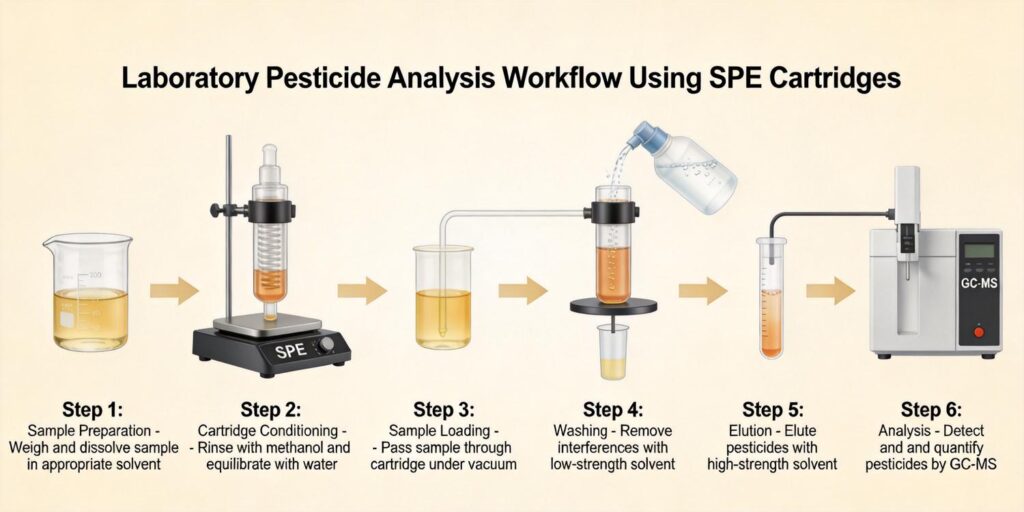
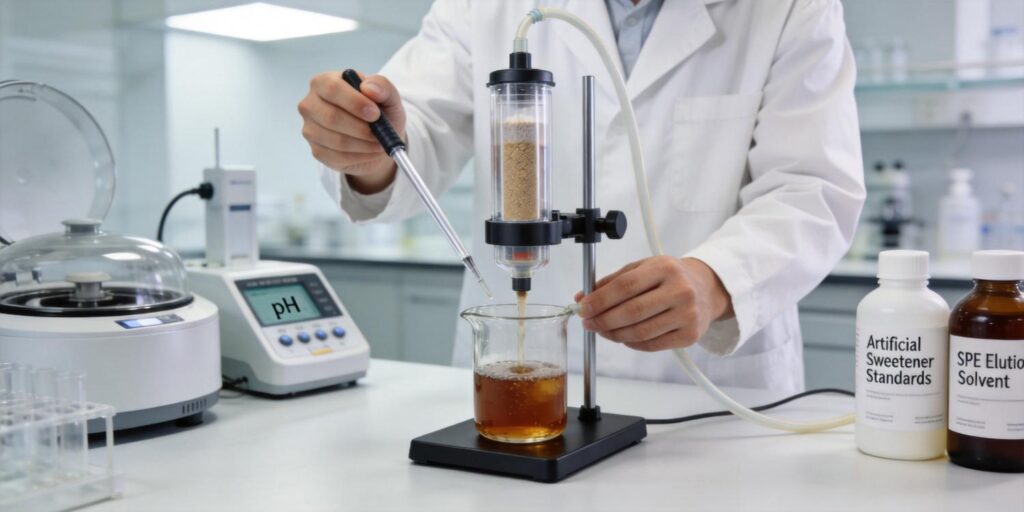
Condition the SPE cartridge with 3–5 mL of methanol followed by 3–5 mL of deionized water to activate the sorbent. Avoid letting the sorbent dry. Load the sample (typically 5–10 mL) at a flow rate of 1–2 mL/min. For better retention, maintain a consistent flow rate using a vacuum manifold or positive pressure system. After loading, wash with 3 mL of water to remove loosely bound matrix components.
5. Washing Steps Removing Sugars and Acids
After sample loading, wash with 5% methanol in water (v/v) to remove sugars and organic acids. For mixed-mode sorbents, a more stringent wash using 0.1 M HCl (for MCX) or 0.1 M NaOH (for MAX) can selectively remove interferences while retaining target analytes. Typically, 2–5 mL of washing solvent is sufficient. Monitor wash fractions to ensure no breakthrough of sweeteners occurs.
6. Elution Solvents for Sweetener Compounds
Elute the retained sweeteners with 2–5 mL of methanol or acetonitrile containing 0.1% formic acid (for acidic sweeteners) or 0.1% ammonium hydroxide (for basic sweeteners). For HLB sorbents, pure methanol often works well. Collect the eluate and evaporate to dryness under nitrogen at 40°C, then reconstitute in 1 mL of mobile phase or water:methanol (90:10) before injection.
7. HPLC or LC-MS Analysis Methods
HPLC with UV detection (210–230 nm) is common for non-volatile sweeteners. Use a C18 column (150 × 4.6 mm, 5 µm) with a mobile phase of ammonium acetate buffer (pH 4.5) and acetonitrile in gradient mode. For LC-MS/MS, use electrospray ionization in negative mode for acidic sweeteners (e.g., saccharin, Ace-K) and positive mode for aspartame. Multiple reaction monitoring (MRM) transitions provide high sensitivity and selectivity. Typical injection volumes are 10–20 µL.
8. Quality Control in Beverage Analysis
Include matrix-matched calibration standards spanning 0.1–50 mg/L. Use internal standards (e.g., isotopically labeled sweeteners) to correct for matrix effects. Analyze blank and spiked samples to assess recovery (target 70–120%) and precision (RSD < 15%). Perform duplicate analyses and include QC check standards every 10–15 samples. Regular monitoring of retention times and signal intensity ensures method robustness.
For more details on SPE cartridges and plates, visit Poseidon Scientific for a wide range of products suitable for beverage analysis.