Understanding Pigment Interference in Plant Extract Chromatography
Plant extracts are rich in bioactive compounds such as flavonoids, alkaloids, terpenoids, and phenolic acids. However, they also contain significant amounts of pigments—primarily chlorophylls, carotenoids, and anthocyanins—that can severely interfere with chromatographic analysis. These pigments often co-extract with target analytes, leading to:
- Suppression of analyte signals in mass spectrometry due to ion suppression.
- Overlapping peaks in HPLC-UV, complicating quantification.
- Column fouling and reduced lifetime of analytical columns.
- Poor reproducibility and elevated limits of detection.
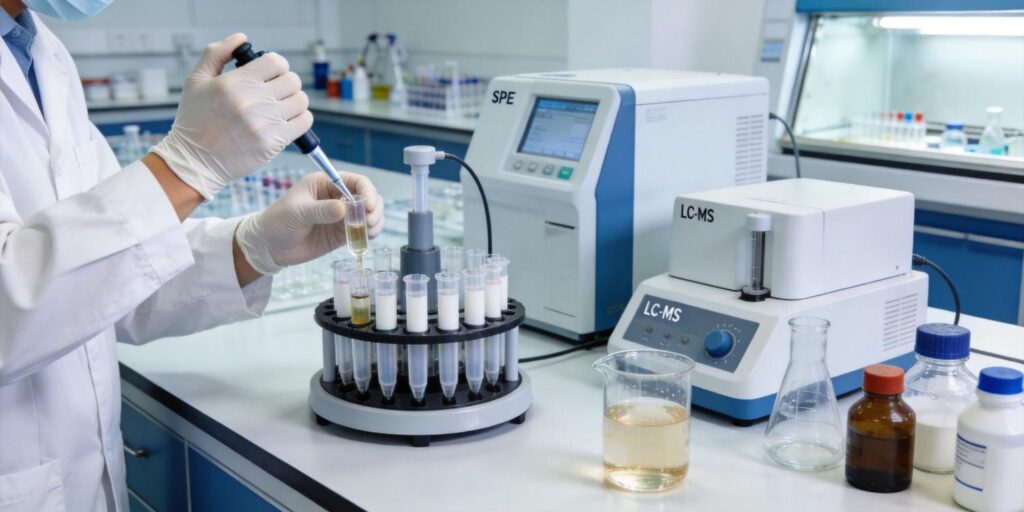
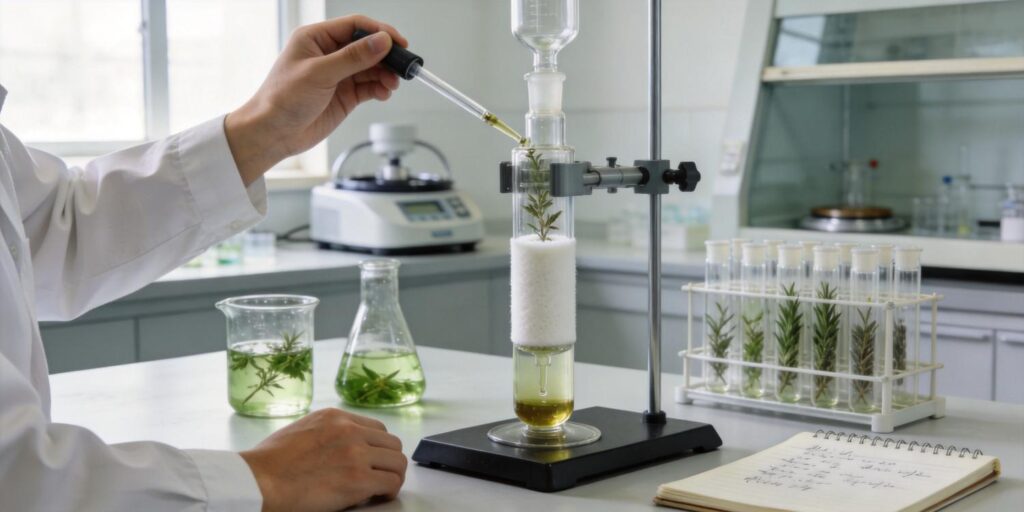
Effective pigment removal is therefore a critical sample preparation step before LC-MS or GC-MS analysis of plant metabolites. Solid-phase extraction (SPE) offers a selective, scalable, and reproducible approach to clean up pigments while retaining target compounds.
Extraction Solvents for Plant Metabolites
The choice of extraction solvent significantly influences both the yield of target analytes and the amount of co-extracted pigments. Common solvents include:
- Methanol/water mixtures: Efficient for polar metabolites (e.g., phenolic acids, flavonoids glycosides) but also extract chlorophylls.
- Ethanol/water: A greener alternative, slightly less efficient for non-polar pigments.
- Acetone/water: Good for both polar and mid-polar compounds; however, acetone extracts carotenoids readily.
- Acetonitrile/water: Common for LC-MS; reduces pigment carryover compared to methanol.
After extraction, the crude extract is typically concentrated and reconstituted in a loading solvent compatible with the chosen SPE sorbent. For pigment removal, the loading solvent should be aqueous enough to retain polar analytes on reversed-phase sorbents, while allowing non-polar pigments to pass through or be washed away.
SPE Sorbent Selection for Pigment Removal
The choice of SPE sorbent is paramount. For plant extracts, the following sorbent phases are commonly used:
Reversed-Phase (C18, C8)
C18 SPE cartridges retain non-polar to moderately polar compounds. Chlorophylls (non-polar) are strongly retained, while many polar metabolites (e.g., glycosylated flavonoids) pass through or are weakly retained. This allows a simple “load and wash” scheme where pigments are held on the sorbent and analytes are collected in the flow-through. However, if target analytes are also non-polar (e.g., some terpenoids), they may co-retain with pigments.
Mixed-Mode Sorbents (MAX, MCX, WAX, WCX)
Mixed-mode ion-exchange/reversed-phase sorbents offer selectivity based on both hydrophobicity and charge. For example, MAX (Mixed-Mode Anion eXchange) cartridges retain acidic compounds, while MCX (Mixed-Mode Cation eXchange) retain basic compounds. Pigments, being neutral or zwitterionic, often pass through or can be selectively washed. This approach is ideal when targeting ionizable metabolites.
Polymeric SPE (HLB)
HLB (Hydrophilic-Lipophilic Balanced) cartridges are versatile for a wide polarity range. They retain both polar and non-polar analytes, but pigments can be removed by careful solvent selection during washing. HLB is often used for broad-scope metabolomics.
Normal-Phase (Silica, Diol)
Less common for pigment removal, but useful for separating carotenoids from more polar metabolites.
For dedicated pigment removal, dedicated pigment-removal SPE products (e.g., Chlorophyll Removal plates) are also available, but standard reversed-phase or mixed-mode cartridges can be optimized.
Conditioning and Loading Procedures
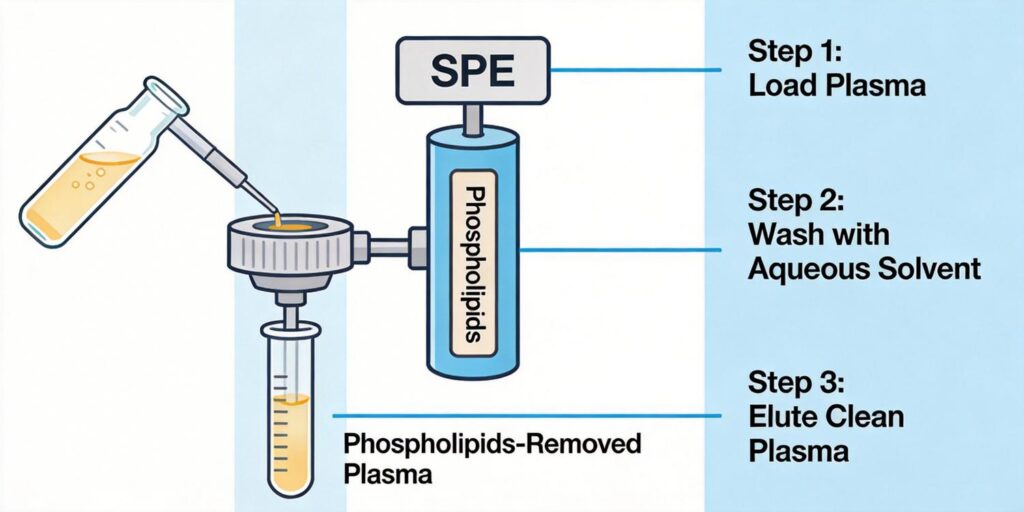
Proper conditioning ensures reproducible retention and maximizes pigment removal:
- Conditioning: Pass 1–2 column volumes of methanol followed by 1–2 column volumes of water or loading buffer. For mixed-mode sorbents, the buffer pH and ionic strength should match the target compound’s pKa to ensure charge state.
- Equilibration: With loading solvent (e.g., 5% methanol in water).
- Loading: Apply the sample (plant extract dissolved in loading solvent) at a controlled flow rate (~1 mL/min for 3 mL cartridges). Avoid overloading—typical loading volumes are 0.5–2 mL of extract.
- Pigment retention: At this stage, chlorophylls and carotenoids are either retained on the sorbent (if using C18) or pass through (if using mixed-mode with aqueous loading).
Washing Solvents Targeting Chlorophyll Removal
If pigments are retained, a wash step is used to remove them while keeping analytes on the sorbent. Common washing schemes include:
- Low organic content: 20–40% methanol in water removes polar interferences but leaves chlorophylls (more non-polar) on the sorbent.
- Mid-organic content: 50–70% methanol or acetonitrile can elute some chlorophylls, but risk losing mid-polar analytes.
- Dedicated pigment wash: Use a solvent like hexane/ethyl acetate (9:1) for reversed-phase sorbents; chlorophylls are soluble in non-polar solvents while polar analytes remain on the sorbent. However, compatibility with the sorbent must be checked to avoid dewetting.
- Weak base or acid: For mixed-mode sorbents, a wash with 5% ammonium hydroxide or formic acid can help remove pigments that ionize at extreme pH.
An ideal wash leaves the target analytes untouched while quantitatively removing pigments. This is often validated by measuring UV absorbance at 450 nm (carotenoids) and 665 nm (chlorophyll) in the wash and eluate fractions.
Elution of Analytes
After washing, the target analytes are eluted with a solvent that disrupts their interaction with the sorbent:
- For reversed-phase: 100% methanol, acetonitrile, or isopropanol. For strongly retained analytes, add 0.1% formic acid or use ethyl acetate.
- For mixed-mode: Use a solvent with both organic content and a competing ion. For MAX, elute with 5% formic acid in methanol; for MCX, elute with 5% ammonium hydroxide in methanol.
- Volume: Typically 1–3 mL for a 100–200 mg cartridge. Collect in a clean tube, then evaporate and reconstitute in LC-MS compatible solvent.
The eluate should be clear or at least significantly less colored than the crude extract, indicating successful pigment removal.
Impact on Chromatographic Performance
Effective SPE cleanup dramatically improves chromatographic results:
- Baseline stability: Reduced drift and ghost peaks.
- Peak shape: Eliminates tailing caused by co-eluting pigments.
- Signal-to-noise ratio: Improved detection limits for trace analytes.
- Column longevity: Less irreversible adsorption of pigments on the analytical column.
- Mass spectrometry: Reduced ion suppression and matrix effects, leading to more accurate quantification.
Example Case Studies
Case 1: Flavonoid Analysis in Spinach Extract
Research by Liu et al. (2020) used HLB cartridges to remove chlorophyll from spinach extracts. After loading in 10% methanol, washing with 40% methanol removed sugars and acids, then chlorophyll was washed with 100% acetonitrile. Flavonoids were eluted with 100% methanol. Recovery exceeded 85% for quercetin and kaempferol glycosides, with >95% pigment removal.
Case 2: Alkaloid Analysis in Papaver somniferum
Using MCX cartridges, alkaloids (basic) were retained at pH 3, while neutral pigments washed off with 50% methanol. Elution with 5% NH₄OH in methanol gave clean extracts with codeine and morphine recoveries >90%.
Case 3: Carotenoid Profiling in Tomato
For non-polar carotenoids, C18 SPE was used. After loading in 80% ethanol, chlorophylls were removed by washing with hexane/ethyl acetate (95:5). Carotenoids were then eluted with ethyl acetate. HPLC analysis showed baseline separation of lycopene and β-carotene with no interfering peaks.
These protocols are scalable to 96-well SPE plates for high-throughput screening.
In summary, SPE cleanup for pigment removal requires careful optimization of sorbent type, loading conditions, and wash/elution solvents. When done correctly, it enables robust, sensitive, and reproducible analysis of plant metabolites.