Introduction
Antibiotic residues in food and environmental samples pose significant risks to public health and ecosystem stability. Broad-spectrum screening methods are essential for regulatory compliance and safety monitoring. Solid-phase extraction (SPE) using hydrophilic-lipophilic balanced (HLB) sorbents has emerged as a powerful technique for the simultaneous extraction of multiple antibiotic classes. This article provides a detailed, evidence-based overview of HLB SPE strategies for broad-spectrum antibiotic screening, covering sorbent selection, sample preparation, method optimization, and validation parameters.
Diversity of Antibiotic Classes
Antibiotics encompass a wide range of chemical structures and properties. Key classes include:
- Beta-lactams (e.g., penicillin, amoxicillin): polar, acidic/basic, susceptible to hydrolysis.
- Macrolides (e.g., erythromycin, azithromycin): moderately polar, basic, large molecular weight.
- Tetracyclines (e.g., tetracycline, doxycycline): amphoteric, chelating agents, prone to metal complexation.
This structural diversity presents a challenge for single-mode SPE sorbents, which often fail to retain all classes simultaneously.
Why Hydrophilic-Lipophilic Balanced Sorbents Are Suitable for Multi-Class Capture
HLB sorbents, such as those from Poseidon Scientific’s HLB SPE Cartridges, are polymeric materials (typically divinylbenzene and N-vinylpyrrolidone) that provide both hydrophilic (polar) and lipophilic (non-polar) retention mechanisms. This dual retention capability allows HLB to effectively capture a wide polarity range of antibiotics—from highly polar beta-lactams to relatively non-polar macrolides—without the need for multiple sorbent types. Additionally, HLB sorbents exhibit high surface area and pH stability (pH 0–14), enabling robust performance across diverse sample matrices.
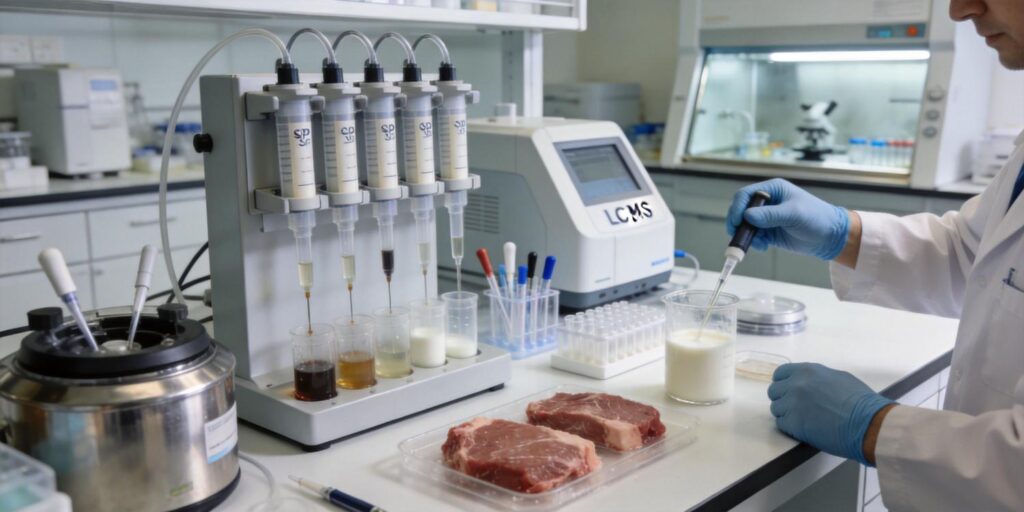
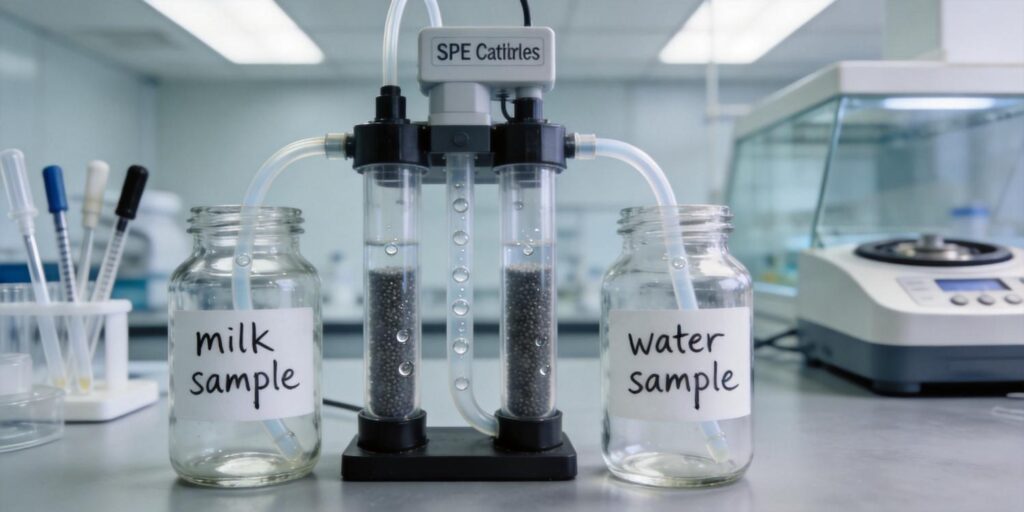
Sample Matrices: Milk, Meat, Environmental Water
The target matrices for antibiotic screening often contain complex interfering components:
- Milk: high fat (3–5%) and protein (3–4%) content.
- Meat: high protein, phospholipids, and fatty acids.
- Environmental water: variable pH, organic matter, and suspended solids.
HLB sorbents handle these matrices effectively through optimized conditioning, washing, and elution steps.
Conditioning Steps to Activate Polymeric Sorbent
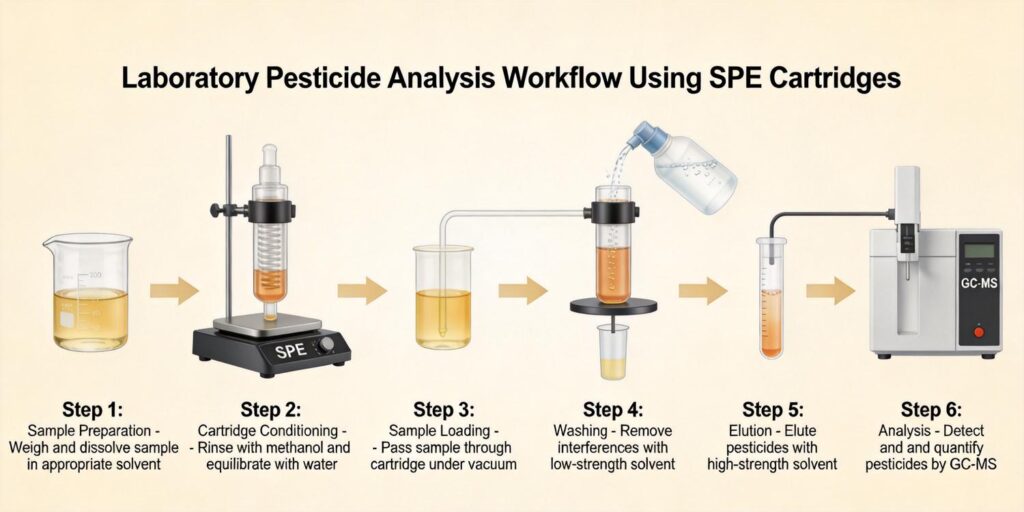
Proper conditioning is critical for reproducible retention. A typical protocol for HLB cartridges (e.g., 200 mg/6 mL) includes:
- Condition with 3 mL methanol to wet the sorbent and expose active sites.
- Equilibrate with 3 mL deionized water (or buffer matching sample pH) to remove excess methanol and ready the sorbent for aqueous sample loading.
This two-step process ensures the polymer is fully solvated, maximizing both hydrophobic and hydrophilic interactions.
Optimization of Wash Solvents to Remove Fats and Proteins
After sample loading, a wash step removes interferences while retaining target analytes. Common strategies:
- For milk: wash with 5% methanol in water (v/v) to elute polar proteins without losing beta-lactams.
- For meat: wash with hexane or 0.1% formic acid in water to remove fats and denature proteins.
- For water: a simple water wash suffices; if organic matter is high, 5% methanol can be used.
Wash volume and strength must be optimized to avoid premature elution of target compounds—especially the more polar beta-lactams.
Gradient Elution with Methanol/Acetonitrile Mixtures
For multi-class recovery, a stepwise or gradient elution is recommended. Typical elution scheme:
- Elution 1: 3 mL of 50:50 methanol/acetonitrile (v/v) to release moderately polar antibiotics (e.g., tetracyclines).
- Elution 2: 3 mL of 90:10 acetonitrile/water (v/v) with 0.1% formic acid to elute non-polar macrolides and beta-lactams.
Alternatively, a single 5 mL of 80:20 acetonitrile/methanol (v/v) can be used, but class-specific recovery may vary.
Integration with LC-MS/MS Multi-Residue Analysis
HLB SPE extracts are highly compatible with LC-MS/MS. The eluate is typically evaporated to dryness under nitrogen and reconstituted in mobile phase (e.g., 0.1% formic acid in water/methanol). LC separation uses a C18 column with a gradient of water and acetonitrile, both containing 0.1% formic acid. Multiple reaction monitoring (MRM) transitions are optimized for each antibiotic, allowing simultaneous quantification of 50–100 analytes in a single 15-minute run.
Validation Parameters: Recovery, Matrix Effect, LOQ
Method validation follows guidelines (e.g., EU 2002/657/EC, FDA). Key parameters:
- Recovery: target 70–120% at three spiking levels (low, medium, high). For HLB, recoveries for most antibiotics are 80–110%.
- Matrix effect: assessed by post-extraction spiking; signal suppression/enhancement should be ≤20%. Isotope-labeled internal standards correct for variability.
- Limit of quantification (LOQ): typically 0.1–10 μg/kg for food matrices and 0.01–1 μg/L for water, depending on instrument sensitivity.
Conclusion
HLB SPE is a versatile, robust method for broad-spectrum antibiotic screening across complex matrices. By leveraging the balanced retention of polymeric sorbents, optimized conditioning, and careful solvent selection, analysts can achieve high recoveries and reproducibility. For laboratories seeking reliable HLB SPE cartridges, MAX, MCX, and WAX options from Poseidon Scientific offer quality alternatives for method development and routine analysis.
Frequently Asked Questions (FAQ)
Can HLB be used for acidic antibiotics like fluoroquinolones?
Yes, HLB retains fluoroquinolones effectively, but elution may require acidified acetonitrile (e.g., 2% formic acid).
How do I handle dirty samples like soil?
Pre-filter (0.45 μm) and dilute with water to reduce matrix load; consider using 96-well SPE plates for high-throughput.
What is the shelf life of HLB cartridges?
Store at room temperature in sealed bags; use within 2 years of manufacture.