Understanding Peptide Biomarkers in Plasma and Serum
Peptide biomarkers in plasma and serum present unique extraction challenges due to their diverse physicochemical properties. Most peptides (typically <10 kDa) exist in a mixture of charge states depending on pH, with isoelectric points (pI) ranging from 4 to 10. At neutral pH, many peptides carry net positive charges (NH₃⁺ groups from lysine, arginine, and histidine) and net negative charges (COO⁻ from aspartic and glutamic acids). Their hydrophilicity also varies widely; small, polar peptides are often poorly retained on reversed-phase sorbents. These characteristics make weak cation-exchange (WCX) SPE an attractive option for selective extraction, as it targets positively charged peptides while excluding neutral and negatively charged species.
WCX Sorbent Chemistry and Weak Cation-Exchange Interaction
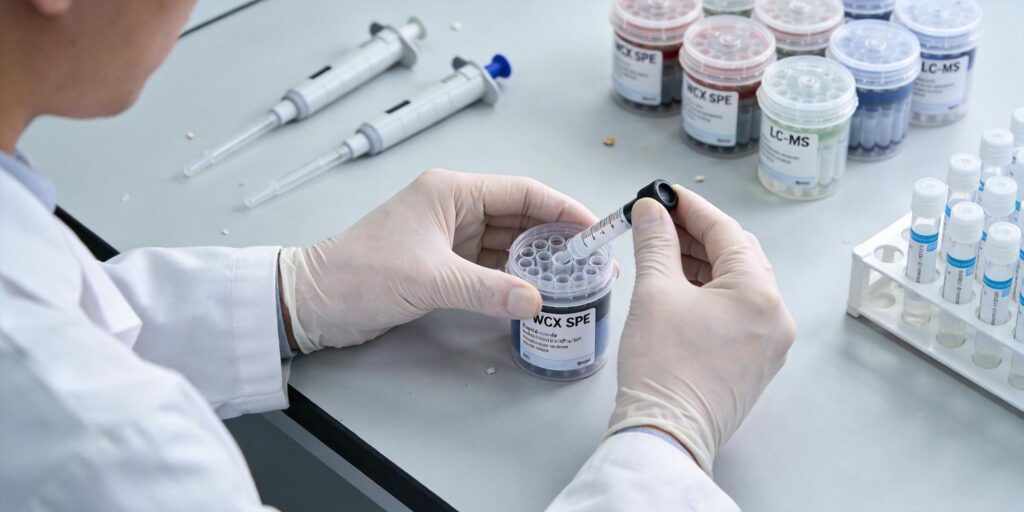
WCX sorbents, such as those in Poseidon Scientific’s WCX SPE cartridges, feature weak carboxylic acid functional groups (−COOH). These groups are negatively charged at pH above ~4.5 (pKa ∼4.8) and become protonated (neutral) at lower pH. The cation-exchange capacity depends on the ionization state of the carboxyl groups. At a loading pH of 5–7, the sorbent is negatively charged and selectively retains positively charged peptides (cation exchangers). The interaction is electrostatic and reversible, allowing mild elution conditions that preserve peptide integrity.
Sample Pretreatment: Protein Precipitation vs. Dilution
Plasma and serum contain high levels of proteins (60–80 mg/mL) that can clog SPE cartridges and interfere with peptide binding. Two common pretreatment strategies are:
- Protein precipitation (PPT): Adding organic solvents (e.g., acetonitrile, methanol) or acids (e.g., TFA) precipitates bulk proteins. After centrifugation, the supernatant contains peptides and small molecules. PPT effectively removes large proteins but can also precipitate some hydrophobic peptides and may require careful pH adjustment before loading.
- Dilution: Diluting plasma 1:1 to 1:4 with a low-ionic-strength buffer (e.g., 20 mM ammonium acetate, pH 5–6) reduces viscosity and protein concentration while maintaining peptide solubility. Dilution is gentler and can improve recovery of hydrophilic peptides, but may still allow smaller proteins to pass through.
For WCX SPE, dilution is often preferred because it avoids organic solvents that could affect peptide retention and is easier to control pH.
Cartridge Conditioning and pH Control for Peptide Retention
Proper conditioning is critical for reproducible peptide binding. A typical WCX conditioning protocol includes:
- Wash with 1–2 bed volumes of methanol or acetonitrile to wet the sorbent and remove any impurities.
- Equilibrate with 2 bed volumes of loading buffer (e.g., 50 mM ammonium acetate, pH 5.5). The pH should be adjusted to 1–2 units above the sorbent’s pKa to ensure full deprotonation (−COO⁻ form).
- Load the pH-adjusted sample (sample pH ~5–6) at a slow flow rate (1–2 mL/min for 3-mL cartridges) to allow sufficient interaction time.
Maintaining a consistent pH during loading is essential, as fluctuations can cause peptide charge reversal or sorbent neutralization, leading to breakthrough.
Washing Steps to Remove Salts and Phospholipids
After sample loading, a wash step removes unwanted matrix components:
- First wash: 1–2 bed volumes of loading buffer to elute unretained neutrals and weakly retained species.
- Second wash (optional): 1 bed volume of 20% methanol in loading buffer to remove hydrophobic phospholipids while maintaining electrostatic interactions. Excessive organic solvent may disrupt binding, so keep methanol below 30%.
Phospholipids are common interferents in plasma that can cause ion suppression in LC-MS. A dedicated phospholipid removal step is beneficial for sensitive biomarker quantification.
Elution Strategies Using High Ionic Strength or Basic Organic Solvent
The elution mechanism for WCX involves neutralizing the sorbent (lower pH) or displacing cationic peptides with a high concentration of competing cations. Effective elution conditions include:
- High ionic strength: 1–2 M ammonium acetate or ammonium formate at neutral pH (e.g., 200 mM ammonium acetate in 50% acetonitrile). The high salt concentration outcompetes peptides for cation-exchange sites.
- Basic organic solvent: 5% ammonia in methanol (v/v) or 1% triethylamine in acetonitrile. The high pH deprotonates the sorbent (turning −COO⁻ to −COOH) and neutralizes bound peptides, releasing them.
Recovery can be optimized by eluting in 2–3 fractions with small volumes (0.5–1 bed volume each). For LC-MS compatibility, the elution buffer should be volatile; ammonium acetate and ammonia are excellent choices.
LC-MS Compatibility Considerations
The final eluate must be compatible with LC-MS analysis. Key considerations:
- Volatility: Use volatile buffers (e.g., ammonium bicarbonate, ammonium acetate, formic acid) to avoid non-volatile salts that cause ion suppression.
- Solvent composition: High organic content (>50% acetonitrile or methanol) is generally fine for reversed-phase LC, but ensure the injection volume is small to avoid peak distortion.
- pH: Basic eluates (pH >10) should be neutralized with a weak acid (e.g., formic acid) before injection to protect the column and improve ionization.
- Evaporation and reconstitution: If the eluate is too dilute, evaporate under nitrogen and reconstitute in a small volume of LC mobile phase (e.g., 0.1% formic acid in water/acetonitrile).
Example Workflow for Biomarker Discovery Studies
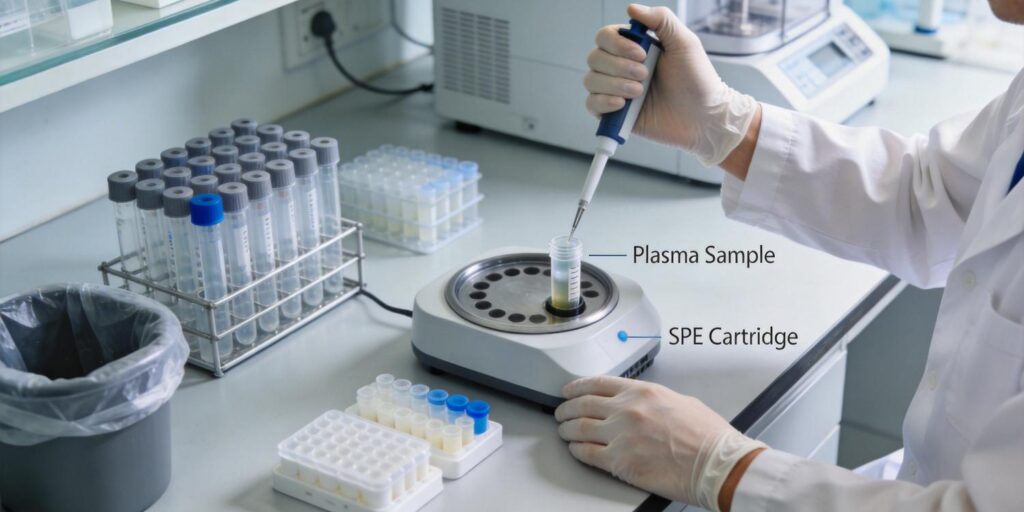
Here is a practical workflow using Poseidon Scientific WCX cartridges for plasma peptide biomarker extraction:
- Sample preparation: Dilute 100 µL plasma with 400 µL of 20 mM ammonium acetate (pH 5.5). Vortex and centrifuge at 10,000×g for 10 min.
- Condition WCX cartridge: 1 mL methanol, then 2 mL 50 mM ammonium acetate (pH 5.5).
- Load sample: Apply the supernatant at 1 mL/min.
- Wash: 1 mL loading buffer, then 1 mL 20% methanol in loading buffer.
- Elute: 2 × 0.5 mL of 5% ammonia in methanol. Combine eluates.
- Evaporate: Dry under nitrogen at 40°C.
- Reconstitute: 100 µL of 0.1% formic acid in 5% acetonitrile.
- Analyze by LC-MS/MS: Use a C18 column with a gradient of 5–35% acetonitrile in 0.1% formic acid over 30 min.
This workflow provides high recovery of positively charged peptide biomarkers while minimizing phospholipid carryover and salt contamination, enhancing sensitivity in discovery-phase studies.
For more product details, please refer to our full SPE portfolio at HLB, MAX, MCX, WAX, and 96-well plate formats.