SPE Method for Detecting Pharmaceutical Residues in Drinking Water
1. Pharmaceutical Contamination in Drinking Water Sources
Pharmaceutical residues in drinking water have emerged as a significant environmental and public health concern. Traces of antibiotics, analgesics, hormones, and antidepressants are commonly detected in surface water, groundwater, and even treated tap water. These compounds enter water bodies through wastewater effluent, agricultural runoff, and improper disposal of unused medications. Even at low concentrations (ng/L to μg/L), chronic exposure may pose risks to human health and aquatic ecosystems. Reliable detection methods are essential for regulatory compliance and risk assessment.
2. Sample Collection and Preservation
Proper sample collection is critical for accurate analysis. Collect water samples in amber glass bottles (pre-cleaned with acid and solvent) to prevent photodegradation and adsorption. Add a preservative such as 0.1% (v/v) formic acid or ascorbic acid (0.1 g/L) to stabilize target analytes. Samples should be filtered through 0.45 μm glass fiber filters to remove particulate matter, then stored at 4°C and processed within 48 hours. For longer storage, freeze at -20°C.
3. SPE Sorbent Selection for Trace Drugs
Selecting the right solid-phase extraction (SPE) sorbent is crucial for achieving high recovery and low detection limits. For multi-residue analysis of neutral, acidic, and basic pharmaceuticals, mixed-mode sorbents like HLB (Hydrophilic-Lipophilic Balance) or MAX (Mixed-mode Anion eXchange) are recommended. HLB offers a broad pH tolerance and retains a wide polarity range. For acidic compounds, WAX (Weak Anion eXchange) provides enhanced retention. Cationic drugs respond well to WCX (Weak Cation eXchange) sorbents. The choice depends on the target analyte list.
4. Conditioning and Loading Protocols
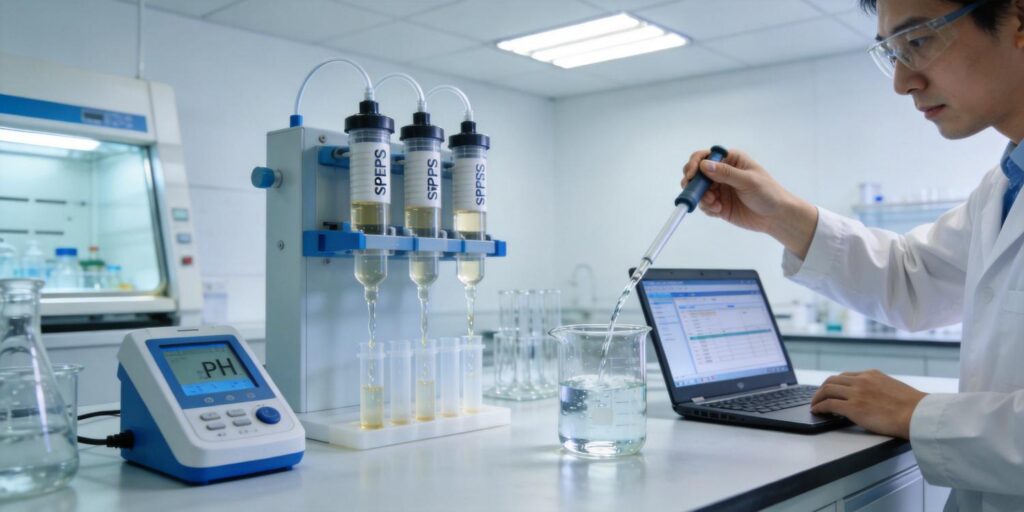
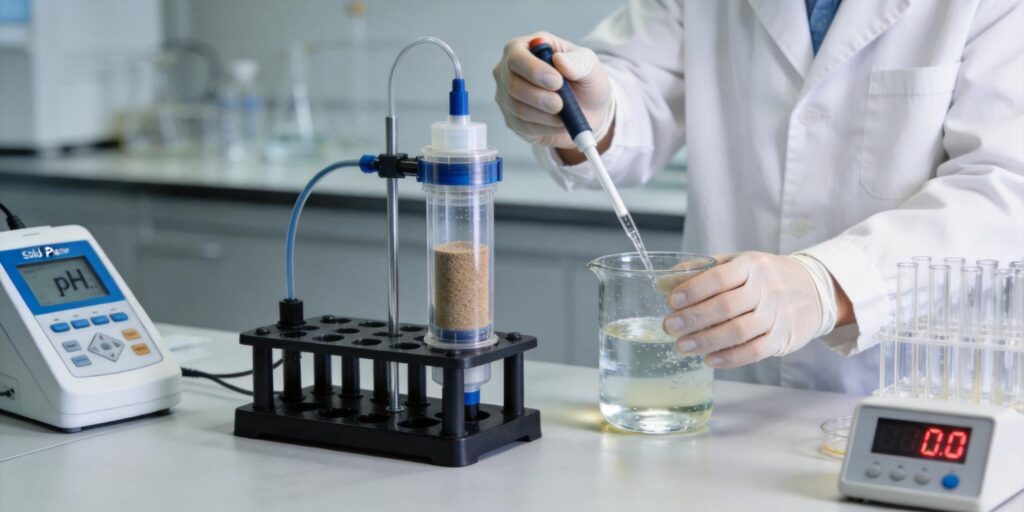
Standard conditioning for HLB cartridges: 3 mL methanol, 3 mL deionized water, and 3 mL buffer (pH 2–7). For MAX, use 3 mL methanol, 3 mL water, 3 mL 5% ammonium hydroxide. Load sample at a flow rate of 1–5 mL/min under vacuum. For trace levels, load up to 1 L of water per cartridge to achieve enrichment factors of 1000×. Avoid exceeding the sorbent capacity (typically 10–50 mg per 200 mg cartridge).
5. Washing Steps Minimizing Matrix Effects
After loading, wash the cartridge with 5–10 mL of 5% methanol in water to remove salts and polar interferences. For mixed-mode sorbents, a mid-polarity wash (e.g., 40% methanol) can reduce humic acid carryover without eluting target analytes. Matrix effects in LC-MS/MS are minimized by keeping wash volumes low and using volatile buffers.
6. Elution Solvent Combinations
Efficient elution requires a solvent that disrupts both hydrophobic and ionic interactions. For HLB: 2× 2 mL methanol (for neutrals) or 2 mL 0.1% formic acid in methanol (for acids). For MAX: 2 mL 2% formic acid in methanol. For WCX: 2 mL 5% ammonium hydroxide in methanol. For MCX (Mixed-mode Cation eXchange), use 2 mL 5% ammonium hydroxide in methanol. Collect eluate, evaporate under nitrogen at 40°C, and reconstitute in mobile phase (e.g., 100 μL 90:10 water/methanol).
7. LC-MS/MS Detection Workflow
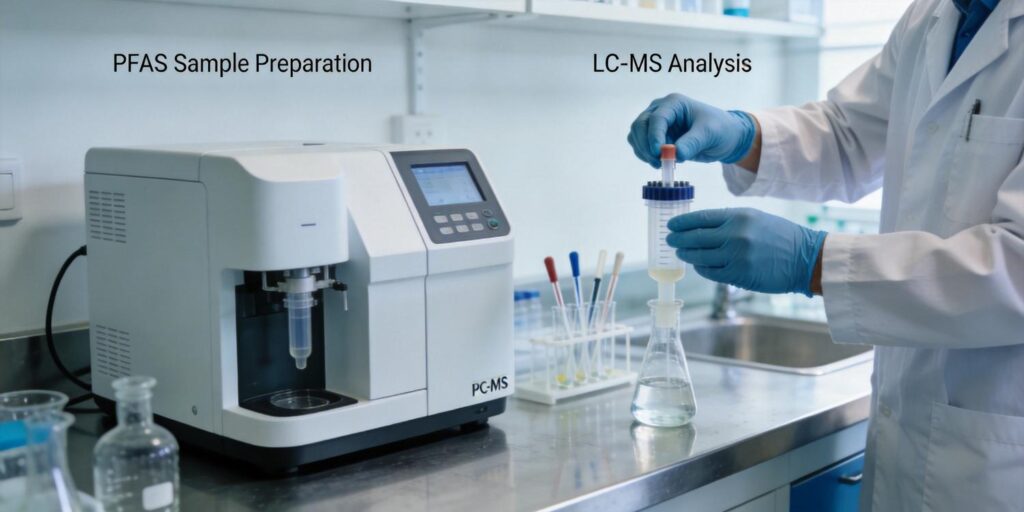
Analyze extracts using liquid chromatography coupled with tandem mass spectrometry (LC-MS/MS). Recommended column: C18 (2.1 × 50 mm, 1.7 μm). Gradient: 0–2 min, 5% B; 2–10 min, 5–95% B; hold 2 min; re-equilibrate. Mobile phase A: 0.1% formic acid in water; B: 0.1% formic acid in acetonitrile. Injection volume: 5–10 μL. Use positive/negative switching electrospray ionization. Quantify using internal standards (e.g., isotope-labeled analogs) to correct for ion suppression.
8. Regulatory Monitoring Standards
Regulatory agencies such as the US EPA (Unregulated Contaminant Monitoring Rule, UCMR 5) and the EU Water Framework Directive list priority pharmaceuticals. The EPA Method 1694 uses HLB SPE for 74 pharmaceuticals. Method detection limits (MDLs) should be below 10 ng/L. Calibration curves over 0.1–100 ng/mL with R² > 0.99 are acceptable. Quality control includes matrix spikes, blanks, and duplicates. For high-throughput needs, 96-well SPE plates offer parallel processing.