Bioactive Peptides in Fermented Food Products
Fermented foods such as cheese, yogurt, kefir, kimchi, and soy sauce are rich sources of bioactive peptides—short amino acid sequences released during fermentation by microbial proteases. These peptides exhibit diverse health-promoting activities including antihypertensive, antioxidant, antimicrobial, and immunomodulatory effects. However, isolating these peptides from complex food matrices poses significant analytical challenges due to the presence of proteins, lipids, salts, and sugars that interfere with downstream analysis and quantification.
Extraction of Peptides from Food Matrices
The first step in peptide analysis is efficient extraction. Common methods include acid precipitation (e.g., 0.1% trifluoroacetic acid, TFA), ethanol precipitation, or ultrafiltration to remove large proteins. For lipid-rich samples like cheese, defatting with hexane or diethyl ether is essential. The resulting crude extract is then centrifuged and filtered through 0.22 μm membranes to obtain a clarified peptide solution ready for solid-phase extraction (SPE).
SPE Sorbent Selection for Peptide Purification
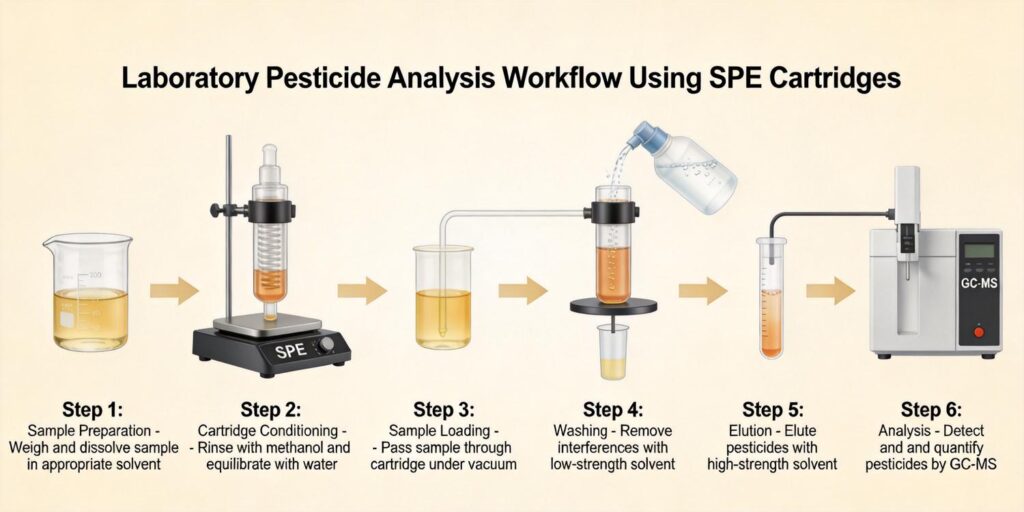
Choosing the right SPE sorbent is critical for selective peptide enrichment. Reversed-phase (RP) sorbents such as C18 are the most widely used, offering high retention of hydrophobic peptides via non-polar interactions. For more polar or small hydrophilic peptides, mixed-mode sorbents like MCX (mixed-mode strong cation exchange) or MAX (mixed-mode strong anion exchange) provide orthogonal selectivity. For targeted isolation of specific peptide classes, weak cation exchange (WCX) or weak anion exchange (WAX) phases can be employed. Our HLB SPE cartridges are particularly suited for broad-spectrum peptide recovery, balancing retention of both polar and non-polar peptides.
Conditioning and Loading Steps
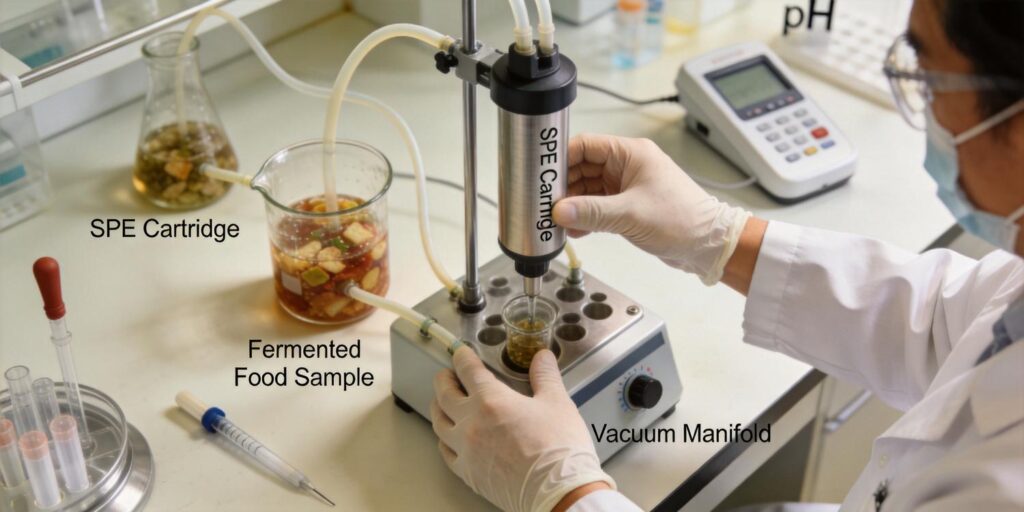
Proper conditioning is essential for reproducible results. For C18 cartridges, condition with 2–3 bed volumes of methanol followed by 0.1% TFA in water. For MCX or WCX, activate with 0.1% formic acid in methanol followed by acidified water. Load the peptide extract at a pH that maximizes retention—typically acidic (pH 2–3) for cation exchange or neutral for reversed-phase. Flow rate should be kept at ~1 mL/min to ensure efficient binding without breakthrough.
Washing to Remove Salts and Sugars
After loading, a washing step with 0.1% TFA in water (for RP) or 5% methanol in water (for mixed-mode) removes non-retained matrix components. For samples high in sugars (e.g., yogurt), include a 10% acetonitrile wash to elute polar sugars while retaining peptides. Salts can be efficiently washed with water containing 0.1% formic acid. Avoid using high organic content in wash buffers to prevent premature peptide elution.
Elution Solvents for Peptide Recovery
Elution conditions depend on sorbent chemistry. For C18, a step gradient of 20–80% acetonitrile/water with 0.1% TFA is typical. For cation exchange phases (MCX, WCX), elute with 5% ammonium hydroxide in methanol to neutralize the charge. For anion exchange (MAX, WAX), use 5% formic acid in methanol. Fractionation can be achieved by collecting multiple eluates, which simplifies downstream analysis by reducing sample complexity.
LC-MS/MS Peptide Analysis
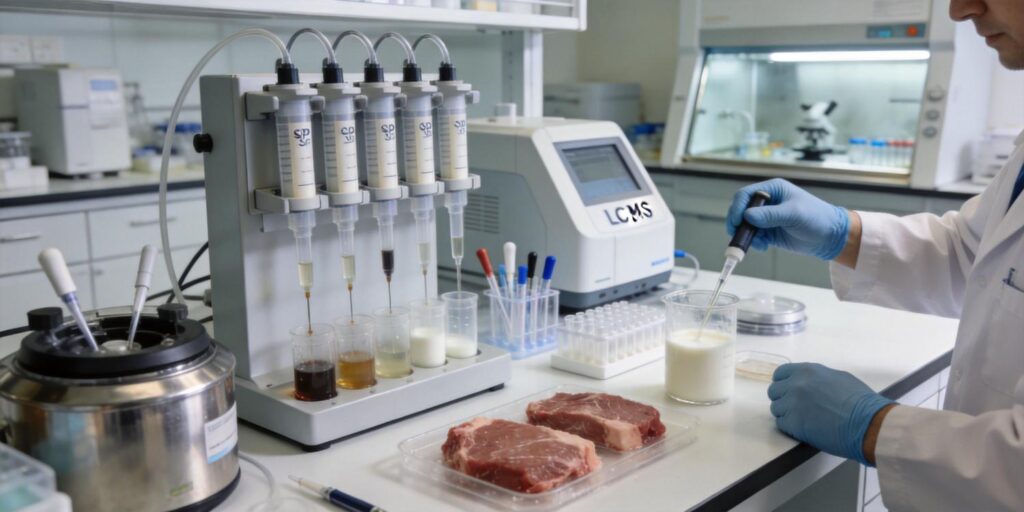
SPE-purified peptides are ideally suited for liquid chromatography-tandem mass spectrometry (LC-MS/MS). A C18 analytical column (e.g., 2.1 × 100 mm, 1.7 μm) with a water/acetonitrile gradient containing 0.1% formic acid provides high-resolution separation. Data-dependent acquisition (DDA) or targeted multiple reaction monitoring (MRM) can quantify specific peptides. For high-throughput screening, 96-well SPE plates enable parallel purification of up to 96 samples, drastically reducing preparation time.
Application in Functional Food Research
The described SPE workflow is widely adopted in functional food research. For example, angiotensin-converting enzyme (ACE) inhibitory peptides from fermented milk are often isolated using C18 SPE followed by LC-MS/MS identification. Similarly, antioxidant peptides from soybean paste can be enriched using MCX to remove interfering amino acids. The use of mixed-mode sorbents allows for selective enrichment of post-translationally modified peptides, such as phosphorylated or glycosylated species, which are of growing interest in nutraceutical development. By integrating robust SPE methods with sensitive MS detection, researchers can accelerate the discovery of novel bioactive peptides with potential health benefits.