Textile Dye Pollution in Industrial Wastewater
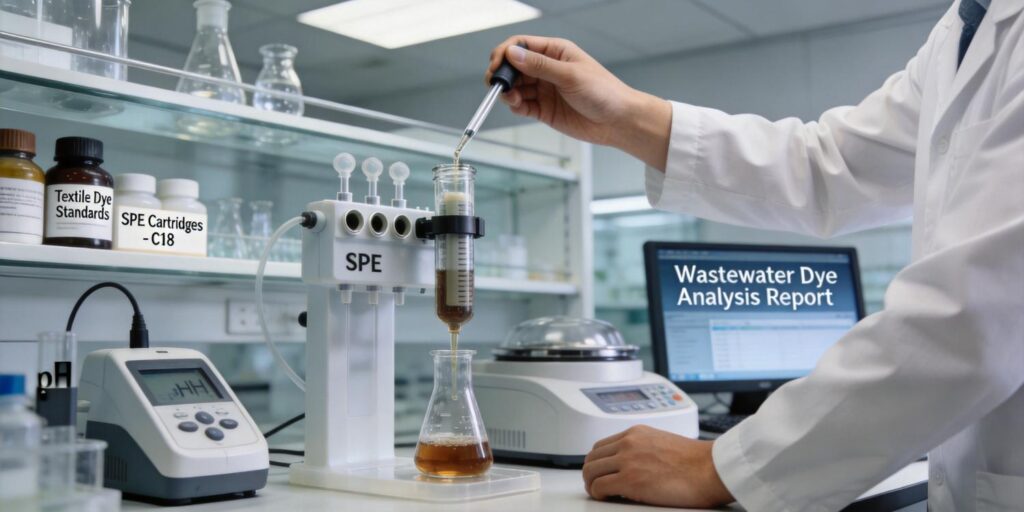
The textile industry is one of the largest consumers of water, generating massive volumes of wastewater contaminated with synthetic dyes. These dyes are designed to resist degradation, leading to persistent environmental pollution. Many dye compounds are toxic, mutagenic, and carcinogenic, posing serious risks to aquatic ecosystems and human health. Regulations such as the EU Water Framework Directive and the US Clean Water Act enforce strict discharge limits, driving the need for reliable analytical methods. Solid-phase extraction (SPE) has emerged as a gold-standard sample preparation technique for isolating and concentrating dye compounds from complex wastewater matrices before instrumental analysis.
Sample Filtration and pH Adjustment
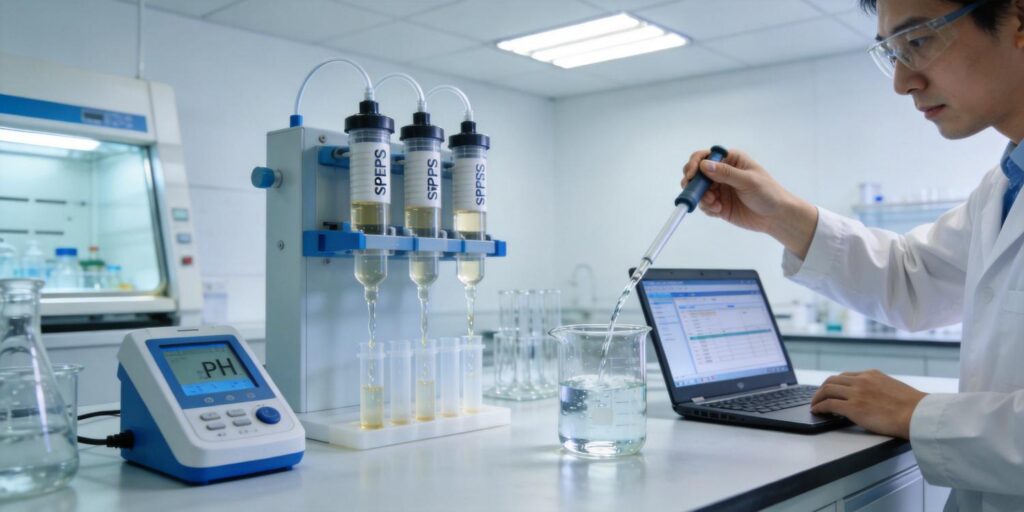
Raw textile wastewater is heterogeneous, containing suspended solids, fibers, and particulate matter. Filtration through 0.45 μm or 0.22 μm membrane filters (e.g., PTFE or PES) is essential to prevent clogging of SPE cartridges and downstream instruments. Following filtration, pH adjustment is critical. Most anionic dyes (acid, reactive, direct) are best retained under acidic conditions (pH 2–4), while cationic dyes (basic) require neutral to alkaline conditions (pH 7–10). Adjusting pH with HCl or NaOH enhances analyte-sorbent interactions and improves recovery.
SPE Sorbent Selection for Dye Compounds
The choice of SPE sorbent depends on the dye’s polarity and ionic character. For a broad range of anionic and neutral dyes, HLB (Hydrophilic-Lipophilic Balance) cartridges offer balanced retention via reversed-phase and water-wettable properties. MAX (Mixed-Mode Anion Exchange) cartridges are ideal for acidic dyes (e.g., sulfonated azo dyes), providing both reversed-phase and strong anion-exchange interactions. MCX (Mixed-Mode Cation Exchange) cartridges effectively retain basic dyes (e.g., methylene blue, malachite green). For hydrophobic dyes, WAX (Weak Anion Exchange) or WCX (Weak Cation Exchange) sorbents can be tailored for pH-controlled selectivity. High-throughput applications may utilize 96-well SPE plates for parallel processing.
Conditioning and Loading Wastewater Samples
Conditioning activates the sorbent surface. For HLB, sequentially wet with methanol and equilibrate with water or buffer at the sample pH. For MAX, condition with methanol followed by pH-adjusted water (e.g., pH 2–4 for anionic dyes). Load the filtered, pH-adjusted wastewater sample at a controlled flow rate (1–2 mL/min) to ensure optimal retention. Excessive flow rates reduce breakthrough volumes; for large volumes (100–500 mL), use cartridges with higher sorbent mass (e.g., 500 mg or 1 g).
Washing Strategies Removing Salts and Organics
After loading, a washing step removes interferences. For HLB cartridges, wash with 5% methanol in water to elute salts and polar co-extractives without losing target dyes. For MAX or MCX, use pH-adjusted wash solutions (e.g., pH 2 water for MAX) to maintain ionic interactions while washing away neutral organic contaminants. Aqueous washes with 2–5% methanol are common; higher organic content risks premature elution of dyes. For dirty industrial samples, a hexane wash can remove nonpolar lipids and oils.
Elution Solvents for Dyes
Elution disrupts the sorbent-dye interaction. For HLB, pure methanol or acetonitrile typically yields >90% recovery for many dyes. For MAX, use acidified methanol (e.g., 2% formic acid in methanol) to neutralize anion-exchange retention. For MCX, basic methanol (e.g., 5% ammonium hydroxide in methanol) effectively elutes cationic dyes. Elution volume is usually 1–3 mL for 60–200 mg cartridges; larger volumes may be evaporated and reconstituted for increased sensitivity.
HPLC or LC-MS Analysis
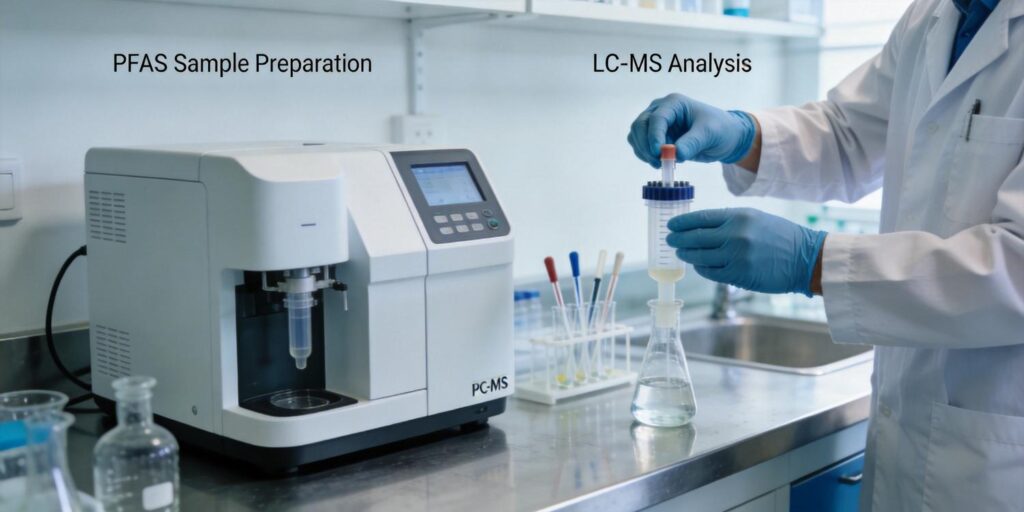
Post-SPE extracts are analyzed by HPLC with UV-Vis detection (diode array) for screening, or LC-MS/MS for quantification and confirmation. C18 reversed-phase columns (e.g., 2.1 × 50 mm, 1.7 μm) with acidic mobile phases (0.1% formic acid in water/acetonitrile) are standard. Multiple reaction monitoring (MRM) provides selectivity for complex wastewater matrices. Internal standards (e.g., deuterated dye analogs) correct for matrix effects and SPE recovery variations.
Environmental Monitoring Applications
SPE-based methods enable compliance monitoring of industrial effluent limits. They are used to track azo dyes, triphenylmethane dyes (malachite green), and anthraquinone dyes in river water, groundwater, and treated wastewater. The HLB SPE cartridges from Poseidon Scientific have been validated for multi-residue dye analysis, achieving detection limits below 0.1 μg/L. Regular monitoring supports pollution prevention and the development of advanced treatment technologies like adsorption and advanced oxidation processes (AOPs).
Summary of SPE Protocol for Dyes
| Step | Details |
|---|---|
| Sample prep | Filter (0.45 μm), adjust pH |
| Sorbent | HLB, MAX, MCX, WAX, or WCX |
| Condition | Methanol, then pH-adjusted water |
| Load | 1–2 mL/min, up to 500 mL |
| Wash | 5% MeOH in water or pH-adjusted |
| Elute | Methanol (+ acid/base) |
| Analysis | HPLC-UV or LC-MS/MS |
For optimal results, always spike surrogate standards to monitor method performance. Customize sorbent and solvent choices based on the specific dye classes in your wastewater. Consult Poseidon Scientific’s technical team for tailored recommendations and high-throughput SPE plate solutions.