Challenges of Lipid-Rich Food Matrices
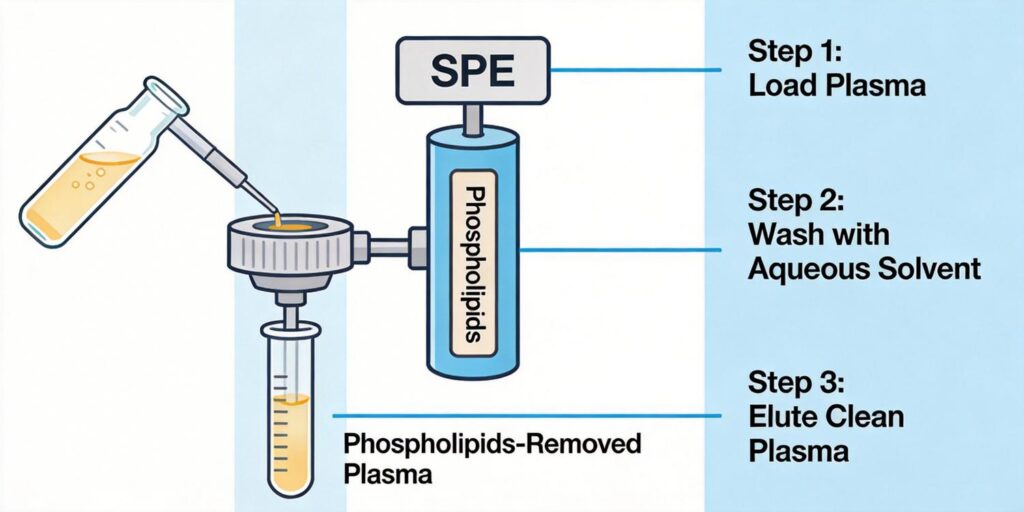
Fat-rich food samples such as oils, butter, cheese, nuts, and fatty meats present significant challenges for LC-MS analysis. The high lipid content, primarily triglycerides, can cause ion suppression, column fouling, and poor reproducibility. Lipids co-extract with target analytes during sample preparation, leading to matrix effects that compromise sensitivity and accuracy. Effective cleanup is essential to remove these interferences while retaining analytes of interest.
Extraction Procedures for Fat-Rich Samples
Initial extraction typically involves solvent-based methods like QuEChERS or liquid-liquid extraction using acetonitrile or ethyl acetate. For oil samples, dilution with hexane or isopropanol helps reduce viscosity. After extraction, the crude extract contains significant lipid co-extractives that must be removed before LC-MS injection. Common approaches include low-temperature precipitation, freezing out lipids, or passing through SPE cartridges for cleanup.
SPE Sorbent Selection for Lipid Removal
For lipid-rich matrices, sorbent choice is critical. Reversed-phase sorbents like C18 retain non-polar lipids but may also trap non-polar analytes. Mixed-mode sorbents offer orthogonal selectivity: HLB (Hydrophilic-Lipophilic Balanced) cartridges provide balanced retention of polar and non-polar compounds while allowing lipid elution in organic solvents. Alternatively, MAX (Mixed-Mode Anion Exchange) or MCX (Mixed-Mode Cation Exchange) can target specific analytes while washing away neutral lipids. Zirconia-based sorbents (e.g., WAX) also exhibit strong lipid retention under certain conditions.
Conditioning and Loading Extracts
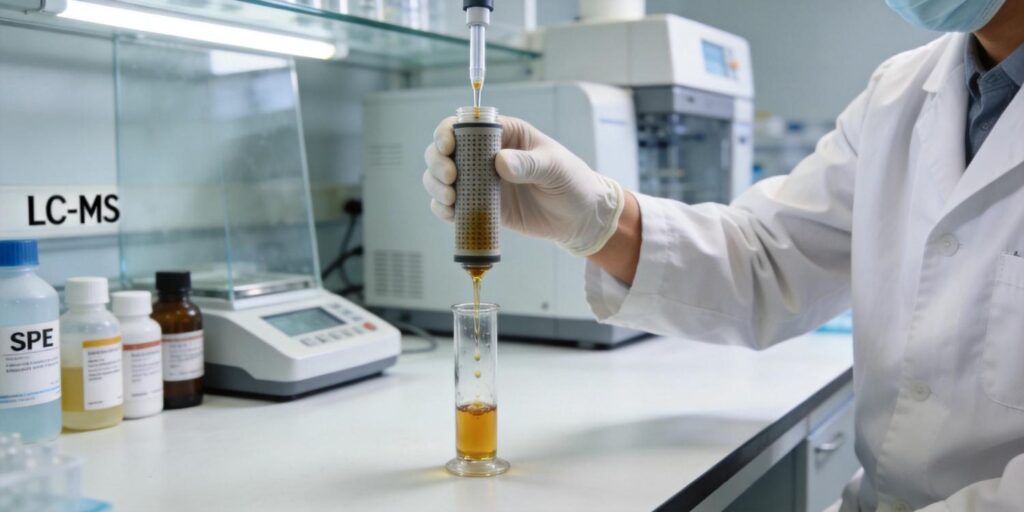
Proper conditioning ensures reproducible interactions. For a generic protocol, condition the SPE cartridge with methanol followed by water or the loading solvent. Load the extract (e.g., acetonitrile extract diluted with water to <30% organic) to promote analyte retention while lipids pass through or are later washed. For lipid-rich samples, loading at slow flow rates (<1 mL/min) prevents channeling and improves recovery.
Washing Steps Removing Triglycerides
A critical step is washing with a solvent that selectively removes triglycerides without eluting target analytes. Typically, a high organic solvent like hexane or 100% acetonitrile can wash away non-polar lipids from reversed-phase or mixed-mode sorbents. For example, on HLB cartridges, a wash with 1 mL of hexane effectively removes triglycerides while retaining polar analytes. On ion-exchange sorbents, a neutral wash (e.g., 5% methanol in water) retains ionic analytes before elution.
Elution Solvents Compatible with LC-MS
Elution should use solvents that are compatible with LC-MS, typically methanol, acetonitrile, or their mixtures with volatile additives (e.g., 0.1% formic acid). For bases, use acidic methanol; for acids, use basic methanol (e.g., 5% NH4OH in methanol). Volume should be sufficient (1-2 mL) to ensure complete recovery. Eluates can be evaporated and reconstituted if needed, but direct injection is possible if the solvent matches the mobile phase.
Analytical Method Performance Improvements
Effective SPE cleanup reduces matrix effects, leading to better accuracy (recovery 85-115%), precision (RSD 50% to <10%. In aflatoxin analysis in peanut butter, MCX cleanup removes fatty acids and improves signal stability. 96-well SPE plates can also be used for high-throughput workflows.
Application Examples in Food Safety Labs
In regulatory labs, SPE cleanup of fat-rich samples is standard. Examples include:
– Pesticides in avocado: QuEChERS extract cleaned on HLB, wash with hexane, elute with acetonitrile. Achieves recovery >90% for 200 pesticides.
– Mycotoxins in corn oil: Dilute with hexane, load on MAX, wash with hexane, elute with 2% formic acid in methanol. Removes >99% triglycerides.
– Veterinary drugs in cheese: Extract with EDTA-acetonitrile, cleanup on MCX, elute with 5% ammonium hydroxide in methanol. Eliminates lipid-based ion suppression.
These protocols are widely adopted due to robustness and compatibility with LC-MS systems.