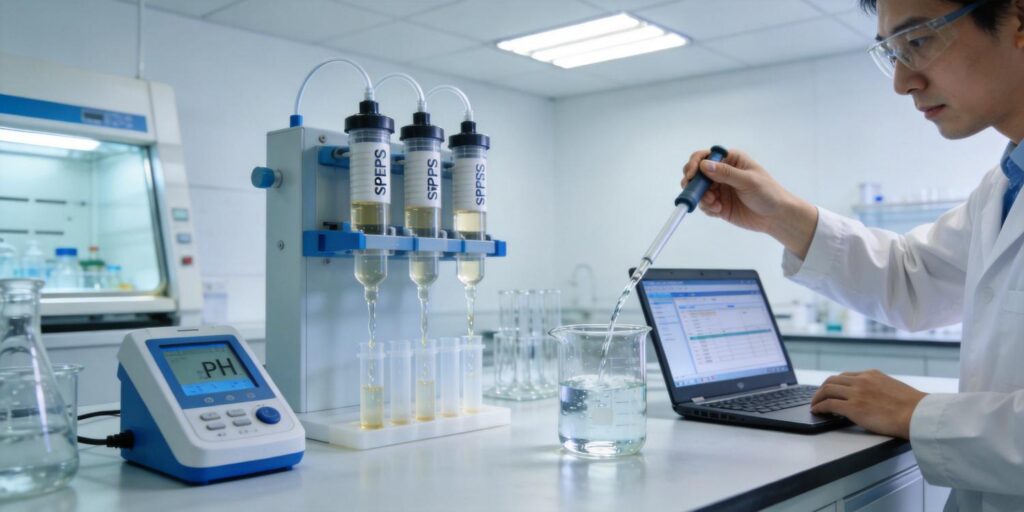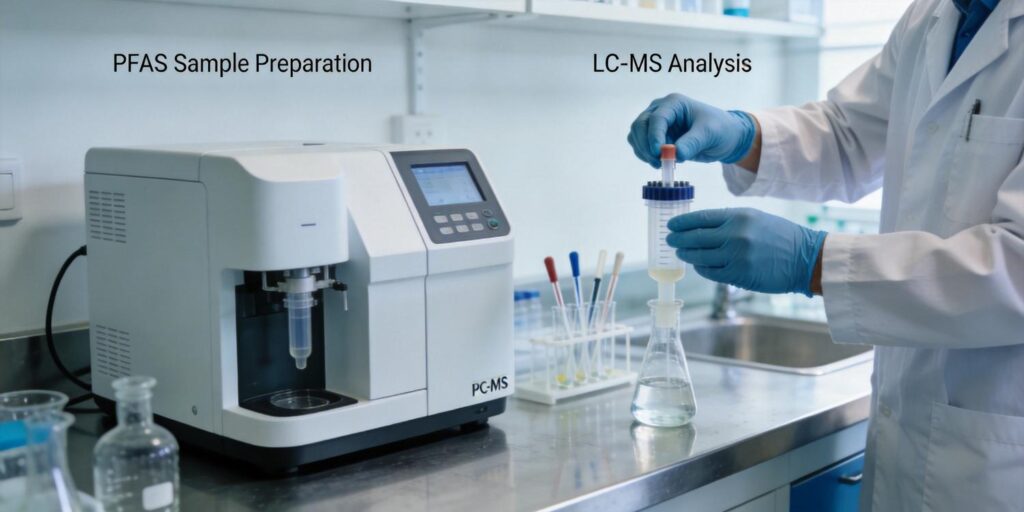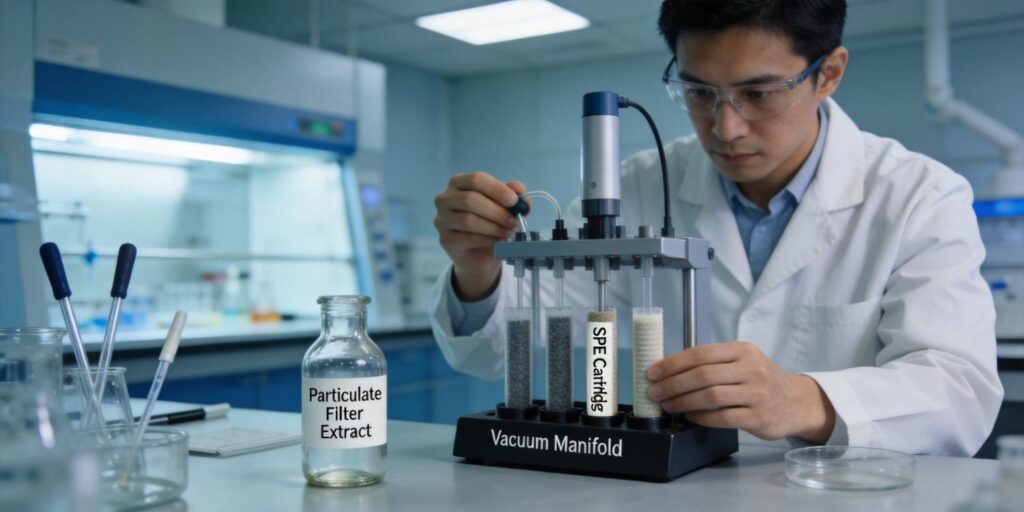
Airborne particulate matter (PM) is a complex matrix containing a wide range of organic contaminants, including polycyclic aromatic hydrocarbons (PAHs) and volatile organic compound (VOC) derivatives. Solid-phase extraction (SPE) has become a routine technique for isolating these analytes prior to gas chromatography-mass spectrometry (GC-MS) analysis. This blog covers a complete workflow: from filter collection to SPE method optimization and final detection.
1. Collection of Airborne Particulate Matter on Filters
Air samples are typically collected using high-volume samplers that draw ambient air through quartz fiber filters (QFFs) or glass fiber filters (GFFs). QFFs are preferred for organic analysis because they can withstand high-temperature treatment to reduce background contamination. Sampling times range from 24 to 72 hours, depending on the expected concentration levels. After collection, filters are stored in pre-cleaned aluminum foil or glass containers at −20°C to minimize analyte degradation.
2. Extraction of Organic Contaminants from Filters
Before SPE, the adsorbed organic compounds must be transferred into a liquid phase. The most common technique is pressurized liquid extraction (PLE) using a mixture of dichloromethane (DCM) and acetone (1:1, v/v) at 100°C and 1500 psi. Alternative methods include Soxhlet extraction with hexane/acetone (3:1) for 18–24 hours, or ultrasonication with DCM/methanol. The extract is then concentrated under a gentle nitrogen stream and reconstituted in a suitable solvent (e.g., hexane) for SPE loading.
3. SPE Sorbent Selection for PAHs and VOC Derivatives
For nonpolar to moderately polar organic contaminants, reversed-phase SPE sorbents such as C18 or HLB (hydrophilic-lipophilic balance) cartridges are widely used. HLB provides better retention for a broader polarity range. For selective isolation of PAHs, WAX (weak anion exchange) or WCX (weak cation exchange) sorbents are rarely used unless targeting specific acidic/basic derivatives. The MAX (mixed-mode strong anion exchange) and MCX (mixed-mode strong cation exchange) sorbents are ideal for extracting ionic VOC metabolites. For high-throughput analysis, 96-well SPE plates offer parallel processing of multiple samples.
4. Conditioning and Loading Filter Extracts
SPE cartridges must be conditioned with a solvent compatible with the sample matrix. For reversed-phase sorbents, common conditioning steps include 3 mL of methanol followed by 3 mL of deionized water or hexane. The filter extract (typically in 1–2 mL of hexane or DCM) is loaded at a flow rate of 1–2 mL/min. It is critical to avoid overloading the sorbent bed; for PAH analysis, a 200 mg sorbent bed is usually sufficient for extracts from ~100 m³ of air.
5. Washing Procedures Removing Particulates
After loading, a washing step removes unwanted matrix components such as elemental carbon, humic-like substances, and salts. For PAHs, a typical wash uses 5% methanol in water (v/v) to eliminate polar interferences without eluting target analytes. For VOC derivatives, a higher organic content (e.g., 20% methanol) may be used. The wash volume is generally 2–3 bed volumes. Ensuring complete removal of fine particulates is crucial; an additional filtration step (0.45 μm PTFE syringe filter) can be inserted before SPE if the extract appears cloudy.
6. Elution Solvents for Organic Analytes
Elution is performed with a solvent that disrupts the analyte–sorbent interaction. For PAHs retained on HLB or C18, 2–5 mL of DCM or hexane/ethyl acetate (1:1) yields recoveries >90%. For acidic/basic derivatives from mixed-mode sorbents, use 2% formic acid in methanol (for MCX) or 5% ammonium hydroxide in methanol (for MAX). The eluate is collected in a glass vial and evaporated to near dryness under a gentle nitrogen stream, then reconstituted in 100–500 μL of an appropriate injection solvent (e.g., isooctane for PAHs).
7. GC-MS Detection Workflow
The final extract is analyzed by GC-MS using a capillary column (e.g., 30 m × 0.25 mm × 0.25 μm 5% phenyl-methylpolysiloxane). The temperature program typically starts at 60°C (hold 2 min), ramps to 300°C at 5°C/min, and holds for 10 min. Helium carrier gas at 1.0 mL/min is common. Mass spectra are acquired in full-scan mode (m/z 50–500) for nontarget screening or selected ion monitoring (SIM) for quantification. Internal standards (e.g., deuterated PAHs) should be added before extraction to correct for losses.
8. Environmental Monitoring Applications
This SPE-GC-MS workflow is applied in ambient air monitoring networks (e.g., PM2.5 speciation), source apportionment studies, and occupational hygiene assessments. Recent studies have used the method to detect trace levels of nitrated PAHs and oxygenated VOC derivatives at concentrations as low as 0.1 ng/m³. The versatility of SPE sorbent selection allows adaptation to emerging contaminants such as organophosphate esters or phthalates. For more information on selecting the right SPE product for your application, visit the Poseidon Scientific product range or contact our technical support team.