Introduction
The widespread use of antidepressants—particularly selective serotonin reuptake inhibitors (SSRIs) and serotonin-norepinephrine reuptake inhibitors (SNRIs)—has led to their ubiquitous detection in municipal wastewater. These compounds, often only partially metabolized in the human body, are excreted as parent drugs and active metabolites, entering wastewater treatment plants (WWTPs) through domestic sewage. Despite treatment processes, many antidepressants persist at trace levels (ng/L to μg/L) in effluent and receiving waters, raising concerns about aquatic ecotoxicity and potential human health impacts. Robust analytical methods are essential for monitoring these contaminants, and solid-phase extraction (SPE) with hydrophilic-lipophilic balance (HLB) cartridges has emerged as the gold standard for sample preparation. This blog outlines a validated workflow using HLB SPE cartridges for quantifying antidepressants in wastewater matrices.
1. Environmental Occurrence of Antidepressants in Wastewater
SSRIs (e.g., fluoxetine, sertraline, citalopram) and SNRIs (e.g., venlafaxine, duloxetine) are among the most prescribed psychotropic drugs globally. Their physicochemical properties—moderate polarity (log Kow 1.5–4.5), basic pKa values (8–10), and low volatility—make them amenable to SPE extraction. Studies have reported concentration ranges in influent wastewater from <50 ng/L to over 1000 ng/L, with venlafaxine often dominating. Efficient extraction across a broad polarity spectrum is critical, and HLB SPE cartridges provide the necessary wettability and retention for both neutral and ionic forms.
2. Sample Collection, Filtration, and Preservation
Grab or 24-hour composite samples are collected in amber glass bottles to prevent photodegradation. Immediate filtration is performed using pre-ashed glass fiber filters (GF/F, 0.7 μm) to remove suspended solids. Samples must be preserved: acidification to pH 2–3 (e.g., with HCl or H₂SO₄) stabilizes basic antidepressants and minimizes biodegradation; storage at 4°C for ≤48 hours or at −20°C for longer periods is recommended. Alternatively, sodium azide (1 g/L) can be added as a biocide. Filtration before SPE prevents clogging of the cartridge.
3. Why HLB Polymeric SPE?
HLB (Hydrophilic-Lipophilic Balanced) copolymers, composed of N-vinylpyrrolidone and divinylbenzene, offer a unique dual retention mechanism: the hydrophilic monomer attracts moderately polar analytes, while the lipophilic monomer retains nonpolar compounds. This makes HLB SPE cartridges ideal for antidepressants spanning a moderate polarity range. Compared to traditional C18 sorbents, HLB provides higher capacity for polar metabolites and better batch-to-batch reproducibility. Additionally, the polymeric sorbent is stable from pH 0–14, allowing aggressive washing and elution conditions.
4. Cartridge Conditioning
Proper conditioning ensures a clean, wetable sorbent surface. For HLB cartridges (e.g., 200 mg, 6 mL), the sequence is: 1) 2–3 mL methanol; 2) 2–3 mL HPLC-grade water. It is critical not to let the cartridge dry between conditioning and sample loading. Methanol activates the sorbent by solvating the polymer, while water establishes the aqueous environment for analyte retention. Some protocols add a buffer (e.g., 10 mM ammonium acetate, pH 7) instead of pure water to match sample pH.
5. Loading Large-Volume Wastewater Samples
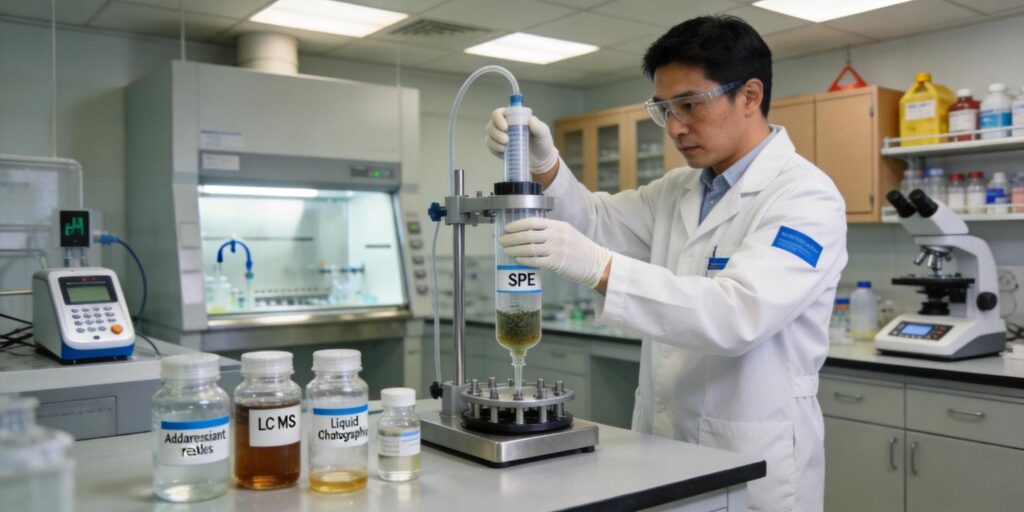
Wastewater volumes of 500–1000 mL are typically loaded to achieve low ng/L detection limits. A flow rate of 5–10 mL/min is recommended using vacuum manifold or positive pressure. Larger volumes demand cartridge capacities: a 200 mg HLB cartridge can retain up to ~50 mg of total organic matter; for heavily loaded samples, 500 mg cartridges (6 or 12 mL) are preferable. The breakthrough volume for moderately polar antidepressants is generally >1000 mL, but it should be verified using spiked samples. If the sample contains high suspended solids, pre-filtration or centrifugation is mandatory.
6. Washing Procedures to Reduce Matrix Interferences
Wastewater contains abundant humic substances, fulvic acids, and other organic matter that co-extract and cause ion suppression in LC-MS/MS. A gentle wash with 5% methanol in water (v/v) effectively removes these interferences without eluting target analytes. Some methods use a pH-adjusted wash (e.g., 2% formic acid in water) to protonate basic compounds and reduce interactions with humics. The wash volume is typically 2–5 mL. Overly aggressive washing (e.g., >30% methanol) may cause premature elution of antidepressants.
7. Elution Using Methanol or Methanol/Ammonium Hydroxide
Elution is performed with a solvent that disrupts both hydrophobic and hydrogen-bonding interactions. Methanol (2 × 2 mL for 200 mg cartridge) is the most common eluent. For basic antidepressants (pKa > 8), adding 0.1–0.5% ammonium hydroxide (NH₄OH) to methanol improves recovery by deprotonating the analytes, making them neutral and more soluble. The eluate is collected, evaporated to dryness under nitrogen at 35–40°C, and reconstituted in 200–500 μL of mobile phase (e.g., 20:80 methanol:water with 0.1% formic acid). If further clean-up is required, the MCX SPE cartridges (mixed-mode cation exchange) can be used after HLB for additional selectivity.
8. LC-MS/MS Quantification and Method Validation
Analytical separation is typically performed on a C18 reversed-phase column (e.g., 2.1 × 50 mm, 1.7 μm) with a mobile phase gradient of (A) 0.1% formic acid in water and (B) 0.1% formic acid in methanol or acetonitrile. Detection uses triple quadrupole MS in positive electrospray ionization (ESI+) mode with multiple reaction monitoring (MRM). Method validation must include: linearity (r² > 0.99, 0.5–500 ng/mL), accuracy (recovery 70–120%), precision (RSD < 20%), limits of detection (LOD ≈ 0.1–1 ng/L) and quantification (LOQ ≈ 0.3–3 ng/L), and matrix effect evaluation via post-extraction spike. Internal standards (e.g., fluoxetine-d₆, venlafaxine-d₆) are essential to correct for matrix effects and volume fluctuations. Regular analysis of procedural blanks and duplicate samples ensures quality control.
Conclusion
HLB SPE, paired with LC-MS/MS, provides a reliable, sensitive, and reproducible platform for quantifying antidepressants in complex wastewater matrices. By carefully controlling each step—from sample preservation to elution—analysts can achieve robust data for environmental monitoring and risk assessment. For laboratories seeking high-throughput or alternative selectivity, Poseidon Scientific offers a full suite of SPE products, including MAX, WAX, WCX, and 96-well SPE plates, all designed to meet the evolving demands of environmental analysis.