Why Honey Monitoring for Antibiotics Matters
Honey is valued for its natural purity and health benefits. Yet, beekeeping practices sometimes introduce antibiotics to control bacterial diseases like American foulbrood. These compounds persist in honey and, even at trace levels, pose risks such as antimicrobial resistance and allergic reactions. Regulatory bodies worldwide, including the EU and FDA, enforce strict maximum residue limits (MRLs) for antibiotics in honey. Reliable analytical methods are essential to ensure compliance and consumer safety. Solid-phase extraction (SPE) offers a robust sample cleanup technique to isolate antibiotics from honey’s complex matrix, enabling sensitive LC-MS/MS quantification.
Sample Preparation Protocols: Dilution and Extraction
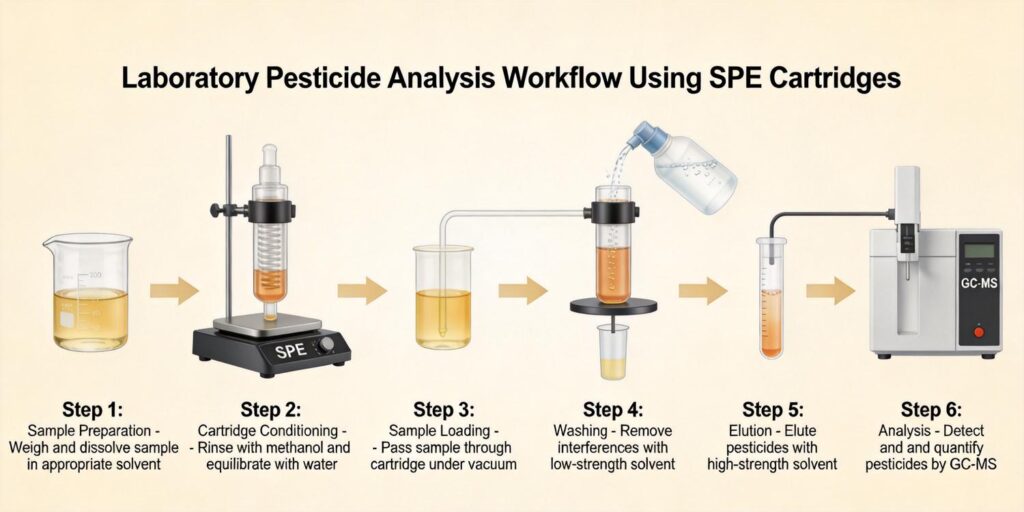
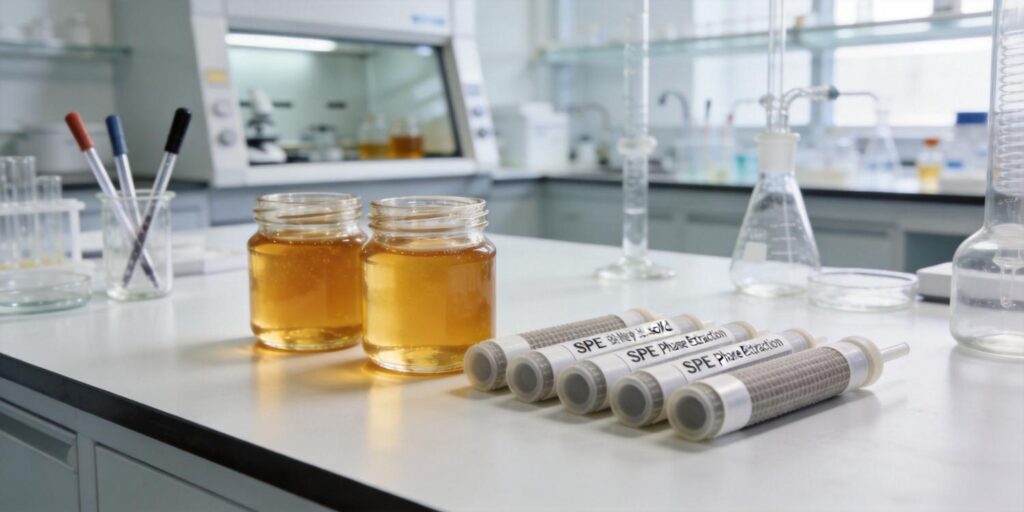
Honey consists of sugars (fructose, glucose), water, and minor components like waxes and pollen. To prepare samples, weigh 2–5 g of honey and dissolve in 10–20 mL of warm water or a buffer (e.g., 0.1 M phosphate buffer, pH 7) to reduce viscosity. Some methods include a liquid-liquid partition step with hexane to remove fatty residues, but direct SPE after dilution is common for multi-class antibiotics. The diluted honey solution is then filtered through a 0.45 μm syringe filter to avoid clogging the SPE cartridge.
Choosing the Right SPE Sorbent for Antibiotics
Antibiotics in honey include several classes: sulfonamides, tetracyclines, fluoroquinolones, macrolides, and aminoglycosides. They differ in polarity and acid-base behavior. Mixed-mode sorbents often outperform single-mode ones. MAX (mixed-mode anion exchange) cartridges retain acidic antibiotics like tetracyclines and fluoroquinolones at basic pH. MCX (mixed-mode cation exchange) cartridges trap basic compounds such as sulfonamides and macrolides at acidic pH. For broad-spectrum screening, a polymeric reversed-phase sorbent (like HLB) works well across all classes. Poseidon Scientific’s HLB SPE cartridges provide balanced retention for polar to mid-polar antibiotics, making them a versatile first choice.
Conditioning the Cartridge for Consistent Recovery
Proper conditioning activates the sorbent bed and ensures reproducible binding. For HLB cartridges, sequentially pass 3 mL of methanol (or acetonitrile) followed by 3 mL of water. For mixed-mode sorbents, use the same solvents but adjust pH to match the loading buffer. WAX cartridges require a low-conductivity conditioning step to ionize the weak anion exchanger. Do not let the cartridge dry out between conditioning and loading.
Loading and Washing: Removing Sugars and Waxes
Load the diluted honey sample onto the conditioned cartridge at a flow rate of 1–2 mL/min. Sugars, honey pigments, and natural waxes are weakly retained and can be washed away. Use 3–5 mL of 5% methanol in water (or pH-adjusted water) to elute interferences while antibiotics stay bound. For extra clean-up, follow with a 5% methanol in 0.1 M sodium acetate solution. Check the recovery of target analytes after wash optimization to avoid breakthrough.
Elution and LC-MS/MS Compatibility
Elute antibiotics with a small volume of organic solvent, typically 2–5 mL of methanol or acetonitrile containing 0.1–1% formic acid (for acidic analytes) or 5% ammonium hydroxide (for basic analytes). This yields a solution directly compatible with LC-MS/MS after evaporation and reconstitution. For multi-class methods, a two-step elution with increasing solvent strength can separate fractions. WCX cartridges offer weak cation exchange, suited for eluting strong bases with minimal matrix effects. Evaporate the eluate under nitrogen and reconstitute in 200–500 μL of mobile phase.
Analytical Validation Parameters
Method validation follows FDA guidelines. Key parameters include linearity (R² > 0.99 over 0.5–200 μg/kg), limits of detection (LOD) and quantification (LOQ) often below 1 μg/kg, recovery (70–120% across three spiking levels), precision (RSD < 20%), and matrix effect evaluation. Use isotope-labeled internal standards to correct for matrix-induced suppression or enhancement. A typical LC-MS/MS method runs on a C18 column with a water/acetonitrile gradient, monitoring two MRM transitions per compound.
Application in Food Safety Monitoring
The developed SPE-LC-MS/MS method is ideal for regulatory monitoring, export quality control, and supplier verification. It can detect more than 40 antibiotics from different classes in a single run. Laboratories conducting routine surveillance can scale up using 96-well SPE plates for high-throughput processing. This approach reduces solvent usage and analyst time while maintaining data quality. As honey trade becomes global, robust SPE methods ensure that products meet international safety standards and protect public health.
References
For further reading, see Journal of Agricultural and Food Chemistry (2019) 67(13), 3725–3733; Food Chemistry (2020) 310, 125897; and EU Commission Regulation (EU) No 37/2010.