Analytical Challenges of Viscous Pharmaceutical Syrups
Pharmaceutical syrups present significant analytical challenges due to their high viscosity, complex matrix composition, and the presence of sugars, flavoring agents, preservatives, and active pharmaceutical ingredients (APIs). These excipients can suppress ionization, clog columns, and cause matrix effects in LC-MS analysis. Direct injection often leads to poor reproducibility, reduced sensitivity, and rapid deterioration of chromatographic performance. Therefore, an efficient sample preparation method, such as solid-phase extraction (SPE), is essential to isolate APIs while removing interfering compounds.
Dilution and Extraction Procedures
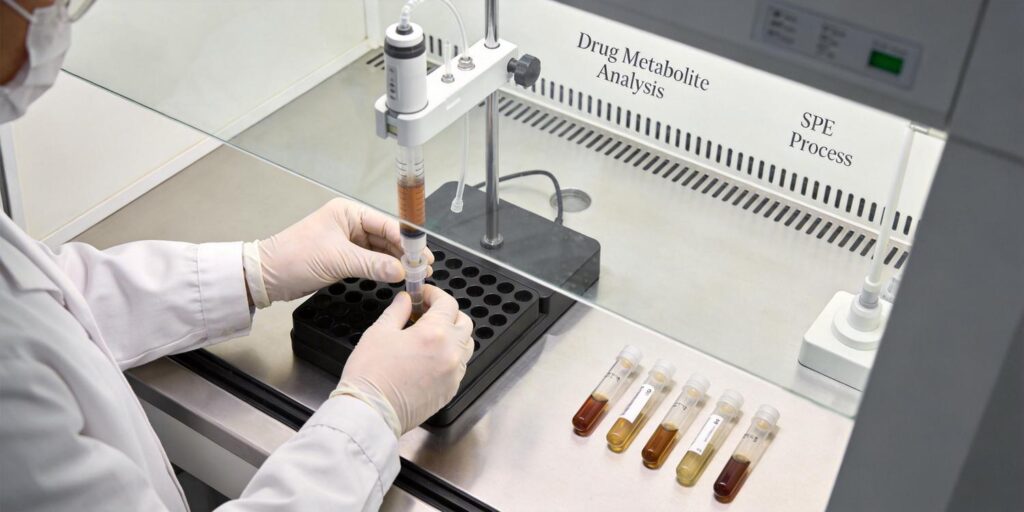
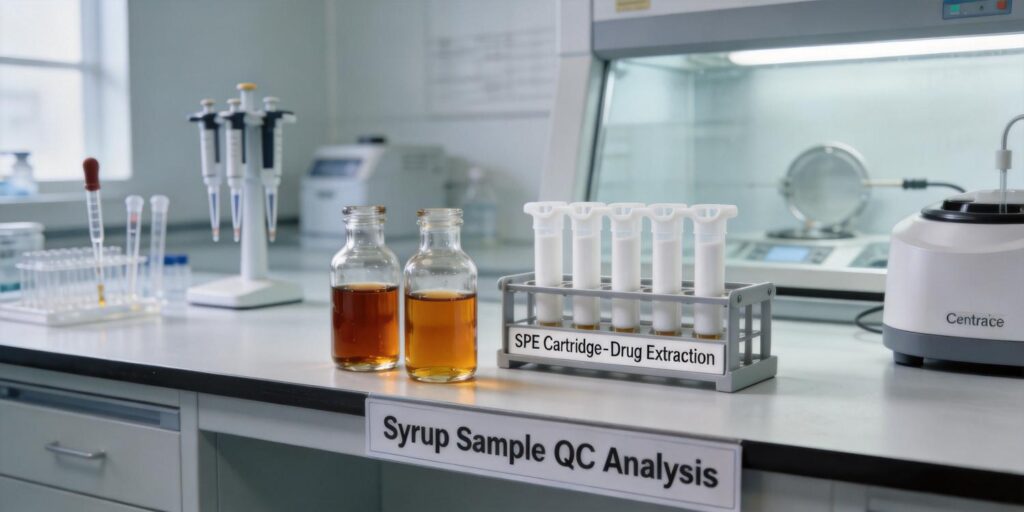
Prior to SPE, syrups must be diluted to reduce viscosity and facilitate handling. A common approach is to dilute the syrup with a suitable aqueous buffer (e.g., 10 mM ammonium acetate, pH 5.0) at a ratio of 1:10 to 1:50 (v/v). The diluted sample is then vortexed and optionally centrifuged to remove particulates. For accurate quantitation, internal standards should be added during the dilution step. The diluted sample is then loaded onto the SPE cartridge at a controlled flow rate (1–2 mL/min) to ensure efficient retention of the target analytes.
SPE Sorbent Selection for Active Pharmaceutical Ingredients
Sorbent selection is critical for achieving selective retention of APIs. For basic APIs (e.g., antihistamines, opioids), mixed-mode cation exchangers such as MCX SPE cartridges (strong cation exchange + reversed phase) offer excellent retention. For acidic APIs (e.g., NSAIDs), weak anion exchangers like WAX SPE cartridges are preferred. For neutral or amphoteric compounds, HLB SPE cartridges (hydrophilic-lipophilic balanced) provide broad-spectrum retention. The choice depends on the pKa and hydrophobicity of the API. Refer to the 96-well SPE plate format for high-throughput applications.
Conditioning Cartridges for Sample Loading
Proper conditioning ensures reproducible sorbent wetting and analyte retention. For reversed-phase and mixed-mode sorbents, the general protocol involves: (1) 1 cartridge volume of methanol or acetonitrile to activate the sorbent, (2) 1 volume of water or loading buffer to equilibrate. For ion-exchange sorbents, a pH-adjusted buffer matching the loading pH is used. Avoid letting the cartridge dry out between steps. For example, MCX cartridges are conditioned with methanol followed by water (pH 2–3) to protonate the sulfonic acid groups.
Washing Steps Removing Sugars and Flavor Additives
After sample loading, a washing step removes matrix interferents. A typical wash for syrups uses 5% methanol in water (v/v) containing 0.1% formic acid for cation-exchange sorbents, or 100% water for HLB. This elutes sugars, organic acids, and polar flavor compounds while retaining the API. For highly contaminated samples, a second wash with 10–20% methanol may be necessary. The wash volume should be 1–2 cartridge volumes to ensure complete removal without breaking through the analytes.
Elution Solvents Optimized for LC-MS Compatibility
Elution solvents must be compatible with LC-MS and provide high recovery. For mixed-mode sorbents, elution typically involves an organic solvent with a volatile additive. Examples: (1) For MCX: 5% ammonium hydroxide in methanol (v/v) neutralizes the cation exchanger and elutes basic APIs. (2) For WAX: 2% formic acid in methanol elutes acidic compounds. (3) For HLB: 100% methanol or acetonitrile works for neutral compounds. The eluate is evaporated under nitrogen and reconstituted in the mobile phase. Ensure final solvent strength does not exceed 30% organic to avoid peak distortion in LC-MS.
Method Validation Parameters
Validation should assess linearity (R² > 0.99 over the expected concentration range), recovery (>80% with RSD < 15%), matrix effects (by post-column infusion), precision (intra- and inter-day RSD < 10%), and limit of quantification (LOQ) consistent with regulatory requirements (e.g., ICH Q2(R1)). A representative validation study using an HLB SPE cartridge for paracetamol syrup showed recovery of 95–102% and LOQ of 0.1 µg/mL. For more challenging matrices, consider using MAX SPE cartridges (mixed-mode anion exchange) for enhanced selectivity.
Application in Pharmaceutical Quality Control
This SPE-LC-MS method is directly applicable to routine quality control of pharmaceutical syrups, including stability studies, content uniformity, and impurity profiling. The robustness of the protocol allows for automation using 96-well plates, increasing throughput. For example, antihistamine syrups (e.g., cetirizine) cleaned up on WCX SPE cartridges (weak cation exchange) achieved rapid analysis with minimal matrix interference. The method aligns with pharmacopoeial standards (USP, EP) and can be easily transferred between laboratories.