Why Blood Analysis Matters in Toxicology Investigations
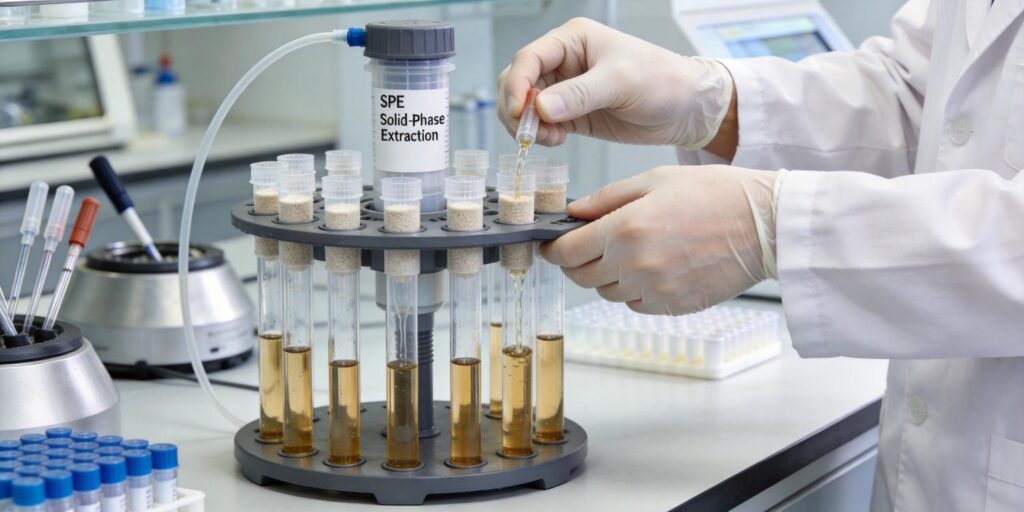
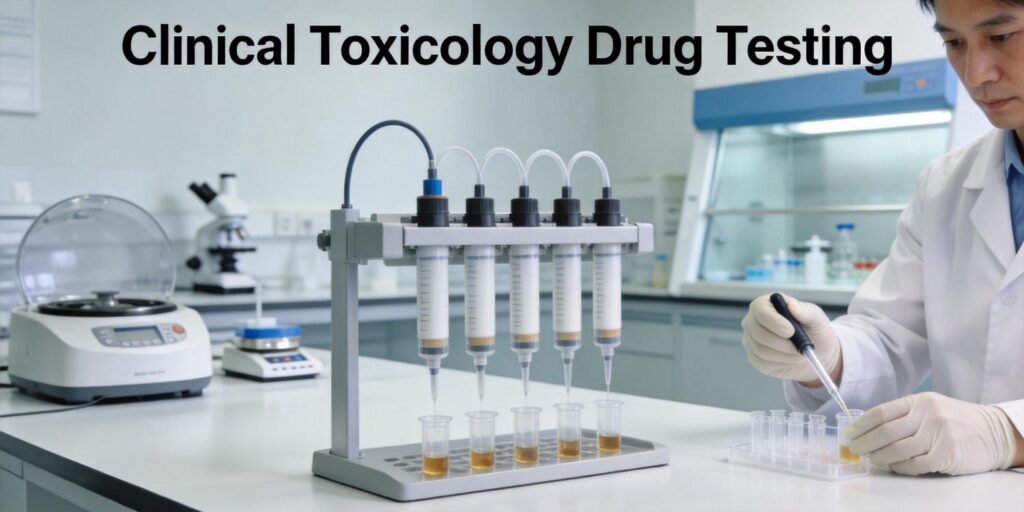
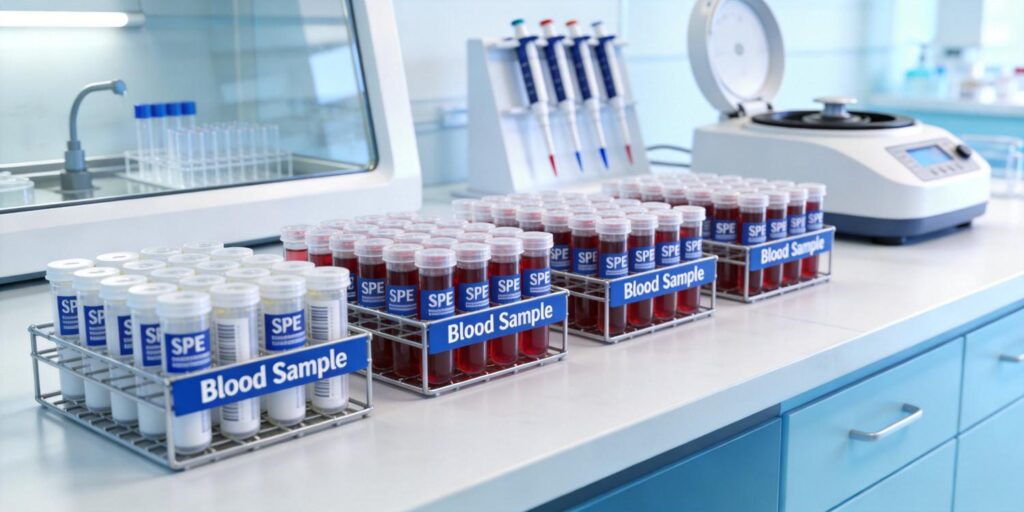
In forensic and clinical toxicology, blood is the gold standard matrix for assessing acute intoxication, therapeutic drug monitoring, and postmortem investigations. The concentration of drugs and their metabolites in whole blood or plasma directly correlates with pharmacological effects, making accurate quantification essential for legal and medical decisions. Solid-phase extraction (SPE) has become the preferred sample preparation technique for LC-MS/MS-based toxicology screening due to its superior cleanup, reproducibility, and ability to concentrate analytes from complex biological fluids.
The Blood Matrix Challenge: Proteins and Lipids
Blood presents a formidable analytical challenge. It contains approximately 7–8 g/dL of proteins (primarily albumin and globulins) and high levels of phospholipids, which can cause severe ion suppression or enhancement in electrospray ionization (ESI) mass spectrometry. Direct injection of protein-precipitated blood often still contains residual phospholipids that degrade column performance and compromise sensitivity. SPE effectively removes these matrix components, yielding cleaner extracts for robust LC-MS analysis.
Protein Precipitation as a Pretreatment Step
Before SPE, protein precipitation (PPT) is commonly applied. Adding 2–3 volumes of acetonitrile (with or without 0.1% formic acid) to whole blood or plasma, followed by centrifugation at 10,000–15,000 RPM for 10 minutes, effectively denatures and removes bulk proteins. The supernatant is then decanted and diluted with 2–5% aqueous formic acid to reduce organic solvent content before loading onto the SPE column. This step prevents column fouling and ensures reproducible retention.
Why MCX SPE Is Ideal for Basic Drugs
For toxicology screening targeting basic and weakly basic drugs (e.g., amphetamines, opioids, benzodiazepines, antidepressants), mixed-mode cation-exchange (MCX) sorbents offer exceptional selectivity. Poseidon Scientific’s MCX SPE Cartridges combine reversed-phase (C18-like) and strong cation-exchange functionalities. At acidic pH (≤3), basic analytes are protonated and retained via ion exchange, while neutral and acidic interferences wash through. The dual retention mechanism provides cleaner extracts compared to single-mode sorbents.
Cartridge Conditioning and Loading
Proper conditioning is critical for reproducible retention. For MCX, condition with 2 mL methanol (to wet the sorbent), followed by 2 mL of 2% formic acid in water (to equilibrate at low pH). Load the diluted PPT supernatant (acidified to ~2% formic acid) at 1–2 mL/min. Ensure the sample pH remains below 3 to maintain the cation-exchange active sites. Do not let the cartridge dry out during conditioning or loading.
Washing Protocols to Minimize Matrix Interference
After loading, a two-step wash effectively reduces matrix while retaining target analytes. First, wash with 2 mL of 2% formic acid in water to remove salts and polar interferences. Second, wash with 2 mL of methanol (or 2 mL of 2% formic acid in methanol) to elute neutral hydrophobic compounds (e.g., lipids, pigments). This step removes the most troublesome phospholipids that cause ion suppression in ESI. Overly aggressive washing may cause early break-through of weakly retained basic drugs, so verify with your specific analyte panel.
Optimized Elution Solvents for Toxicology Screening
Elution is performed with a basic organic solvent mixture. For MCX, 2 mL of 5% ammonium hydroxide in methanol (freshly prepared) effectively disrupts the ion-exchange interaction. The high pH deprotonates basic drugs, allowing them to partition into the organic phase. Alternatively, 2 mL of methanol containing 5% ammonium hydroxide and 5% water may improve elution for highly polar metabolites. Collect the eluate in a glass tube, evaporate under nitrogen at 40°C, and reconstitute in 100–200 µL of mobile phase (e.g., 90:10 water:methanol with 0.1% formic acid).
LC-MS/MS Confirmatory Analysis Workflow
Reconstituted extracts are analyzed by LC-MS/MS using a C18 column (e.g., 50 × 2.1 mm, 1.7 µm) with a gradient of 0.1% formic acid in water (A) and 0.1% formic acid in methanol (B) at 0.3 mL/min. Typical gradient: 5% B to 95% B over 8 min. MRM transitions are monitored for each analyte. Quantification is performed using isotope-labeled internal standards (e.g., d5-diazepam, d3-morphine). The SPE process consistently yields recoveries >85% with matrix effects below 15% RSD across 10 batches.
Method Validation Considerations
Follow SWGTOX guidelines for validation: linearity (1–1000 ng/mL), accuracy (85–115%), precision (<15% RSD), limit of detection (0.1–1 ng/mL), and matrix effect assessment via post-extraction spike. Ensure the SPE method is robust over 100+ extractions; replace cartridges after one use.
For laboratories seeking high-throughput solutions, Poseidon Scientific also offers 96-Well SPE Plates with MCX sorbent for parallel processing, reducing overall analysis time. For alternative sorbent chemistries covering a broader drug spectrum, explore the HLB, WAX, and WCX series.