Why Flavonoid Analysis Matters in Herbal Products
Flavonoids are bioactive polyphenolic compounds widely distributed in medicinal plants, contributing to antioxidant, anti-inflammatory, and anticancer properties. Accurate extraction and quantification of flavonoids are essential for quality control, standardization, and pharmacological studies of herbal medicines. Solid-phase extraction (SPE) has become a preferred technique due to its efficiency, reproducibility, and compatibility with downstream analytical methods like LC-MS and HPLC.
Chemical Characteristics of Flavonoids
Flavonoids share a diphenylpropane (C6-C3-C6) skeleton, with variations in hydroxylation, methoxylation, and glycosylation patterns. Their polarity ranges from moderately polar aglycones (e.g., quercetin, kaempferol) to more polar glycosides (e.g., rutin, naringin). These properties dictate solubility in organic solvents and retention on SPE sorbents, typically under reversed-phase or mixed-mode mechanisms.
Extraction of Plant Powders Using Organic Solvents
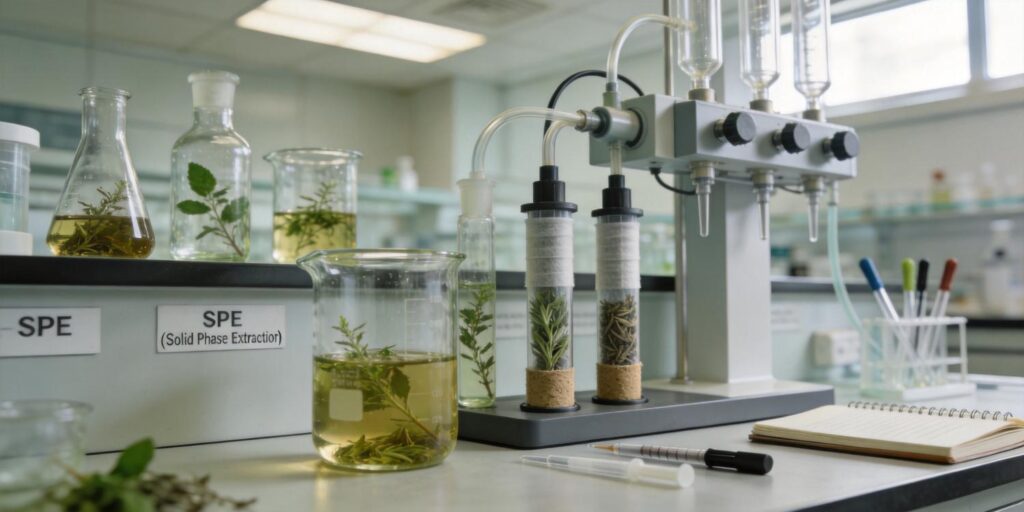
Before SPE, flavonoids are usually extracted from dried, ground plant material using organic solvents such as methanol, ethanol, or acetone, often mixed with water (e.g., 70% ethanol). The extraction is performed via maceration, sonication, or Soxhlet methods. The crude extract contains flavonoids along with chlorophyll, sugars, waxes, and other co-extractives, which must be removed to avoid interference in analysis.
SPE Sorbent Selection for Flavonoid Purification
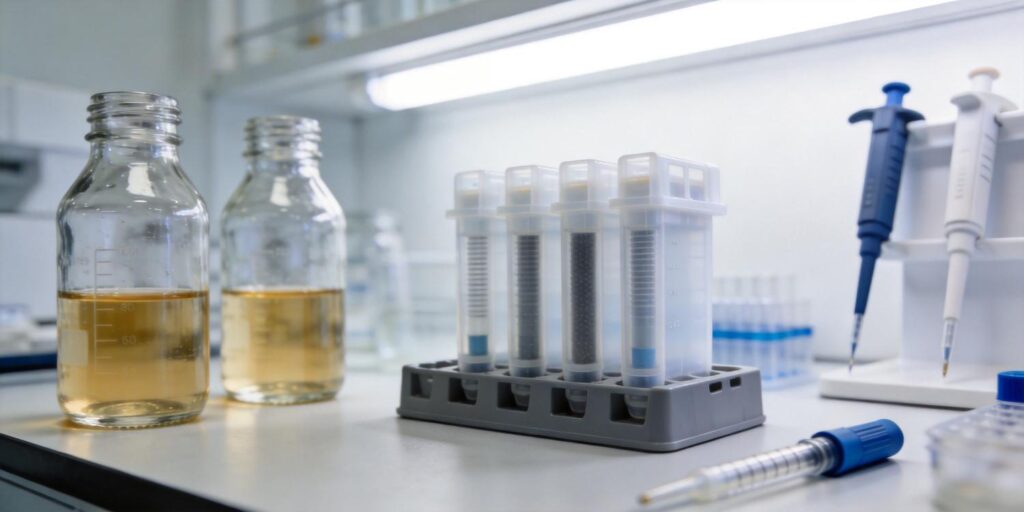
Choosing the right SPE sorbent is critical. For neutral or acidic flavonoids, HLB (Hydrophilic-Lipophilic Balanced) cartridges offer broad-spectrum retention via reversed-phase and water-wettable properties. For selective isolation of acidic flavonoids (e.g., those with carboxyl groups), MAX (Mixed-mode Anion eXchange) cartridges combine reversed-phase with strong anion exchange. Similarly, MCX (Mixed-mode Cation eXchange) cartridges can retain basic flavonoids like anthocyanins. WAX (Weak Anion eXchange) and WCX (Weak Cation eXchange) cartridges offer milder selectivity for charged flavonoids. For high-throughput purification, 96-well SPE plates are ideal.
Conditioning Cartridges and Loading Plant Extracts
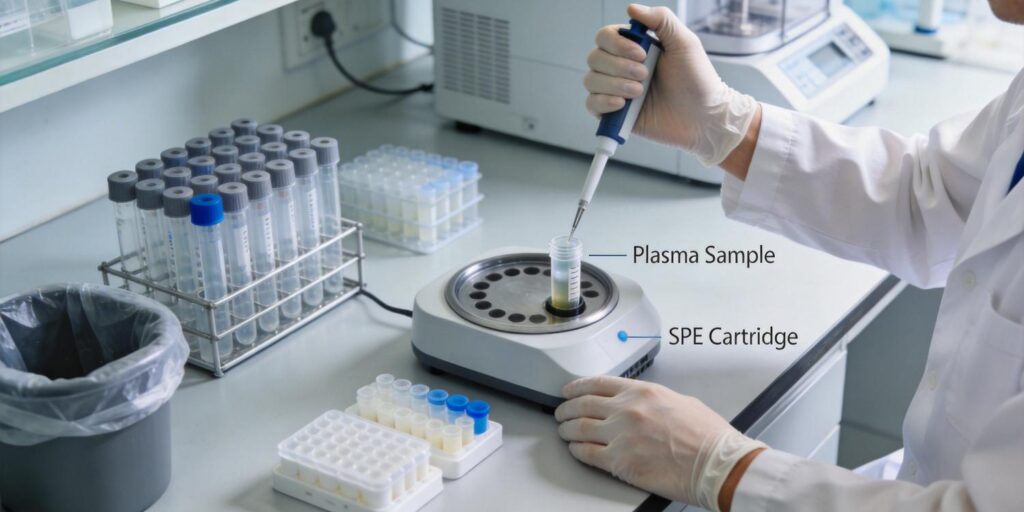
SPE cartridges must be conditioned to activate the sorbent. For reversed-phase SPE (e.g., HLB), condition with methanol followed by water or buffer at the sample pH. For mixed-mode cartridges (MAX, MCX), condition with organic solvent and appropriate buffer. Load the filtered plant extract (diluted in a weak solvent) at a controlled flow rate (1-2 mL/min) to ensure efficient retention.
Washing Steps Removing Chlorophyll and Sugars
After loading, wash the cartridge to remove interferences. For reversed-phase HLB, a 5% methanol in water wash removes sugars and polar compounds without eluting flavonoids. For MAX, a wash with 5% ammonium hydroxide in water can remove neutral and basic impurities. Chlorophyll, being highly hydrophobic, often requires a stronger wash (e.g., 20-40% methanol) but must be optimized to avoid flavonoid loss. Sugars are effectively removed with aqueous washes.
Elution of Purified Flavonoids
Elute retained flavonoids with a small volume of organic solvent. For HLB, 100% methanol or acetonitrile works. For MAX, acidic methanol (e.g., 2% formic acid in methanol) disrupts anion exchange. For MCX, basic methanol (e.g., 5% ammonium hydroxide in methanol) elutes basic flavonoids. Collect the eluate, evaporate under nitrogen, and reconstitute in the LC-MS mobile phase.
LC-MS or HPLC Quantification Methods
Purified flavonoid extracts are analyzed using reversed-phase HPLC with C18 columns, mobile phases of water/acetonitrile with 0.1% formic acid, and UV detection at 254–370 nm. LC-MS in negative ion mode provides structural confirmation via fragmentation patterns. Calibration standards (e.g., rutin, quercetin) enable quantification. This workflow ensures reliable data for herbal medicine research and quality assurance.