Introduction to Veterinary Drug Monitoring in Poultry Products
Veterinary drugs, including antibiotics, anthelmintics, and coccidiostats, are widely used in poultry farming to prevent disease and promote growth. However, their residues can persist in eggs, posing potential health risks such as antimicrobial resistance or allergic reactions in consumers. Regulatory agencies worldwide, including the FDA, EU, and Codex Alimentarius, have established maximum residue limits (MRLs) for these compounds in eggs. Effective monitoring requires robust analytical methods that can reliably quantify trace levels of multiple drug classes in complex egg matrices.
Egg Matrix Challenges: Lipids and Proteins
Eggs are notoriously difficult to analyze due to their high content of proteins (≈13%) and lipids (≈11%), including phospholipids, cholesterol, and triglycerides. These components can co-extract with target analytes, leading to severe matrix effects—both signal suppression and enhancement—during LC-MS/MS analysis. Lipid-rich extracts can also clog columns and contaminate the ion source, reducing instrument uptime and requiring frequent maintenance. Effective sample cleanup is therefore critical to remove these interfering substances while retaining the veterinary drugs of interest.
Homogenization and Solvent Extraction of Egg Samples
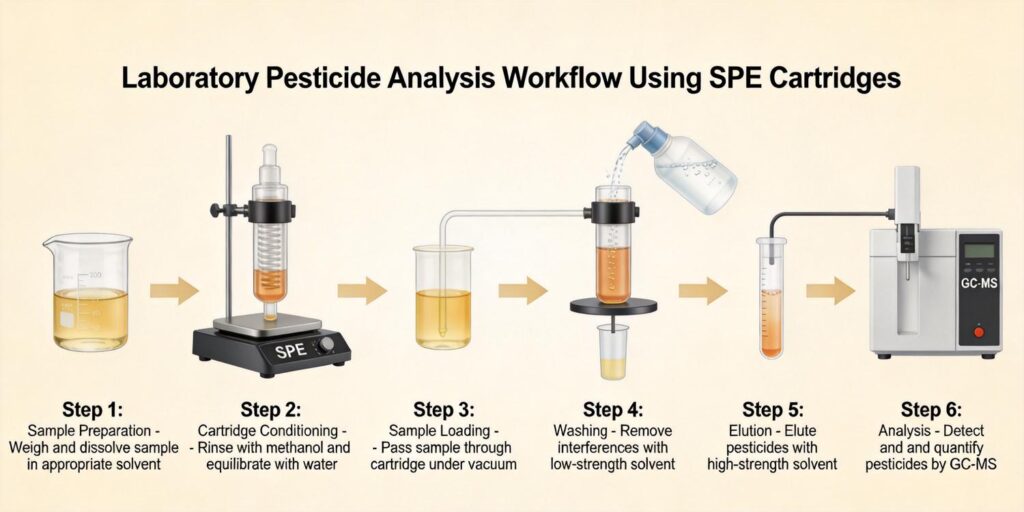
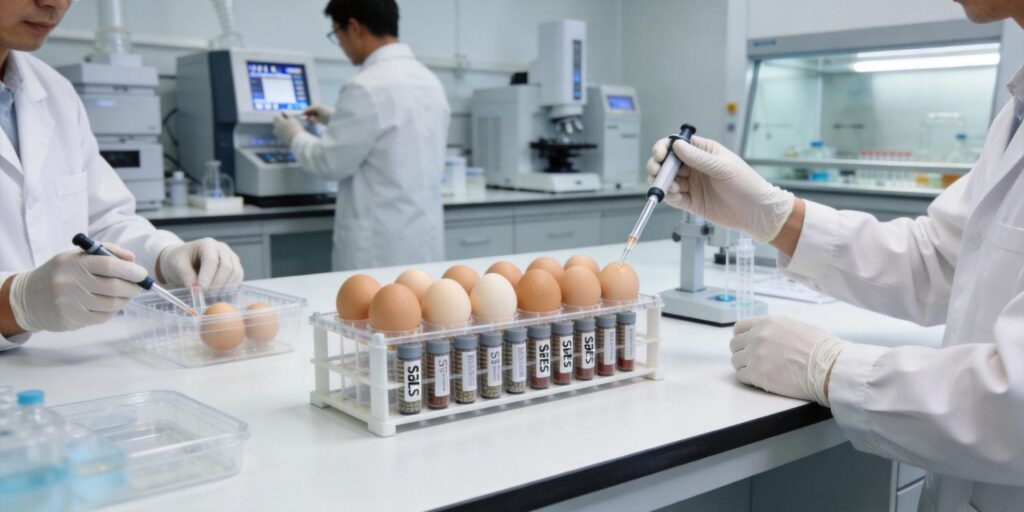
The first step in sample preparation is homogenization. Typically, whole egg (including yolk and white) is blended or homogenized to ensure a representative sample. A common extraction protocol involves weighing 2–5 g of homogenized egg into a centrifuge tube, adding a known volume of acetonitrile (ACN) or acidified acetonitrile (e.g., 0.1% formic acid in ACN), vortexing, and then centrifuging to separate the precipitate. Acetonitrile is preferred because it effectively precipitates proteins while extracting a wide range of polar and moderately polar drug residues. The supernatant is then diluted with water to reduce the organic solvent concentration to ≤5% before SPE loading, ensuring optimal retention on the HLB sorbent.
HLB SPE Conditioning and Analyte Capture
For sample cleanup, Poseidon HLB SPE cartridges (Hydrophilic-Lipophilic Balanced, polymeric sorbent) are ideally suited. The HLB sorbent comprises both hydrophilic N-vinylpyrrolidone and lipophilic divinylbenzene monomers, offering a water-wettable surface that retains compounds across a wide polarity range. Conditioning is performed by passing 3–6 mL of methanol followed by 3–6 mL of water through the cartridge. The diluted egg extract is then loaded at a flow rate of 1–2 mL/min. Analyte retention occurs via reversed-phase and polar interactions, while many proteins and polar matrix components pass through unretained.
Washing Steps: Removing Fats and Phospholipids
After loading, a selective washing step is critical. A common wash solvent is 5% methanol in water (v/v) or water containing 5% acetonitrile. This removes remaining salts, polar matrix components, and loosely bound interferences without eluting the target analytes. For more thorough lipid removal, an additional wash with hexane (2–5 mL) can be employed, as lipids are non-polar and will be retained by the sorbent less strongly than many drugs. Alternatively, some protocols use a wash with 40% methanol in water to remove phospholipids. The choice of wash solvent should be optimized for the specific drug panel to avoid premature analyte breakthrough.
Elution Solvent Systems for LC-MS/MS
Elution from the HLB cartridge is typically achieved with 5–10 mL of methanol or acetonitrile. For enhanced recovery of basic compounds (e.g., fluoroquinolones, tetracyclines), acidified methanol (e.g., 0.1% formic acid in methanol) is recommended. The eluate is evaporated to dryness under nitrogen at 40°C, then reconstituted in a mobile phase-compatible solvent, such as 0.1% formic acid in water:acetonitrile (90:10). This sample is then filtered (0.22 μm PTFE filter) into an autosampler vial for LC-MS/MS analysis.
Analytical Method Validation Parameters
A validated method should demonstrate linearity (R² > 0.99) over the expected concentration range, typically 1–500 μg/kg. Limits of detection (LOD) and quantification (LOQ) are determined based on signal-to-noise ratios of 3:1 and 10:1, respectively. Recovery experiments at three spiking levels (e.g., 10, 50, and 100 μg/kg) should yield recoveries between 70–120% with relative standard deviations (RSD) below 20%. Matrix effects can be evaluated by comparing analyte responses in neat solution versus post-extraction spiked matrix. With proper cleanup on HLB, matrix effects are typically reduced to below 15% for most veterinary drugs.
Application in Regulatory Food Safety Laboratories
This SPE-based cleanup method is widely adopted in regulatory food safety laboratories for routine screening of egg samples. The use of Poseidon HLB cartridges offers a consistent, high-purity sorbent that yields reproducible results across batches. By effectively reducing lipid and protein interference, this approach ensures reliable quantitation of veterinary drug residues, meeting the stringent requirements of EU and FDA monitoring programs. For laboratories requiring higher throughput, the method can be easily transferred to 96-well plate formats using Poseidon 96-well SPE plates, enabling parallel processing of multiple samples.
For further optimization, laboratories may consider using specialized SPE sorbents such as MAX (mixed-mode anion exchange) or MCX (mixed-mode cation exchange) for targeted cleanup of acidic or basic drugs, respectively. However, the universal HLB approach provides a versatile starting point for multi-class residue analysis in eggs.