Sample Preparation for Pesticide Residue Analysis in Tea
Tea is one of the most widely consumed beverages globally, but its leaves are susceptible to pesticide contamination during cultivation. Regulatory bodies such as the EPA and the European Commission set strict maximum residue limits (MRLs) for pesticides in tea products. To ensure compliance and consumer safety, reliable analytical methods are required. Solid-phase extraction (SPE) using Hydrophilic-Lipophilic Balance (HLB) cartridges has become a cornerstone technique for cleaning up tea extracts prior to LC-MS/MS analysis.
Pesticide Contamination Risks in Tea Leaves
Tea plants (Camellia sinensis) are often treated with a variety of pesticides, including organophosphates, carbamates, and pyrethroids, to control pests and diseases. These compounds can persist through harvesting and processing, posing health risks to consumers. The complex tea matrix—rich in polyphenols, caffeine, pigments, and lipids—interferes with instrumental analysis, causing ion suppression or enhancement in mass spectrometry. Effective sample cleanup is therefore critical to achieve accurate quantification at trace levels (typically μg/kg).
Sample Grinding and Solvent Extraction
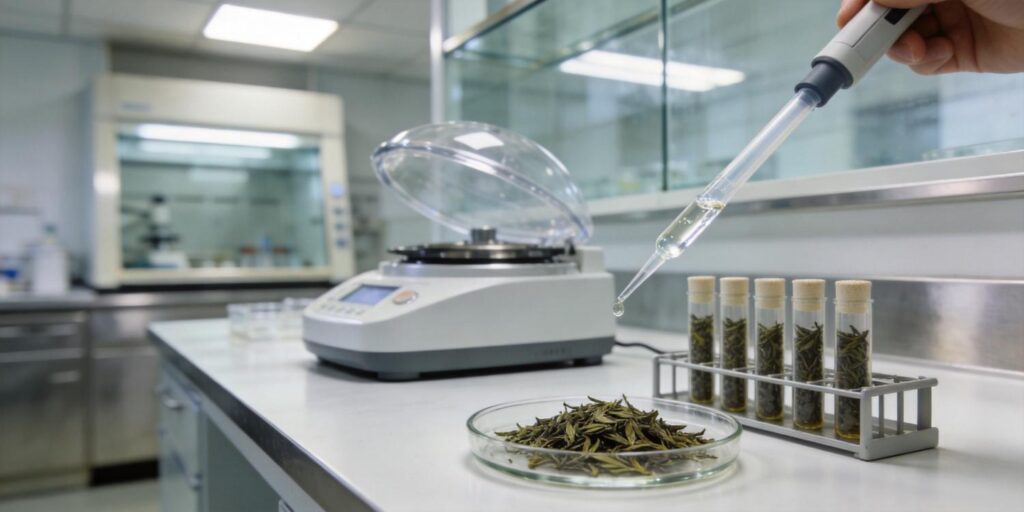
Tea samples are first ground to a fine powder using a cryogenic mill to ensure homogeneity and maximize surface area. An aliquot (typically 2 g) is extracted with a solvent mixture such as acetonitrile:water (80:20, v/v) or ethyl acetate, often acidified with 1% acetic acid, to recover both polar and non-polar pesticides. The extract is vortexed, sonicated, and centrifuged. The supernatant is collected and may be concentrated or diluted with water to reduce organic solvent content before SPE loading.
Role of HLB Polymeric Sorbent for Broad Pesticide Retention
HLB SPE cartridges feature a macroporous poly(divinylbenzene-co-N-vinylpyrrolidone) copolymer that provides a balanced hydrophilic-lipophilic retention mechanism. This sorbent retains a wide polarity range of pesticides, from polar methamidophos (log P –0.7) to non-polar cypermethrin (log P 6.6), without the need for dedicated reversed-phase or normal-phase phases. The polymeric structure also offers high capacity and resistance to pH extremes, making it ideal for acidic tea extracts.
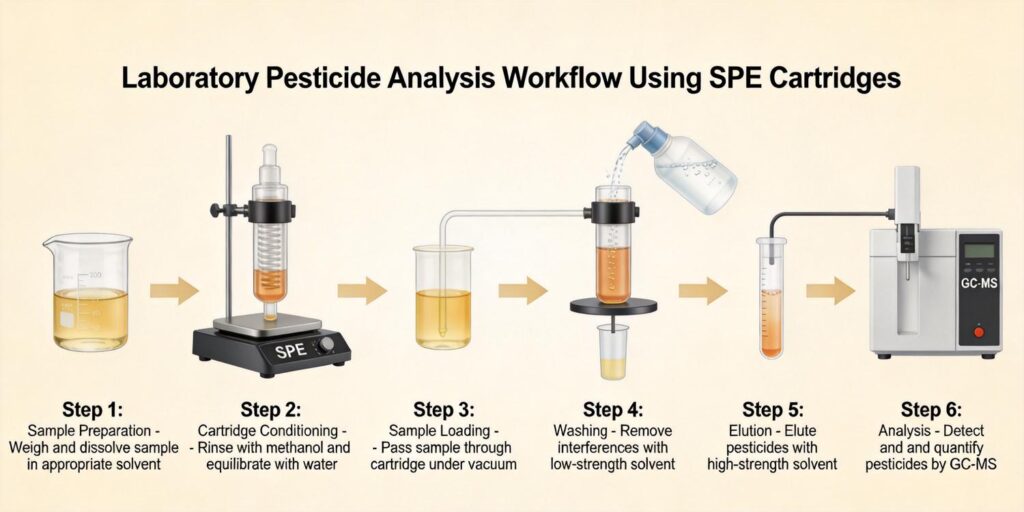
Cartridge Conditioning with Methanol and Water
Before sample loading, the HLB cartridge (e.g., 200 mg, 6 mL) is conditioned with one bed volume of methanol to wet the sorbent and activate retention sites, followed by two bed volumes of water or buffer to equilibrate. This step ensures reproducible interaction between the sorbent and analytes, preventing channeling and early breakthrough.
Loading Tea Extracts and Maintaining Analyte Recovery
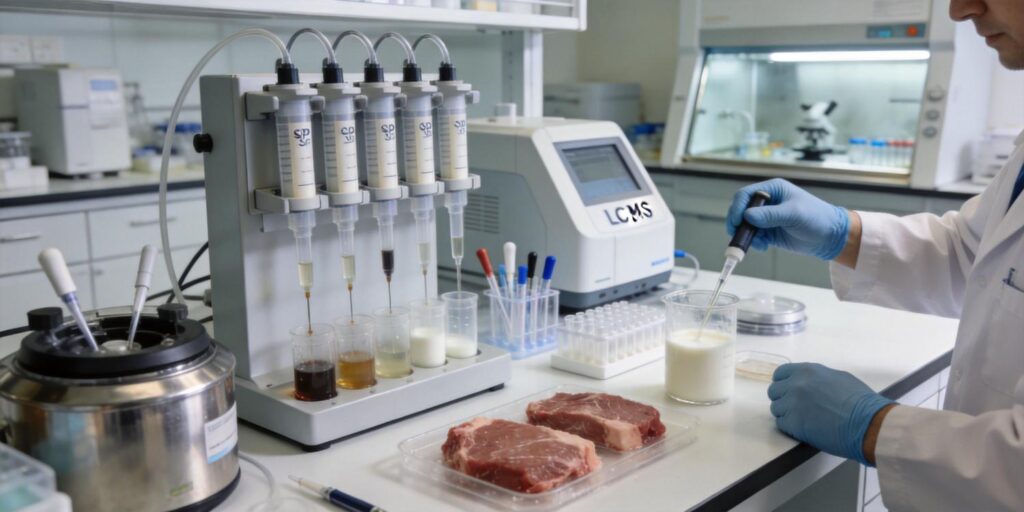
The clarified tea extract, diluted to ≤10% organic solvent, is loaded onto the conditioned cartridge at a flow rate of 1–2 mL/min. The HLB sorbent retains target pesticides while allowing early-eluting matrix components to pass through. Careful control of loading volume and flow rate is essential to avoid overload and ensure quantitative recovery (typically >85% for most pesticides).
Washing Steps Removing Polyphenols and Pigments
After loading, the cartridge is washed with 5–10 mL of 5% methanol in water or a low-pH buffer (e.g., 2% formic acid in water) to remove polar interferences such as polyphenols, tannins, and pigments without eluting the retained pesticides. A subsequent water wash further cleans the sorbent. These steps significantly reduce matrix effects in LC-MS/MS.
Elution Solvents Compatible with LC-MS/MS
Target pesticides are eluted with 5–10 mL of methanol or acetonitrile, which effectively disrupts hydrophobic interactions with the sorbent. For more polar analytes, 0.1% formic acid in methanol can be used to improve recoveries. The eluate is evaporated under nitrogen and reconstituted in a compatible solvent (e.g., water:methanol 90:10) for injection.
Validation Metrics Including Recovery, Matrix Suppression, and LOQ
Validation studies report absolute recoveries of 70–120% for over 100 pesticides at spiking levels of 10–500 μg/kg, with relative standard deviations <20%. Matrix effects are typically reduced to less than 15% after HLB cleanup. Limits of quantification (LOQs) range from 1 to 10 μg/kg, meeting regulatory requirements. The method is robust across different tea types (green, black, oolong) and is widely adopted in routine surveillance laboratories.
For more information on HLB SPE cartridges, please visit our HLB SPE Cartridges product page. For high-throughput applications, consider our 96-well SPE plates.