Why Phenolic Profiling Matters in Wine Quality Analysis
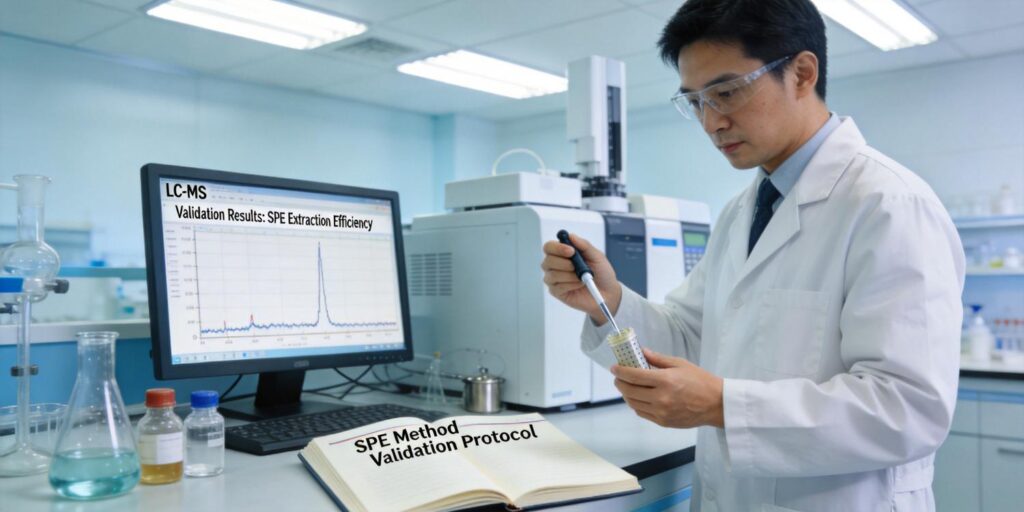
Phenolic compounds are critical to wine quality, influencing color, astringency, bitterness, and aging potential. Accurate profiling helps winemakers optimize processes, ensure consistency, and meet regulatory standards. Solid-phase extraction (SPE) is the preferred method for isolating these compounds prior to analysis, as it efficiently removes interfering matrices while enriching target analytes. This blog outlines a robust SPE workflow for phenolic extraction from wine, based on established methods (e.g., OIV-MA-AS315-11).
Understanding Phenolic Chemistry
Wine phenolics include flavan-3-ols (catechins, proanthocyanidins), flavonols (quercetin, myricetin), anthocyanins (in red wines), hydroxybenzoic and hydroxycinnamic acids (gallic acid, caffeic acid). These compounds range from polar acids to moderately non-polar flavonoids, with molecular weights from ~150 to >2000 Da. Their diverse polarity and acidity require careful sorbent selection and pH control during SPE.
Sample Preparation: Dilution and pH Adjustment
Wine samples typically contain 12-15% ethanol and high sugar content. Direct loading onto SPE can cause early breakthrough. Dilute wine 1:2 to 1:5 with 0.1% HCl (v/v) to reduce ethanol and protonate phenolic acids. Adjust pH to 2-3 using HCl, which suppresses ionization of carboxylic acids and enhances retention on hydrophobic sorbents. For anthocyanins, maintain acidic conditions to preserve the flavylium cation form. Filter through 0.45 µm nylon membrane to remove particulates.
Choosing the Right SPE Sorbent
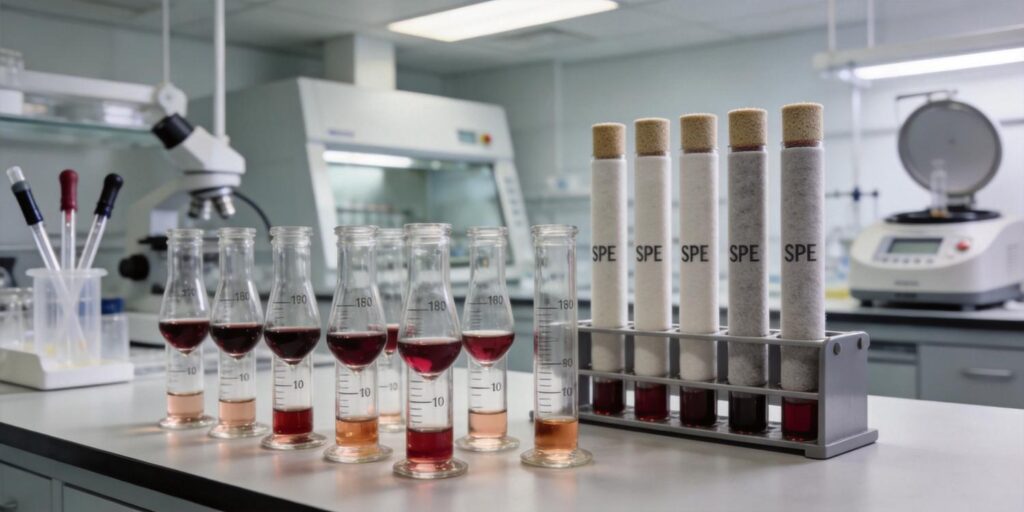
For comprehensive phenolic profiling, a mixed-mode sorbent like Poseidon MAX (strong anion exchange) is ideal: it retains acidic phenolics via anion exchange at pH > pKa, while hydrophobic interactions capture non-ionized compounds. Alternatively, HLB (hydrophilic-lipophilic balanced) cartridges offer high recovery for a wide polarity range without pH adjustment. For targeted anthocyanin analysis, WCX (weak cation exchange) can selectively retain cationic anthocyanins. Poseidon Scientific provides these sorbents in cartridge and 96-well plate formats for high-throughput.
Step-by-Step SPE Protocol
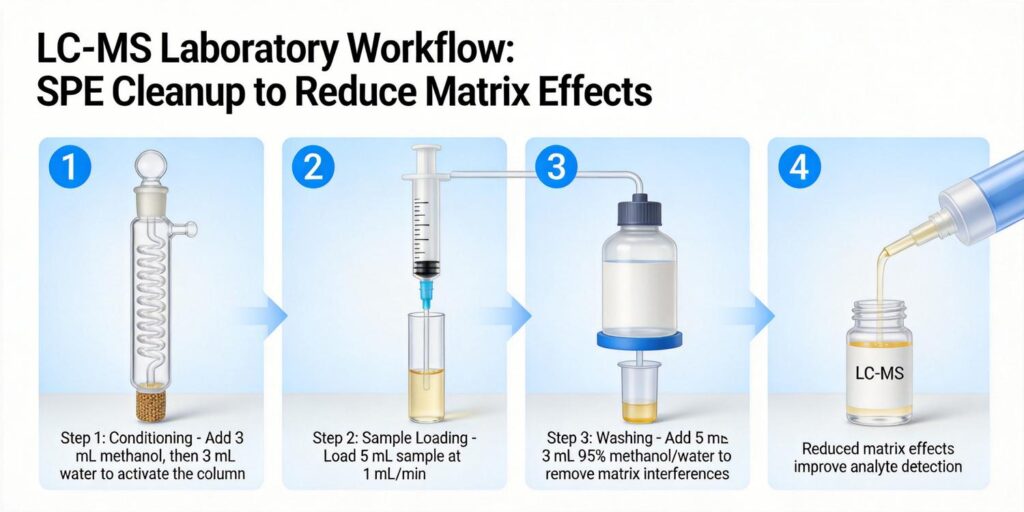
1. Cartridge Conditioning
For a 200 mg MAX cartridge: 2 mL methanol, then 2 mL 0.1% HCl (pH 2) to equilibrate. Do not let the bed dry.
2. Sample Loading
Pass 10 mL diluted wine (pH 2) at 1 mL/min. For HLB: load directly without acidification. For WCX: load at pH 3.5 (adjust with HCl).
3. Washing to Remove Interferences
Wash with 2 mL of 0.1% HCl to elute sugars, organic acids (tartaric, malic), and alcohol. For MAX, an additional wash with 2 mL 50% methanol in 0.1% HCl removes neutral interferences.
4. Elution of Phenolics
For MAX: elute acidic phenolics with 2 mL of 2% formic acid in methanol (v/v). For neutral phenolics retained by reversed-phase, a second elution with 2 mL methanol can be performed. For HLB: elute with 2 mL methanol followed by 2 mL 2% formic acid in methanol. Collect eluates separately or combine for broad profiling.
Post-SPE Processing and Analysis
Evaporate eluates under nitrogen at 35°C to dryness. Reconstitute in 0.5 mL of mobile phase (e.g., 80:20 water/methanol with 0.1% formic acid). Filter through 0.22 µm PTFE syringe filter. Analyze by HPLC-DAD (280 nm for phenolic acids, 320 nm for flavonols, 520 nm for anthocyanins) or LC-MS/MS for quantification. Typical recoveries exceed 85% for most phenolics using the methods above.
Method Performance and Scalability
This SPE method is validated for red, white, and rosé wines. Detection limits range from 0.1-1 mg/L, suitable for routine quality control. For high-throughput labs, 96-well SPE plates using the same sorbent chemistries allow simultaneous processing of 96 samples, reducing time and solvent consumption. Explore Poseidon’s range of MCX, WAX, and WCX cartridges for tailored selectivity.
For further optimization, consult the references: Pérez-Magariño et al., J. Chromatogr. A (2008) 1189:452; OIV-MA-AS315-11. Poseidon Scientific’s technical team provides application support to ensure robust, reproducible results for your wine analysis.