What Are Matrix Effects in LC-MS Analysis?
Matrix effects represent one of the most significant challenges in liquid chromatography-mass spectrometry (LC-MS) workflows, particularly when analyzing complex biological or environmental samples. These effects occur when co-eluting compounds from the sample matrix interfere with the ionization process of target analytes in the mass spectrometer, leading to either ion suppression (reduced signal) or ion enhancement (increased signal).
As noted in the literature, “An undesirable feature of atmospheric pressure ionization-MS analysts is suppression of ionization by co-extracted endogenous interferences from biofluids” (Simpson, 2000). This phenomenon can compromise quantitative accuracy, method sensitivity, and overall analytical reliability, making it a critical consideration in method development and validation.
Sources of Ion Suppression and Enhancement
Chemical Interferences
Matrix effects typically arise from several sources:
- Endogenous compounds: Proteins, lipids, salts, and other biological components in plasma, serum, or tissue samples
- Exogenous compounds: Drug metabolites, environmental contaminants, or sample processing additives
- Co-eluting analytes: Other target compounds or structurally similar molecules
- Sample preparation artifacts: Residual solvents, buffer components, or SPE cartridge leachables
The literature highlights that “components of the sample (often proteins or other macromolecules), which deposited in the transfer capillary/interface to the MS system” can cause rapid decline in signal intensity and quality of spectra (Simpson, 2000). This deposition creates a new phase that affects analyte interactions and ionization efficiency.
Mechanisms of Interference
Matrix components can interfere through several mechanisms:
- Competition for charge: Matrix compounds compete with analytes for available protons or charges during ionization
- Surface activity effects: Surface-active compounds alter droplet formation and evaporation in electrospray ionization
- Gas-phase reactions: Matrix compounds react with analyte ions in the gas phase, reducing their abundance
- Physical interference: Non-volatile compounds deposit on ion source components, reducing ionization efficiency
The Critical Role of SPE Cleanup in Minimizing Matrix Effects
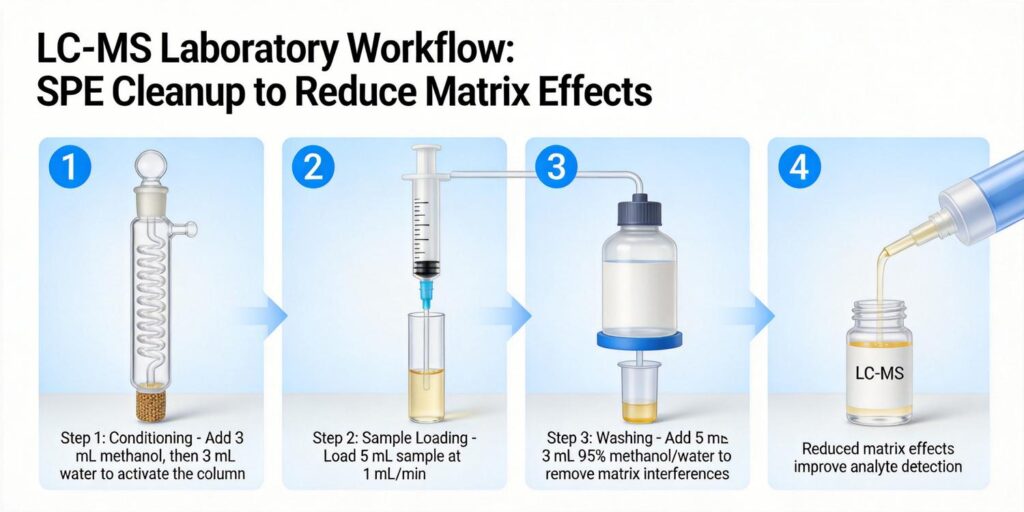
Solid-phase extraction serves as a powerful tool for reducing matrix effects through selective removal of interfering compounds. As noted in SPE literature, “SPE has been shown to significantly increase gas (GC) and liquid chromatography (LC) column life while reducing the downtime on equipment like gas chromatography and liquid chromatography mass spectrometers (GCMS and LCMS) for source cleaning” (Forensic and Clinical Applications of SPE, 2007).
How SPE Reduces Matrix Effects
SPE addresses matrix effects through several mechanisms:
- Selective retention: Target analytes are retained while interfering compounds pass through during loading and washing steps
- Matrix component removal: Proteins, lipids, and other macromolecules are eliminated before MS analysis
- Concentration effect: Analytes are concentrated while matrix components are diluted or removed
- Solvent exchange: Sample is transferred to MS-compatible solvents that enhance ionization
The literature emphasizes that “SPE recoveries should exceed 90% absolute recovery. If you don’t get that kind of recovery you are not adjusting other parameters (such as solubility, pH, and solvent strength) correctly” (Forensic and Clinical Applications of SPE, 2007). Proper SPE optimization is therefore essential for minimizing matrix effects.
Experimental Evaluation of Matrix Effects
Post-Extraction Spike Method
The most common approach for evaluating matrix effects involves comparing the response of analytes spiked into extracted blank matrix versus pure solvent. The matrix effect (ME) is calculated as:
ME (%) = (Response in matrix extract / Response in pure solvent) × 100
Values below 100% indicate ion suppression, while values above 100% indicate ion enhancement. Significant matrix effects are typically considered when ME values fall outside the 85-115% range.
Post-Column Infusion
This technique involves continuous infusion of analyte standards while injecting extracted blank matrix. Regions of ion suppression or enhancement appear as dips or peaks in the baseline chromatogram, providing visual identification of problematic retention times.
Optimization Strategies in Washing Steps
Strategic Wash Solvent Selection
Effective washing is crucial for removing matrix interferences while retaining target analytes. The literature notes that “washing the cartridge with pure water will eliminate excess ions and this will, in turn, improve system performance” (Simpson, 2000). Key considerations include:
- Solvent strength optimization: Using solvents strong enough to elute interferences but weak enough to retain analytes
- pH adjustment: Modifying wash pH to manipulate ionization states of interfering compounds
- Organic content: Adjusting organic solvent percentage to balance cleanup and recovery
- Multiple wash steps: Employing sequential washes with increasing solvent strength
Practical Wash Optimization
For reversed-phase SPE applications, typical wash optimization involves:
- Initial aqueous wash: 5-10% methanol or acetonitrile in water or buffer to remove polar interferences
- Intermediate wash: 20-40% organic solvent to remove moderately retained compounds
- Drying step: Complete removal of water before elution (critical for non-aqueous elution solvents)
The literature emphasizes that “elution using a pure organic solvent, without modifiers or buffer ions is desirable” for LC-MS applications (Simpson, 2000), highlighting the importance of effective washing to achieve this goal.
Internal Standard Approaches for Matrix Effect Compensation
Stable Isotope-Labeled Internal Standards
The gold standard for compensating matrix effects involves using stable isotope-labeled analogs of target analytes as internal standards. These compounds:
- Experience nearly identical matrix effects as target analytes
- Co-elute with target compounds
- Provide accurate compensation for ionization variability
- Enable precise quantification despite matrix effects
Structural Analog Internal Standards
When stable isotope-labeled standards are unavailable, structural analogs with similar physicochemical properties can provide partial compensation. Selection criteria include:
- Similar retention time to target analyte
- Comparable ionization characteristics
- Similar extraction recovery
- Absence in sample matrix
Example from Clinical Bioanalysis: Antidepressant Quantification in Plasma
Challenge
A common clinical application involves quantifying antidepressant drugs (e.g., SSRIs, SNRIs) in human plasma for therapeutic drug monitoring. These analyses face significant matrix effects from:
- Plasma proteins (albumin, α1-acid glycoprotein)
- Endogenous lipids and phospholipids
- Co-administered medications
- Metabolites with similar structures
SPE Solution
Mixed-mode SPE cartridges combining reversed-phase and ion-exchange mechanisms provide effective cleanup:
- Sample pretreatment: Protein precipitation with acetonitrile followed by dilution with ammonium acetate buffer (pH 4.0)
- SPE conditioning: Methanol followed by ammonium acetate buffer
- Sample loading: At controlled flow rate (1-2 mL/min)
- Washing: 5% methanol in water followed by 100 mM ammonium acetate (pH 4.0)
- Elution: 5% ammonium hydroxide in methanol
- Reconstitution: Mobile phase compatible with LC-MS analysis
Results
This approach typically achieves:
- Matrix effect reduction from >50% suppression to <15% variation
- Recoveries >85% for target antidepressants
- Elimination of phospholipid interference (major source of ion suppression)
- Improved method sensitivity and precision
- Extended LC-MS system uptime between source cleanings
Conclusion
Matrix effects represent a significant challenge in LC-MS analysis, but strategic implementation of SPE cleanup provides an effective solution. By understanding the sources of ion suppression and enhancement, systematically evaluating matrix effects, optimizing washing protocols, and employing appropriate internal standards, analysts can develop robust methods that deliver accurate and reliable results.
The literature consistently demonstrates that “SPE has been found to have a useful role to play in the clean-up and concentration steps of the analysis” (Simpson, 2000). For laboratories seeking to improve their LC-MS workflows, investing in proper SPE method development represents one of the most effective strategies for overcoming matrix effect challenges and achieving high-quality analytical results.
For more information on SPE products and applications, visit our HLB SPE cartridges, MAX SPE cartridges, MCX SPE cartridges, WAX SPE cartridges, WCX SPE cartridges, and 96-well SPE plates.