Environmental Occurrence of Cosmetic Ingredients and Preservatives
Pharmaceuticals and personal care products (PPCPs) represent a diverse class of emerging contaminants in aquatic environments. These compounds enter surface waters through multiple pathways including wastewater treatment plant effluents, agricultural runoff, and direct disposal. Cosmetic ingredients such as UV filters (benzophenones, octocrylene), preservatives (parabens, triclosan), fragrances (musk compounds), and antimicrobial agents are particularly persistent due to their chemical stability and widespread use.
Recent monitoring studies have detected these compounds at concentrations ranging from ng/L to μg/L in surface waters worldwide. The environmental persistence varies significantly based on chemical structure, with some compounds undergoing rapid photodegradation while others accumulate in sediments and biota. Understanding this environmental occurrence is crucial for developing effective monitoring strategies and assessing potential ecological risks.
Sample Filtration and Preservation Methods
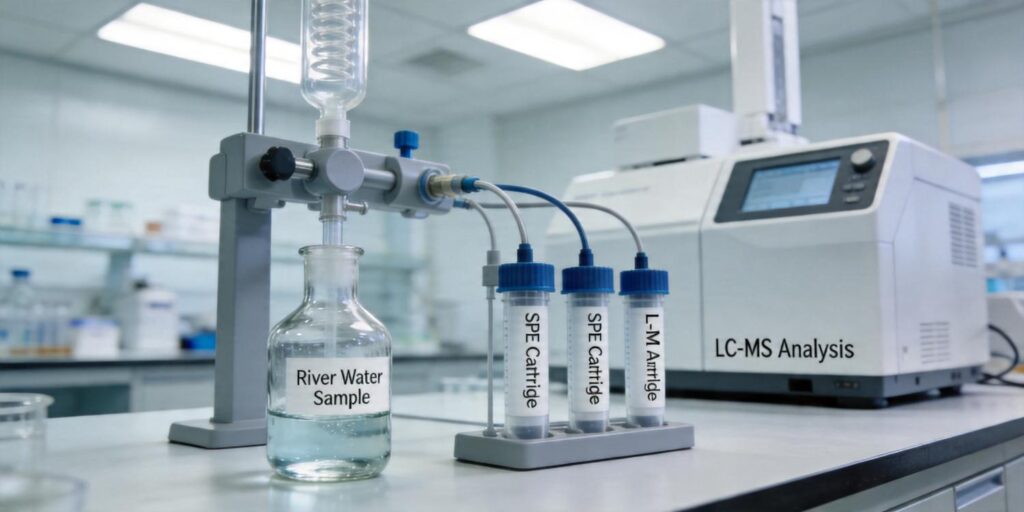
Proper sample handling is critical for accurate PPCP analysis in surface water. Immediate filtration through 0.45 μm glass fiber or nylon membranes removes suspended solids that could interfere with SPE efficiency. For samples with high particulate loads, pre-filtration through larger pore sizes (1-5 μm) may be necessary to prevent cartridge clogging.
Preservation typically involves acidification to pH 2-3 using hydrochloric or sulfuric acid to prevent microbial degradation of target analytes. Some protocols recommend adding sodium azide (0.1% w/v) as a biocide, though this may interfere with certain detection methods. Samples should be stored at 4°C and analyzed within 48 hours, though longer storage (up to 7 days) may be acceptable with proper preservation. For extended storage, freezing at -20°C is recommended, though some compounds may degrade during freeze-thaw cycles.
HLB SPE Cartridge Selection for Diverse Polarity Compounds
The hydrophilic-lipophilic balance (HLB) cartridge represents the optimal choice for PPCP extraction from surface water. Unlike traditional C18 phases that rely solely on hydrophobic interactions, HLB sorbents contain a copolymer of divinylbenzene and N-vinylpyrrolidone that provides both hydrophilic and lipophilic retention characteristics.
This dual retention mechanism enables efficient extraction of compounds across a wide polarity range – from hydrophobic UV filters (log P > 5) to relatively polar preservatives (log P < 2). The water-wettable nature of HLB sorbents allows direct loading of aqueous samples without the need for extensive conditioning steps required by silica-based phases. This characteristic is particularly valuable for surface water analysis where sample volumes may be large and flow rates need optimization.
For routine environmental monitoring, 200-500 mg cartridges with 6 mL reservoirs provide adequate capacity for typical 100-500 mL sample volumes. Higher capacity cartridges (1 g) may be necessary for samples with high organic content or when analyzing ultra-trace concentrations.
Conditioning and Loading Protocols
Proper conditioning ensures optimal sorbent activation and reproducible recoveries. The standard HLB conditioning protocol involves sequential passage of 5-10 mL methanol followed by 5-10 mL deionized water or acidified water (pH 2-3). The methanol serves to wet the sorbent surface and penetrate the bonded phase, while the aqueous solution removes excess methanol and prepares the sorbent for sample loading.
A critical consideration is maintaining sorbent wetness – the cartridge should not be allowed to dry between conditioning and sample loading. If drying occurs, the conditioning process must be repeated to ensure proper analyte retention.
Sample loading rates significantly impact recovery efficiency. For optimal results, maintain flow rates of 5-10 mL/min using vacuum or positive pressure. Slower flow rates (1-3 mL/min) may improve recovery for highly polar compounds but increase processing time. For large volume samples (>500 mL), consider using SPE disks or 96-well plates for improved throughput.
Washing Strategies to Remove Natural Organic Matter
Surface water contains complex mixtures of natural organic matter (NOM) including humic acids, fulvic acids, and other dissolved organic compounds that can co-extract with target analytes. Effective washing protocols must balance removal of these interferences with retention of target PPCPs.
A standard washing approach involves 5-10 mL of 5% methanol in water (acidified to pH 2-3). This solution effectively removes polar interferences while retaining most PPCPs on the HLB sorbent. For samples with high NOM content, additional washing with 2-5 mL of 0.1 M ammonium acetate buffer (pH 4.5) may improve extract cleanliness.
Some protocols incorporate a drying step after washing to remove residual water before elution. This is particularly important when using non-polar elution solvents that are immiscible with water. Drying can be achieved by applying vacuum for 5-10 minutes or passing a small volume of air through the cartridge.
Elution Solvents for PPCPs
Elution solvent selection depends on the polarity range of target analytes and downstream analytical requirements. For comprehensive PPCP analysis, mixed solvent systems often provide optimal recovery across compound classes.
Common elution protocols include:
- Methanol (5-10 mL): Effective for most PPCPs, particularly polar compounds
- Acetonitrile (5-10 mL): Provides good recovery for a wide range of compounds and evaporates rapidly
- Mixed solvents: Methanol:ethyl acetate (1:1, v/v) or methanol:dichloromethane (1:1, v/v) for broader polarity coverage
- Acidified or basified solvents: Methanol with 2% formic acid or 5% ammonium hydroxide for ionizable compounds
Elution volume typically ranges from 5-10 mL, though smaller volumes (2-3 mL) may be sufficient for highly retained compounds. Multiple elution fractions can improve recovery for compounds with varying retention characteristics. Allow the elution solvent to soak the sorbent for 30-60 seconds before applying vacuum to maximize analyte displacement.
LC-MS Detection of Trace Contaminants
Liquid chromatography-mass spectrometry (LC-MS) represents the analytical method of choice for PPCP detection in environmental samples. The combination of reversed-phase LC separation with tandem mass spectrometry (MS/MS) provides the sensitivity and selectivity required for trace-level analysis.
Chromatographic conditions typically involve C18 columns (100-150 mm × 2.1 mm, 3-5 μm particle size) with gradient elution using water and methanol or acetonitrile, both modified with 0.1% formic acid. The acidic modifier improves ionization efficiency in positive electrospray ionization (ESI+) mode, which is suitable for most PPCPs.
Mass spectrometric detection employs multiple reaction monitoring (MRM) for maximum sensitivity and specificity. Two transitions per compound provide both quantitation and confirmation, with careful optimization of collision energies and cone voltages for each analyte. Internal standards, preferably isotope-labeled analogs of target compounds, correct for matrix effects and recovery variations.
Method detection limits for well-optimized LC-MS/MS methods typically range from 0.1-10 ng/L, depending on compound ionization efficiency and matrix complexity.
Environmental Monitoring Considerations
Effective environmental monitoring of PPCPs requires careful consideration of sampling design, quality control, and data interpretation. Seasonal variations in water flow, temperature, and photodegradation rates can significantly affect detected concentrations. Composite sampling over 24-hour periods may provide more representative data than grab samples for wastewater-influenced sites.
Quality control measures should include field blanks, laboratory blanks, matrix spikes, and duplicate samples to assess contamination, recovery, and precision. Surrogate recovery standards added before extraction monitor method performance for each sample.
Data interpretation must consider transformation products and metabolites, as many PPCPs undergo biological or photochemical transformation in the environment. Some transformation products may be more persistent or toxic than parent compounds, necessitating expanded analytical scope.
Regular method validation against certified reference materials and participation in proficiency testing programs ensure data quality and comparability across monitoring programs. As analytical capabilities improve and new compounds of concern emerge, monitoring programs should remain flexible to incorporate emerging contaminants and evolving regulatory requirements.
For laboratories seeking reliable SPE solutions for environmental monitoring, Poseidon Scientific’s HLB SPE cartridges offer consistent performance for PPCP extraction. Our MCX and MAX cartridges provide additional selectivity for basic and acidic compounds, while our 96-well SPE plates enable high-throughput processing for large monitoring studies.