Importance of Monitoring Veterinary Drug Residues in Dairy
Veterinary drug residues in milk represent a significant public health concern with far-reaching implications for consumer safety, regulatory compliance, and international trade. The dairy industry operates under stringent regulations worldwide, with maximum residue limits (MRLs) established for various classes of veterinary drugs including antibiotics, sulfonamides, anthelmintics, and anti-inflammatory compounds.
Research by Long et al. (1990) demonstrated the importance of monitoring sulfonamide residues in milk, developing methods for the isolation and liquid chromatographic determination of eight sulfonamides. These compounds, when present above regulatory limits, can contribute to antimicrobial resistance development in human pathogens and may cause allergic reactions in sensitive individuals. The complex matrix of milk—containing proteins, fats, carbohydrates, and minerals—presents unique analytical challenges that require sophisticated sample preparation techniques.
Regulatory bodies including the FDA, EU Commission, and Codex Alimentarius have established comprehensive monitoring programs for veterinary drug residues in dairy products. Compliance with these regulations is not merely a legal requirement but also essential for maintaining consumer confidence and market access in an increasingly globalized dairy industry.
Sample Pretreatment and Protein Precipitation in Milk
Effective sample preparation is the cornerstone of reliable veterinary drug residue analysis in milk. The high protein content (approximately 3.3%) and complex lipid composition of milk necessitate careful pretreatment to prevent analytical interference and ensure method robustness.
Protein precipitation represents the initial critical step in milk sample preparation. Common approaches include:
- Acid precipitation using trichloroacetic acid (TCA) or perchloric acid
- Organic solvent precipitation with acetonitrile or methanol
- Combination methods employing acidified organic solvents
Studies by Long et al. (1990) utilized metaphosphoric acid/methanol mixtures (3:2 v/v) for effective deproteinization of milk samples. This approach simultaneously precipitates proteins while maintaining the stability of target analytes. Following precipitation, centrifugation at 4,000-5,000 × g for 10-15 minutes effectively separates the protein pellet from the supernatant containing the analytes of interest.
The choice of precipitation method depends on the target analyte class. For sulfonamides and tetracyclines, acid precipitation generally provides superior recovery, while for more lipophilic compounds, organic solvent precipitation may be preferred. Temperature control during this step is crucial, as excessive heat can degrade thermolabile antibiotics.
SPE Sorbent Choice for Antibiotics and Sulfonamides
The selection of appropriate solid-phase extraction sorbents is critical for successful veterinary drug residue analysis in milk. Different classes of veterinary drugs require specific sorbent chemistries based on their physicochemical properties.
Mixed-Mode Sorbents for Comprehensive Extraction
Mixed-mode sorbents combining reversed-phase and ion-exchange functionalities have demonstrated superior performance for veterinary drug residue analysis. As noted in veterinary drug abuse applications, mixed-mode cartridges like Certify® allow the rapid recovery of diverse groups including β-blockers, β-agonists, opiates, and basic diuretics. These sorbents provide enhanced selectivity by exploiting multiple retention mechanisms simultaneously.
Sorbent Selection by Drug Class
- Sulfonamides: Strong anion exchange (SAX) or mixed-mode anion exchange sorbents work effectively, particularly when operated at pH 6-8 where sulfonamides exist predominantly in their anionic form.
- Tetracyclines: These zwitterionic compounds benefit from mixed-mode sorbents with both hydrophobic and cation exchange properties. Studies by Long et al. (1990) successfully isolated oxytetracycline, tetracycline, and chlortetracycline from milk using appropriate sorbent selection.
- Macrolides and β-lactams: Reversed-phase sorbents (C18, C8) often provide adequate retention, though pH adjustment may be necessary for optimal recovery.
- Quinolones: These amphoteric compounds typically require mixed-mode sorbents for effective isolation from complex matrices.
Research by Van Poucke et al. (1991) demonstrated successful sulfonamide residue determination in milk using high-performance thin-layer chromatography following SPE cleanup, highlighting the versatility of properly selected sorbents.
Cartridge Conditioning and Extract Loading
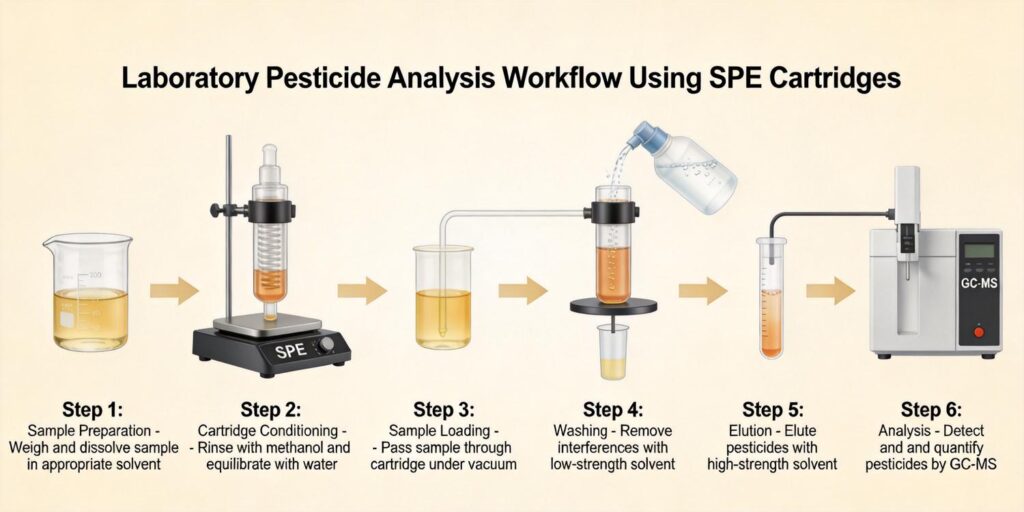
Proper SPE cartridge conditioning establishes the necessary environment for optimal analyte retention and matrix component removal. The conditioning protocol varies depending on sorbent chemistry but generally follows these principles:
Conditioning Protocols
For reversed-phase sorbents (C18, C8, HLB):
- Condition with 3-5 mL methanol to solvate the hydrophobic chains
- Rinse with 3-5 mL water or buffer to remove methanol and establish aqueous environment
- Maintain sorbent wetness throughout the loading process
For ion-exchange sorbents (SAX, SCX, MAX, MCX, WAX, WCX):
- Condition with 3-5 mL methanol to solvate the sorbent
- Equilibrate with 3-5 mL buffer at appropriate pH to establish ionic form
- Ensure sorbent remains moist to prevent channeling
As demonstrated in pharmaceutical cream analysis, proper conditioning of SPE columns is essential for reproducible results. For SAX sorbents, conditioning typically involves rinsing with methanol followed by methanol-buffer solution (pH 8) (1:1, v/v), while SCX sorbents require methanol followed by buffer solution (pH 4.5).
Extract Loading Considerations
The deproteinized milk extract should be loaded onto the conditioned cartridge at a controlled flow rate, typically 1-3 mL/min. For viscous samples or those with particulate matter, filtration through a 0.45 μm membrane prior to loading is recommended. The loading volume should not exceed the cartridge’s breakthrough capacity, which for veterinary drug residues in milk typically ranges from 10-50 mL depending on sorbent mass and analyte concentration.
Washing Steps to Remove Fats and Proteins
Effective washing protocols are essential for removing matrix interferences while retaining target analytes. Milk contains significant amounts of fats, proteins, and other endogenous compounds that can interfere with subsequent chromatographic analysis.
Washing Strategy Development
The washing step should be optimized to maximize interference removal while minimizing analyte loss. Common washing solvents include:
- Water or aqueous buffers: Remove polar interferences and salts
- Water-methanol mixtures (5-20% methanol): Remove moderately polar interferences
- Water-acetonitrile mixtures: Alternative to methanol-based washes
- Hexane or heptane: Remove non-polar lipids (for reversed-phase sorbents)
For mixed-mode sorbents, washing protocols become more complex. As noted in veterinary applications, mixed-mode cartridges allow elimination of compounds such as cholesterol, vitamin E, and fatty acids that are prominent in fractions recovered by solvent extraction. The washing step typically involves:
- Water or dilute buffer to remove salts and polar interferences
- Water-methanol mixtures to remove neutral interferences
- Mild acidic or basic solutions to remove ionizable interferences without eluting target analytes
Research by Bonazzi et al. (1995) demonstrated that for basic drugs like chlorhexidine, washing with buffer solution (pH 4.5) effectively removed interferences while retaining the target analytes on PRS (propylsulphonic acid) SPE columns.
Elution with Organic Solvent Mixtures
The elution step must efficiently recover target analytes while minimizing co-elution of remaining interferences. Elution solvent selection depends on sorbent chemistry and analyte properties.
Elution Solvent Systems
For reversed-phase sorbents:
- Methanol: Effective for moderately polar to non-polar compounds
- Acetonitrile: Alternative to methanol, often provides cleaner extracts
- Methanol or acetonitrile with acid modifiers (0.1-1% formic acid): Enhances elution of basic compounds
- Methanol or acetonitrile with base modifiers (ammonium hydroxide): Enhances elution of acidic compounds
For ion-exchange sorbents:
- Methanol with competing ions: For anion exchange (e.g., chloride, acetate)
- Methanol with pH adjustment: To neutralize ionic interactions
- Methanol-buffer mixtures: As demonstrated in pharmaceutical analysis where ibuprofen was eluted from SAX columns with methanol-phosphate buffer solution (pH 4.5) (9:1, v/v)
For mixed-mode sorbents, elution typically requires solvent mixtures that disrupt both hydrophobic and ionic interactions. Common approaches include:
- Organic solvent with acid or base to disrupt ionic interactions
- High organic content to disrupt hydrophobic interactions
- Sequential elution for fractionation of different compound classes
Studies have shown that elution of acidic and neutral drugs from mixed-mode sorbents often requires aprotic organic solvents following conversion of acids to their protonated forms on the SPE cartridge.
LC-MS/MS Detection Method
Liquid chromatography coupled with tandem mass spectrometry (LC-MS/MS) has become the gold standard for veterinary drug residue analysis in milk due to its exceptional sensitivity, selectivity, and ability to confirm analyte identity.
Chromatographic Considerations
Reversed-phase chromatography using C18 or equivalent columns remains the most common approach for veterinary drug analysis. Mobile phase composition typically involves:
- Aqueous phase: Water with 0.1% formic acid or 5-10 mM ammonium acetate/formate
- Organic phase: Methanol or acetonitrile with same modifiers
- Gradient elution: Essential for separating diverse compound classes
Column temperature control (30-40°C) improves peak shape and reproducibility, while flow rates of 0.2-0.5 mL/min provide optimal separation for most applications.
Mass Spectrometric Detection
Modern triple quadrupole mass spectrometers operating in multiple reaction monitoring (MRM) mode provide the necessary sensitivity and specificity for regulatory compliance monitoring. Key considerations include:
- Ionization mode: Electrospray ionization (ESI) positive or negative mode depending on analyte properties
- Source parameters: Optimized for each compound class
- MRM transitions: Typically two transitions per compound for confirmation
- Collision energies: Optimized for each transition
As noted in veterinary applications, LC-MS interfaces allow the introduction of aqueous samples into the mass spectrometer and may reduce the need for derivatization of some compounds. The technique has found significant application in the analysis of water-soluble compounds including sulfonamides and carboxylates for which HPLC is the preferred chromatographic method.
Validation and Regulatory Compliance
Method validation is essential for demonstrating fitness-for-purpose and ensuring regulatory compliance. Comprehensive validation should address the following parameters:
Validation Parameters
- Selectivity/Specificity: Demonstration of absence of interference from matrix components
- Linearity: Typically over 1-2 orders of magnitude covering the regulatory range
- Accuracy: Determined through recovery studies at multiple concentration levels
- Precision: Both within-day and between-day variability
- Limit of Detection (LOD) and Quantification (LOQ): Sufficiently low to detect residues at regulatory limits
- Matrix Effects: Evaluation and compensation for ionization suppression/enhancement
- Ruggedness/Robustness: Assessment of method performance under varying conditions
Regulatory Framework
Veterinary drug residue methods must comply with relevant guidelines including:
- European Commission Decision 2002/657/EC for performance criteria
- FDA Guidelines for the Validation of Chemical Methods
- Codex Alimentarius Guidelines
- ISO 17025 requirements for testing laboratories
The requirement for analytical results that can be defended under both scientific and legal scrutiny demands the use of techniques that provide unequivocal results. As noted in veterinary drug analysis, the “fingerprint” of a digitized mass spectrum provides more definitive identification of a compound at biological concentrations than other techniques.
Quality Control Measures
Routine analysis should include:
- Method blanks to monitor contamination
- Fortified samples at multiple concentration levels
- Certified reference materials when available
- Internal standards for quantification
- System suitability tests
Proper documentation of all validation parameters and ongoing quality control measures is essential for maintaining regulatory compliance and ensuring the reliability of analytical results in veterinary drug residue monitoring programs.
For laboratories seeking optimized SPE solutions for veterinary drug analysis in milk, Poseidon Scientific offers a comprehensive range of HLB SPE cartridges, MAX SPE cartridges, MCX SPE cartridges, WAX SPE cartridges, WCX SPE cartridges, and 96-well SPE plates designed to meet the rigorous demands of modern analytical laboratories.