Chemical Properties of Alkaloids: Basic Nitrogen Compounds
Alkaloids represent a diverse class of naturally occurring organic compounds characterized by their basic nitrogen atoms, typically derived from amino acids. These compounds exhibit a wide range of pharmacological activities and are found in approximately 20% of plant species. The basic nature of alkaloids stems from the presence of nitrogen atoms that can accept protons, making them particularly amenable to cation-exchange solid-phase extraction (SPE) techniques.
From a chemical perspective, alkaloids typically contain one or more nitrogen atoms within heterocyclic ring systems. Their basicity (pKa values) varies significantly depending on the specific structural features, with most alkaloids having pKa values ranging from 6 to 12. This basic character allows them to form positively charged species (cations) under acidic conditions, which is crucial for their selective retention on cation-exchange sorbents during SPE procedures.
The structural diversity of alkaloids includes several major classes: isoquinoline alkaloids (morphine, codeine), indole alkaloids (strychnine, reserpine), tropane alkaloids (atropine, cocaine), pyrrolizidine alkaloids, and quinolizidine alkaloids. Each class presents unique challenges and opportunities for extraction and purification, necessitating careful method development.
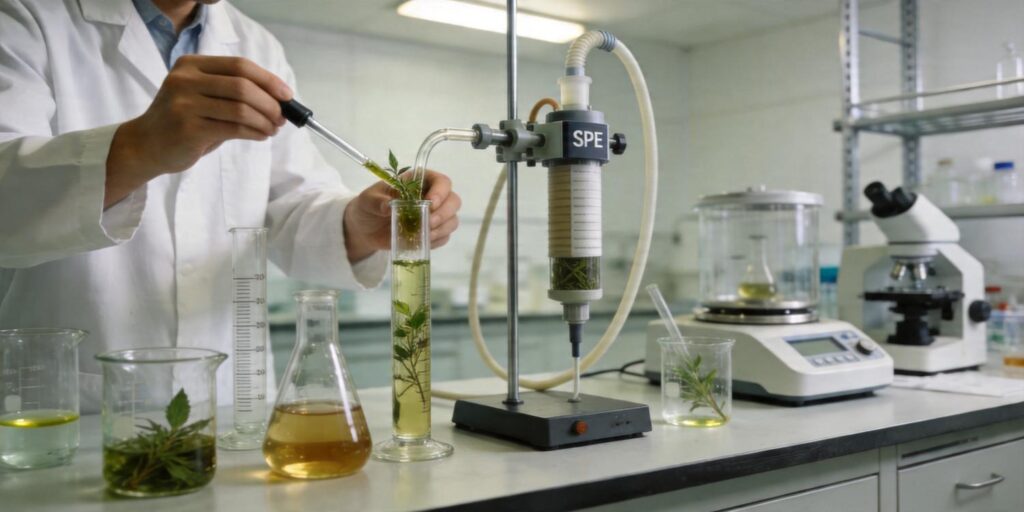
Sample Extraction from Plant Tissue Using Acidified Solvent
Effective alkaloid extraction begins with proper sample preparation from plant materials. Plant tissues consist of aqueous, fatty, and insoluble fibrous components, requiring strategic extraction approaches. The methodology described by Simpson (2000) demonstrates that plant homogenates prepared in phosphate buffer can successfully isolate a wide range of basic alkaloids from plant tissues.
The standard approach involves homogenizing plant material in an acidified solvent system, typically using dilute hydrochloric acid, formic acid, or acetic acid in methanol or water. The acidification serves two critical purposes: it protonates the basic nitrogen atoms of alkaloids, converting them to water-soluble cations, and it helps break down plant cell walls to release intracellular alkaloids. Common extraction solvents include methanol-water (80:20, v/v) acidified with 0.1-1% formic acid or hydrochloric acid.
After homogenization, the mixture is typically centrifuged or filtered to remove particulate matter. The resulting acidic extract contains protonated alkaloids along with various plant matrix components, including pigments, phenolic compounds, sugars, and other polar constituents. This extract serves as the loading solution for subsequent SPE purification.
MCX or Cation-Exchange SPE Sorbent Selection
Selecting the appropriate SPE sorbent is critical for successful alkaloid isolation. Mixed-mode cation exchange (MCX) sorbents represent the gold standard for alkaloid extraction due to their dual retention mechanisms. As documented in Waters technical literature, Oasis MCX sorbents combine reversed-phase retention with strong cation-exchange functionality (sulfonic acid groups), providing exceptional selectivity for basic compounds.
The mixed-mode mechanism operates through two complementary interactions: hydrophobic interactions with the polymeric backbone and ionic interactions with the sulfonic acid groups. This dual retention ensures strong binding of protonated alkaloids even in the presence of high organic solvent concentrations during washing steps. The tightly controlled ion-exchange capacity of 1 meq/g in Oasis MCX sorbents ensures reproducible extraction protocols.
Alternative cation-exchange options include strong cation exchange (SCX) sorbents with benzenesulfonic acid or propylsulfonic acid functional groups. Research by Strobiecki et al. (1997) demonstrated successful application of both SCX and C18 sorbents in tandem for separating quinolizidine alkaloids and phenolic compounds in lupin seedlings. However, mixed-mode sorbents generally offer superior performance for complex plant matrices.
Conditioning and Loading Acidic Extracts
Proper SPE cartridge conditioning establishes the optimal environment for alkaloid retention. For MCX cartridges, the standard conditioning protocol involves sequential treatment with methanol (or acetonitrile) followed by acidified water or buffer. This two-step process serves to activate the sorbent, remove potential contaminants, and prepare the ionic exchange sites for interaction with protonated alkaloids.
The conditioning sequence typically includes:
- 3-6 mL methanol to solvate the polymeric matrix and remove any manufacturing residues
- 3-6 mL acidified water (pH 2-4) to protonate the cation-exchange sites and establish the appropriate ionic environment
Loading the acidic plant extract should be performed at a controlled flow rate (typically 1-3 drops per second) to ensure optimal interaction between protonated alkaloids and the cation-exchange sites. The sample pH during loading should be maintained at least 2 pH units below the pKa of the target alkaloids to ensure complete protonation and efficient retention.
Washing to Remove Neutral Plant Compounds
Selective washing represents a critical step in removing interfering compounds while retaining target alkaloids on the SPE cartridge. The washing strategy leverages the dual retention mechanism of MCX sorbents to eliminate neutral and acidic plant constituents while maintaining strong ionic binding of protonated alkaloids.
Recommended washing protocols typically include:
- Water or dilute acid (2% formic acid) to remove water-soluble polar compounds
- Methanol or methanol-water mixtures to elute neutral compounds retained by reversed-phase interactions
- Optional: Additional organic solvent washes with controlled pH to remove specific interference classes
The washing step effectively removes pigments, phenolic compounds, sugars, and other neutral plant constituents that could interfere with downstream analysis. The protonated alkaloids remain strongly bound through ionic interactions with the sulfonic acid groups, unaffected by the organic solvent washes.
Elution Using Alkaline Methanol
Alkaloid elution from MCX cartridges employs alkaline conditions to neutralize the protonated nitrogen atoms, disrupting the ionic interactions with the cation-exchange sites. The standard elution solvent consists of methanol containing 2-5% ammonium hydroxide or other alkaline modifiers.
The alkaline methanol serves dual purposes:
- Neutralizes the protonated alkaloids, converting them back to their neutral forms
- Provides sufficient organic solvent strength to elute the now-neutral compounds from the reversed-phase component of the sorbent
Typical elution volumes range from 3-6 mL, depending on cartridge size and alkaloid loading. The eluate should be collected in a clean vessel and may require concentration (nitrogen evaporation) and reconstitution in appropriate solvent for subsequent analysis. Some protocols recommend a two-step elution: first with methanol to remove any remaining neutral compounds, followed by alkaline methanol for alkaloid elution.
LC-MS Analysis of Plant Alkaloids
Liquid chromatography-mass spectrometry (LC-MS) represents the analytical method of choice for alkaloid characterization and quantification following SPE purification. The combination of chromatographic separation with mass spectrometric detection provides exceptional sensitivity and specificity for complex plant alkaloid mixtures.
Recommended LC-MS conditions for alkaloid analysis typically include:
- Chromatography: Reversed-phase C18 or C8 columns with gradient elution using water-acetonitrile or water-methanol mobile phases containing volatile buffers (ammonium formate, ammonium acetate)
- Mass Spectrometry: Electrospray ionization (ESI) in positive ion mode, with selected ion monitoring (SIM) or multiple reaction monitoring (MRM) for targeted analysis
- Method Optimization: Consideration of alkaloid-specific parameters including ionization efficiency, fragmentation patterns, and chromatographic behavior
The SPE-purified alkaloid extracts typically yield clean chromatograms with minimal matrix interference, enabling accurate quantification and structural characterization. For comprehensive alkaloid profiling, high-resolution mass spectrometry (HRMS) coupled with LC separation provides detailed molecular formula information and facilitates identification of novel alkaloids.
Optimization of pH and Solvent Strength
Method optimization represents a critical aspect of developing robust alkaloid extraction protocols. Key parameters requiring optimization include pH control throughout the SPE process and appropriate solvent selection for each step.
pH Optimization
The sample pH during loading should be maintained at least 2 pH units below the lowest pKa of target alkaloids to ensure complete protonation. For alkaloids with pKa values ranging from 6-12, loading at pH 2-4 typically ensures efficient retention. Washing steps should maintain acidic conditions (pH 2-4) to preserve alkaloid protonation, while elution requires alkaline conditions (pH 10-12) to neutralize the alkaloids and disrupt ionic interactions.
Solvent Strength Optimization
Solvent composition significantly impacts extraction efficiency:
- Loading Solvent: Should contain sufficient water (≥10%) to maintain alkaloid solubility while minimizing organic content to prevent premature elution
- Washing Solvents: Methanol or acetonitrile with controlled water content (0-20%) effectively removes neutral compounds without eluting protonated alkaloids
- Elution Solvent: Methanol or acetonitrile with 2-5% ammonium hydroxide provides optimal alkaloid recovery
Method Validation
Comprehensive method validation should include assessment of recovery, precision, linearity, and matrix effects. Recovery studies using spiked plant matrices help evaluate extraction efficiency, while precision assessments ensure method reproducibility. Linearity should be established across the expected concentration range, and matrix effects should be evaluated using post-extraction spiking approaches.
For laboratories requiring high-throughput analysis, 96-well SPE plates offer significant advantages in processing efficiency. Poseidon Scientific provides comprehensive 96-well SPE plate solutions compatible with automated liquid handling systems, enabling simultaneous processing of multiple samples with consistent results.
Conclusion
SPE isolation of alkaloids from plant extracts represents a powerful methodology combining the selectivity of cation-exchange chemistry with the efficiency of solid-phase extraction. The MCX mixed-mode approach provides exceptional purification of basic alkaloids from complex plant matrices, yielding clean extracts suitable for sensitive analytical techniques like LC-MS.
Successful implementation requires careful attention to sample preparation, pH control, solvent selection, and method optimization. By following established protocols and leveraging advanced sorbent technologies like Poseidon Scientific’s MCX SPE cartridges, researchers can achieve reliable, reproducible alkaloid extraction with minimal matrix interference.
The continued evolution of SPE technologies, including improved sorbent chemistries and automated processing platforms, promises to further enhance alkaloid isolation efficiency and expand applications in natural product research, pharmaceutical development, and quality control of herbal preparations.