The Complexity of Food Matrices in Pesticide Residue Analysis
Food pesticide analysis presents unique challenges due to the complex nature of food matrices. Fruits, vegetables, grains, and processed foods contain diverse interfering compounds including pigments, sugars, organic acids, fats, waxes, and natural plant metabolites. These matrix components can co-extract with target pesticides, leading to signal suppression or enhancement in analytical instruments, reduced column lifetime, and increased background noise. According to Simpson and Wynne (2000), the high or variable water and fat contents of citrus fruit, berries, and nuts can present capacity problems during extraction, requiring careful method optimization.
The variability in matrix composition across different food types necessitates adaptable cleanup strategies. For instance, fruits like apples contain significant waxes that require specific removal techniques, while leafy vegetables contain chlorophyll and other pigments that interfere with detection. The Luke procedure, as described in literature, demonstrates how SPE steps contribute to cleanup of matrix components where plant sugars and acids are retained on SAX and PSA sorbents while analytes pass through unretained.
Comparison of QuEChERS and SPE Cleanup Approaches
Two primary approaches dominate food pesticide analysis: QuEChERS (Quick, Easy, Cheap, Effective, Rugged, and Safe) and traditional Solid Phase Extraction (SPE). QuEChERS methods offer simplified protocols with decreased sample preparation time, making them ideal for multi-residue analysis of pesticides, veterinary drugs, and mycotoxins in various food products. Waters’ DisQuE products, for example, provide pre-weighed sorbents and buffers in pouches and tubes that conform to both AOAC and CEN protocols.
Traditional SPE, however, offers superior selectivity and cleaner extracts for specific applications. SPE provides higher and more reproducible recoveries, cleaner extracts with less contamination, and tunable selectivity through various phase choices and solvent mixtures. While QuEChERS excels in high-throughput screening, SPE remains essential for challenging matrices or when ultra-clean extracts are required for sensitive detection methods.
SPE Sorbent Choices for Pesticide Classes
Selecting appropriate SPE sorbents is critical for effective pesticide residue cleanup. Different pesticide classes require specific sorbent chemistries:
Reversed-Phase Sorbents (C18, C8, HLB)
These sorbents are ideal for non-polar to moderately polar pesticides. C18 cartridges effectively retain organochlorine pesticides, pyrethroids, and many organophosphates. Hydrophilic-Lipophilic Balanced (HLB) sorbents offer superior retention for a broader range of polarities, making them excellent for multi-class pesticide analysis.
Normal-Phase Sorbents (Silica, Florisil, Alumina)
These are particularly effective for removing pigments, fats, and waxes from food extracts. Florisil solid-phase extraction cartridges have been specifically validated for cleanup of organochlorine pesticide residues in foods, providing excellent removal of lipid interferences.
Mixed-Mode and Ion-Exchange Sorbents (MCX, MAX, WAX, WCX)
Mixed-mode sorbents combine reversed-phase and ion-exchange mechanisms, making them ideal for acidic or basic pesticides. For chlorphenoxy acids, which must be methylated before passage through SAX/PSA combination cartridges to prevent retention, these sorbents offer exceptional selectivity.
Conditioning and Extract Loading from Acetonitrile Extracts
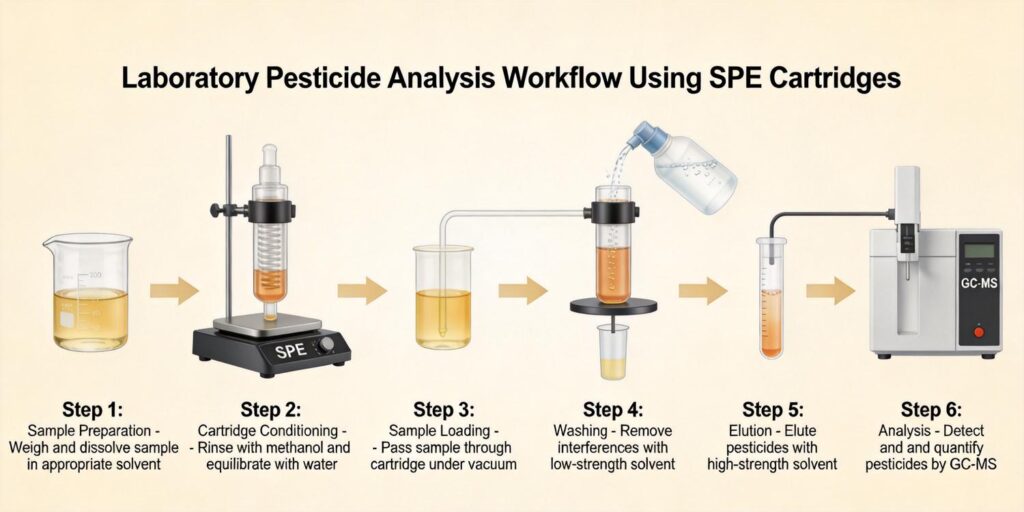
Proper conditioning of SPE cartridges is essential for optimal performance. For reversed-phase sorbents, typical conditioning involves sequential passage of methanol (or acetonitrile) followed by water or buffer. This process activates the sorbent and creates the proper environment for analyte retention.
When loading acetonitrile extracts, careful consideration must be given to solvent strength. Acetonitrile is a strong elution solvent for reversed-phase sorbents, so extracts often require dilution with water to reduce solvent strength and ensure proper analyte retention. The general procedure involves loading the solution through the SPE phase at controlled flow rates (typically 1-3 drops per second), as recovery is inversely proportional to flow rate.
Removal of Pigments, Fats, and Sugars
Food matrices contain numerous interfering compounds that must be removed during cleanup. Simpson and Wynne (2000) note that elimination of co-extracted waxes, often problematic in fruit analysis, can sometimes be achieved post-extraction by careful selection of solvents for reconstitution. Since waxes are typically insoluble in methanol, this solvent can be used to redissolve an SPE eluate after evaporation, resulting in precipitation of the waxes.
For pigment removal, normal-phase sorbents like Florisil or silica are particularly effective. Sugars and organic acids can be removed using primary secondary amine (PSA) sorbents or anion-exchange materials. The combination of different sorbent chemistries in stacked cartridges or mixed-mode phases provides comprehensive cleanup for complex food matrices.
Elution Solvent Systems Compatible with GC-MS/LC-MS
Choosing appropriate elution solvents is crucial for compatibility with downstream analytical techniques. For GC-MS analysis, non-polar solvents like hexane, toluene, or ethyl acetate are preferred. The chlorpyrifos analysis case study demonstrates successful elution using 5mL of hexane, followed by concentration to about 1mL using gentle nitrogen evaporation.
For LC-MS applications, more polar solvents are required. Acetonitrile and methanol, often with modifiers like formic acid or ammonium acetate, provide excellent elution while maintaining compatibility with reversed-phase LC columns. The key consideration is ensuring the elution solvent is compatible with the analytical instrument’s injection system and doesn’t cause matrix effects in the ionization source.
Recovery and Matrix Effect Evaluation
Method validation requires thorough evaluation of recovery rates and matrix effects. According to Agilent documentation, QuEChERS methods typically achieve high recovery rates (mostly 90-110%) with RSDs <5%. These parameters are essential for regulatory compliance and reliable quantification.
Matrix effects, particularly in LC-MS/MS analysis, can significantly impact method accuracy. Signal suppression or enhancement must be evaluated using matrix-matched calibration standards. The use of isotopically labeled internal standards helps compensate for these effects, but proper cleanup through SPE remains the first line of defense against matrix interference.
Case Study: Fruit Pesticide Screening
A comprehensive study by Luke (1995) explores the extraction of a large range of pesticides from fruit and vegetable matrices. This method demonstrates considerable sample manipulation and liquid-liquid extraction, indicating its origins as an LLE method to which other preparation steps and SPE extractions have been added as method goals became more stringent.
For fruit analysis specifically, the extraction of benzimidazole fungicides with acetone from various fruits and vegetables followed by SPE cleanup on diol-bonded sorbents has been reported. This approach effectively removes matrix interferences while maintaining high recovery of target analytes. The method’s success highlights the importance of selecting sorbents that complement the extraction solvent and target analyte properties.
Modern approaches increasingly utilize mixed-mode sorbents and optimized solvent systems to streamline fruit pesticide analysis while maintaining regulatory compliance. The evolution from traditional LLE to sophisticated SPE methods represents significant progress in food safety testing, enabling laboratories to detect pesticide residues at increasingly lower levels with greater confidence and efficiency.