Importance of Metabolite Profiling in Biomedical Research
Metabolite profiling has emerged as a critical component in modern biomedical research, providing unprecedented insights into biological systems at the molecular level. Unlike genomics and proteomics, which focus on potential biological activities, metabolomics captures the actual biochemical phenotype resulting from genetic, environmental, and lifestyle factors. This “downstream” approach offers a direct reflection of cellular processes, making it invaluable for biomarker discovery, disease diagnosis, therapeutic monitoring, and understanding metabolic pathways.
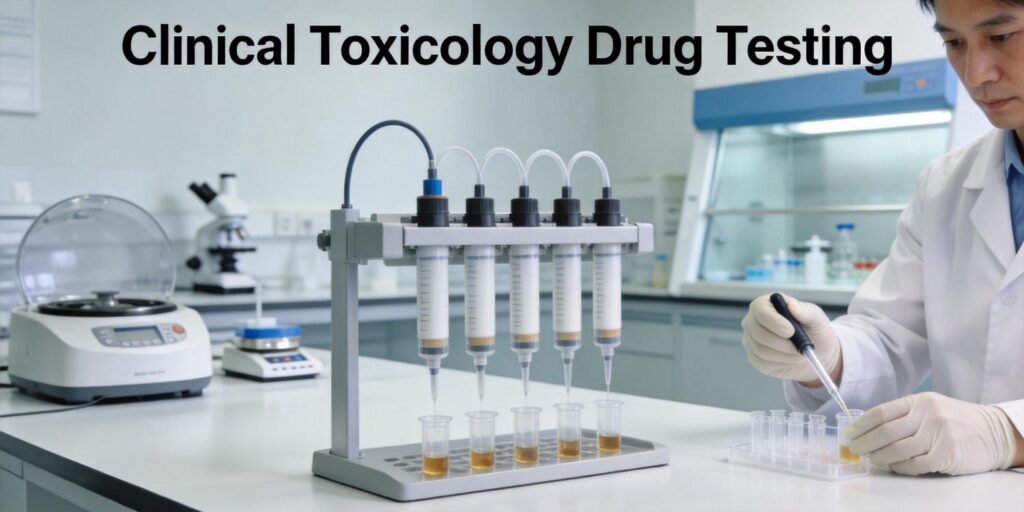
In urine analysis specifically, metabolite profiling provides a non-invasive window into systemic metabolism. Urine contains a rich array of endogenous metabolites, drug metabolites, and exogenous compounds that collectively represent the body’s metabolic state. The comprehensive nature of urine metabolomics allows researchers to identify metabolic signatures associated with various conditions, from cancer and cardiovascular diseases to neurological disorders and metabolic syndromes.
The clinical significance of urine metabolite analysis extends beyond research applications. Therapeutic drug monitoring, detection of inborn errors of metabolism, and assessment of organ function all rely on accurate metabolite quantification in urine samples. As Simpson and Wynne noted in their comprehensive review, “Urine is by far the most common matrix analyzed in the screening or confirmation of drugs of abuse in humans and animals,” highlighting its established role in analytical toxicology and clinical chemistry.
Matrix Complexity of Urine Samples
Understanding the complex nature of urine is fundamental to developing effective sample preparation strategies. Urine composition is highly variable, consisting of approximately 95% water with the remaining 5% containing a diverse mixture of organic and inorganic compounds. As documented in forensic and clinical applications, “The composition of urine is highly variable and changes considerably with the nature and composition of the diet and amount of endogenous metabolites, and depends on other factors such as body weight, emotional status, rate of metabolism, and so forth.”
Key Challenges in Urine Matrix
- Variable pH and Ionic Strength: Normal urine pH ranges from 4.5 to 8.0, significantly affecting analyte ionization and extraction efficiency. Electrolyte content varies considerably depending on diet and hydration status.
- High Levels of Endogenous Compounds: Urine contains numerous hydrophilic compounds including urea, creatinine, amino acids, sugars, and organic acids that can interfere with target metabolite analysis.
- Conjugated Metabolites: Many drugs and endogenous compounds are excreted as glucuronide, sulfate, or other conjugates, requiring hydrolysis steps for accurate quantification of parent compounds.
- Matrix Effects: The presence of pigments, proteins, and variable salt concentrations can cause significant matrix effects in analytical detection systems.
- Sample Stability Issues: Bacterial contamination and enzymatic activity can compromise analyte stability, particularly for labile metabolites.
Ingwersen’s research on SPE of biological samples emphasizes that “Urine is characterized by a low protein content and by a less well defined sample matrix than plasma. For instance, urine pH varies between 4.5 and 8 in normal subjects and the content of electrolytes also varies considerably, depending on the diet and the rate of urine production.” This variability necessitates robust sample preparation methods that can accommodate diverse sample characteristics.
SPE Sorbent Selection for Polar Metabolites
Selecting appropriate SPE sorbents for polar metabolite extraction requires careful consideration of analyte properties and matrix characteristics. Traditional reversed-phase sorbents like C18 often prove inadequate for highly polar compounds due to insufficient retention. As research indicates, “Occasionally, adjusting a method for urine can be a difficult task, particularly where the extraction requires isolation of a hydrophilic analyte in the presence of high levels of the endogenous hydrophilic compounds typically found in urine.”
Recommended Sorbents for Polar Metabolites
Hydrophilic-Lipophilic Balanced (HLB) Phases
HLB sorbents, such as those available from Poseidon Scientific, offer balanced retention for both polar and non-polar compounds. These copolymer-based materials provide superior recovery for polar metabolites compared to traditional silica-based phases. The HLB mechanism combines hydrophilic N-vinylpyrrolidone with lipophilic divinylbenzene, creating a sorbent that retains compounds across a wide polarity range.
Mixed-Mode Sorbents
Mixed-mode sorbents combining reversed-phase and ion-exchange functionalities provide enhanced selectivity for charged metabolites. For acidic metabolites, weak anion exchange (WAX) or strong anion exchange (SAX) phases offer excellent retention when analytes are ionized. Similarly, weak cation exchange (WCX) or strong cation exchange (SCX) phases effectively retain basic metabolites. Poseidon Scientific’s MCX (Mixed-mode Cation Exchange) and MAX (Mixed-mode Anion Exchange) cartridges exemplify this approach, providing dual retention mechanisms for improved selectivity.
Specialized Polar Phases
For extremely polar metabolites, specialized phases may be necessary:
- Diol Phases: Useful for compounds with hydroxyl groups through hydrogen bonding interactions
- Cyano Phases: Offer intermediate polarity with both hydrophobic and dipole-dipole interactions
- Porous Graphitic Carbon: Provides unique retention for highly polar compounds that don’t retain well on traditional phases
pH Considerations in Sorbent Selection
Proper pH adjustment is critical for optimizing retention of ionizable metabolites. For acidic compounds, sample acidification (pH 2-3) suppresses ionization and enhances retention on reversed-phase sorbents. For basic compounds, alkalization (pH 9-10) achieves similar effects. When using ion-exchange sorbents, opposite pH strategies apply—acidic conditions promote cation exchange retention, while basic conditions favor anion exchange.
Example Urine Sample Preparation Workflow
A comprehensive urine metabolite analysis workflow typically involves several critical steps to ensure accurate and reproducible results. The following protocol represents a robust approach suitable for most polar metabolite applications:
Step 1: Sample Collection and Preservation
Collect mid-stream urine in appropriate containers, preferably with preservatives (sodium azide, boric acid) to inhibit bacterial growth. Store samples at -80°C if not processed immediately to prevent metabolite degradation.
Step 2: Sample Pretreatment
- Thawing and Mixing: Thaw frozen samples at 4°C overnight and mix thoroughly to ensure homogeneity.
- Centrifugation: Centrifuge at 10,000 × g for 10 minutes at 4°C to remove particulate matter.
- pH Adjustment: Adjust supernatant pH according to target metabolite properties and selected SPE mechanism.
- Dilution: Dilute urine 1:1 with appropriate buffer to reduce matrix effects and improve flow characteristics during SPE.
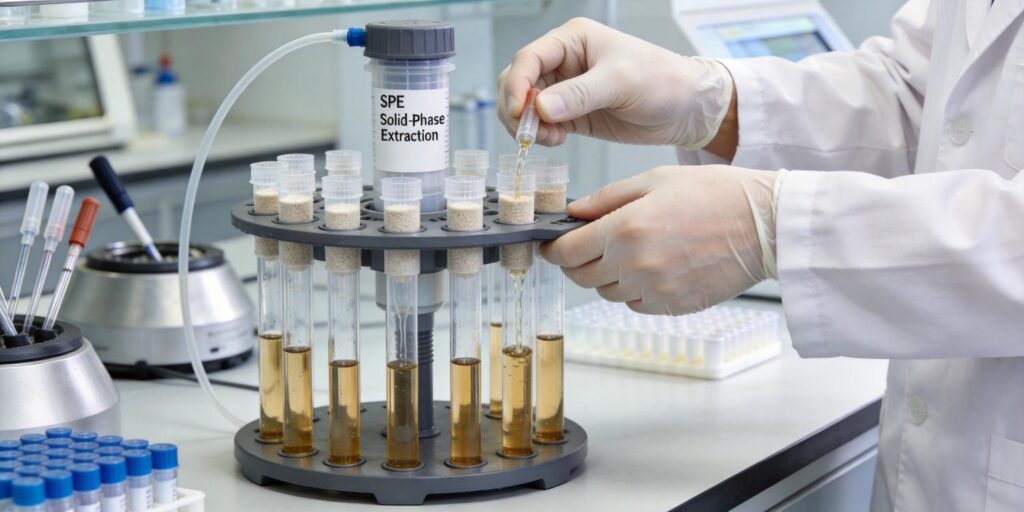
Step 3: SPE Procedure Using HLB Cartridges
- Conditioning: Condition Poseidon Scientific HLB cartridge (60 mg, 3 mL) with 3 mL methanol followed by 3 mL water or appropriate buffer.
- Sample Loading: Load diluted urine sample at 1-2 mL/min flow rate.
- Washing: Wash with 3 mL 5% methanol in water to remove weakly retained interferences.
- Drying: Apply vacuum or positive pressure for 5 minutes to remove residual water.
- Elution: Elute metabolites with 2 × 1 mL methanol or methanol:acetonitrile (1:1) mixture.
- Concentration: Evaporate eluate to dryness under nitrogen at 35°C and reconstitute in mobile phase compatible solvent.
Step 4: Hydrolysis (When Required)
For conjugated metabolites, enzymatic hydrolysis with β-glucuronidase/sulfatase (12-18 hours at 37°C) or acid hydrolysis (20 minutes at 90°C with 1M HCl) may be necessary prior to SPE. Enzymatic hydrolysis is preferred for labile compounds to prevent degradation.
LC-MS/MS Metabolite Detection Strategies
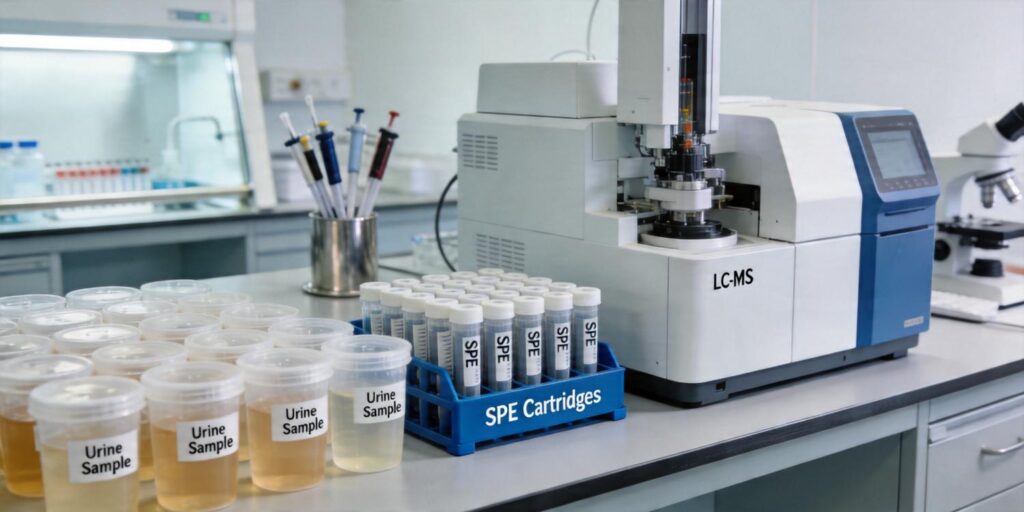
Liquid chromatography coupled with tandem mass spectrometry (LC-MS/MS) represents the gold standard for metabolite detection due to its superior sensitivity, selectivity, and capability for multiplexed analysis. Successful implementation requires optimization of both chromatographic separation and mass spectrometric detection parameters.
Chromatographic Considerations
Stationary Phase Selection
For polar metabolite separation, hydrophilic interaction liquid chromatography (HILIC) often outperforms reversed-phase chromatography. HILIC columns retain polar compounds through partitioning between a water-rich layer on the stationary phase and the organic-rich mobile phase. Poseidon Scientific recommends:
- Amide-based HILIC: Excellent for sugars, amino acids, and organic acids
- Silica-based HILIC: Suitable for basic compounds and nucleotides
- Mixed-mode Columns: Combine HILIC and reversed-phase mechanisms for comprehensive coverage
Mobile Phase Optimization
HILIC mobile phases typically consist of acetonitrile with small amounts of aqueous buffer (5-40%). Ammonium acetate or formate buffers (5-20 mM) at pH 3-5 provide good ionization efficiency for both positive and negative electrospray ionization modes.
Mass Spectrometric Strategies
Ionization Techniques
Electrospray ionization (ESI) remains the most common technique for metabolite analysis due to its compatibility with aqueous mobile phases and gentle ionization that preserves molecular information. Atmospheric pressure chemical ionization (APCI) may be preferable for less polar compounds.
Scanning Modes
- Full Scan MS: For untargeted metabolomics and discovery applications
- Selected Reaction Monitoring (SRM): For targeted quantification with maximum sensitivity
- Multiple Reaction Monitoring (MRM): For simultaneous quantification of multiple metabolites
- Neutral Loss/Precursor Ion Scanning: For class-specific metabolite screening
Data Acquisition Parameters
Optimize collision energies, declustering potentials, and entrance potentials for each metabolite to maximize sensitivity. Use scheduled MRM to maintain adequate dwell times across chromatographic peaks.
Improving Reproducibility in Metabolomics Studies
Reproducibility remains a significant challenge in metabolomics, particularly for urine analysis where matrix variability is substantial. Implementing rigorous quality control measures throughout the analytical workflow is essential for generating reliable data.
Pre-analytical Considerations
Standardized Sample Collection
Establish standardized protocols for urine collection, including time of day, fasting status, and collection containers. First morning voids typically provide more concentrated samples with reduced diurnal variation.
Internal Standards
Incorporate stable isotope-labeled internal standards for each analyte class to correct for matrix effects and recovery variations. For untargeted studies, use a cocktail of internal standards covering different chemical classes.
Analytical Quality Control
System Suitability Testing
Implement daily system suitability tests using reference standards to monitor instrument performance. Include checks for retention time stability, peak shape, sensitivity, and mass accuracy.
Quality Control Samples
- Pooled QC Samples: Create a representative pool from all study samples for monitoring analytical drift
- Blank Samples: Process blanks through entire workflow to identify contamination
- Reference Materials: Use certified reference materials when available for method validation
Data Processing and Normalization
Normalization Strategies
Apply appropriate normalization to account for variations in urine concentration:
- Creatinine Normalization: Traditional approach but limited by variable creatinine excretion
- Specific Gravity Normalization: Accounts for overall solute concentration
- Probabilistic Quotient Normalization: Statistical approach using most stable metabolites
- MS Total Useful Signal: Normalize to total ion current or sum of detected features
Batch Effects Correction
Implement batch correction algorithms (ComBat, EigenMS) to remove technical variation while preserving biological signals. Randomize sample processing order to distribute potential batch effects evenly across experimental groups.
Method Validation
Comprehensive validation following FDA or EMA guidelines ensures method reliability:
- Linearity: Assess over expected concentration range with R² > 0.99
- Accuracy and Precision: Evaluate at multiple concentrations with acceptance criteria ±15%
- Matrix Effects: Quantify using post-extraction addition experiments
- Stability: Test short-term, long-term, and freeze-thaw stability
- Carryover: Ensure < 20% of lower limit of quantification in blank injections following high concentration samples
Standardized Reporting
Adhere to metabolomics standards initiative (MSI) guidelines for reporting experimental details, including sample preparation, analytical conditions, and data processing parameters. This facilitates comparison across studies and enhances reproducibility.
By implementing these comprehensive strategies for SPE sample preparation and LC-MS/MS analysis, researchers can achieve robust, reproducible metabolite profiling in urine samples. The combination of appropriate sorbent selection, optimized workflows, and rigorous quality control ensures that the complex biological information contained in urine is accurately captured and interpreted, advancing our understanding of metabolic processes in health and disease.