Chemical Diversity of Polyphenols in Wine
Red wine represents one of the most complex natural matrices for polyphenol analysis, containing over 200 different phenolic compounds that contribute to its color, flavor, stability, and health benefits. These compounds can be broadly categorized into flavonoids (including anthocyanins, flavan-3-ols, and flavonols) and non-flavonoids (such as hydroxybenzoic and hydroxycinnamic acids, and stilbenes like resveratrol).
Anthocyanins, responsible for the red and purple hues in wine, include malvidin, cyanidin, delphinidin, peonidin, and petunidin glycosides. Flavan-3-ols, particularly catechins and proanthocyanidins (tannins), contribute to wine’s astringency and bitterness. The chemical diversity extends to varying degrees of glycosylation, methylation, and polymerization, creating a challenging analytical landscape that requires sophisticated separation and detection methods.
Matrix Interference from Alcohol and Pigments
Wine presents unique matrix challenges that complicate polyphenol extraction and analysis. The ethanol content (typically 10-15% v/v) affects solvent polarity and can interfere with solid-phase extraction (SPE) retention mechanisms. Ethanol’s relatively low toxicity makes it a practical extractant, but its presence requires careful method optimization to ensure proper analyte retention on SPE sorbents.
Pigments, particularly anthocyanins and their polymeric forms, can co-elute with target analytes and interfere with detection. As noted in the literature, “wine has been fractionated into volatile components by employing a solid-supported LLE to trap volatiles in one example and SPE on a CH bonded phase to extract pigments (anthocyanins), leaving sugars in the effluent in another” (Gelsomini, 1990). This demonstrates the need for selective extraction strategies that can separate polyphenol classes while eliminating matrix interferences.
Additional matrix components include sugars (glucose and fructose), organic acids (tartaric, malic, citric), proteins, and various metal ions that can complex with phenolic compounds. These components can compete for binding sites on SPE sorbents and affect recovery rates if not properly addressed during method development.
SPE Sorbent Selection for Phenolic Compounds
Reversed-Phase Sorbents
C18 (octadecylsilane) bonded silica remains the most commonly used sorbent for polyphenol extraction from wine due to its excellent retention of moderately polar to non-polar compounds. The hydrophobic interactions between the alkyl chains and phenolic rings provide strong retention, while the silica backbone offers secondary interactions with hydroxyl groups. However, traditional C18 sorbents may show reduced retention for highly polar polyphenols, particularly in the presence of ethanol.
Polymeric Sorbents
Hydrophilic-lipophilic balanced (HLB) sorbents, composed of poly(divinylbenzene-co-N-vinylpyrrolidone), offer superior performance for wine polyphenol extraction. As documented in research, “the copolymer which exhibits both hydrophilic and lipophilic retention characteristics plays a valid role in the extraction of medium-polar and non-polar organic compounds from mixtures of water and organic solvent” (Journal of Chromatographic Science, 2008). This dual retention mechanism makes HLB sorbents particularly effective for the broad polarity range of wine polyphenols.
Mixed-Mode and Specialized Sorbents
For specific applications, mixed-mode sorbents combining reversed-phase and ion-exchange functionalities can be employed. Weak anion exchange (WAX) sorbents are useful for acidic polyphenols, while strong cation exchange (SCX) sorbents can help remove interfering metal ions. As noted in the literature, “interfering metal ions [can be] removed by an in-line SCX pre-column before analysis by ion-chromatography” (Vasconcelos et al., 1994).
Sorbent Selection Criteria
When selecting SPE sorbents for wine polyphenol analysis, consider:
- Analyte polarity: Match sorbent chemistry to compound hydrophobicity
- Matrix composition: Account for ethanol content and other wine components
- Recovery requirements: Balance retention strength with elution efficiency
- Throughput needs: Consider 96-well plate formats for high-volume analysis
Example Purification Workflow for Wine Samples
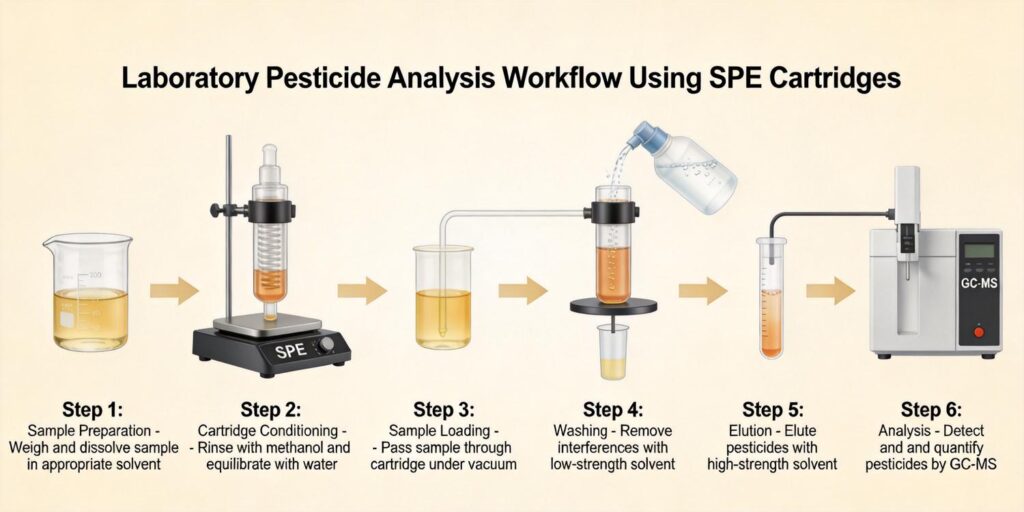
Sample Preparation
Begin by centrifuging wine samples at 4,000 × g for 10 minutes to remove particulate matter. For red wines with high pigment content, consider a preliminary dilution with acidified water (pH 2.0-3.0 using formic or phosphoric acid) to reduce matrix effects and improve SPE performance.
SPE Cartridge Conditioning
Condition HLB or C18 cartridges (typically 60-200 mg bed mass) with 3-5 mL methanol followed by 3-5 mL acidified water (pH 2.5-3.0). Maintain a flow rate of 1-3 mL/min to ensure proper sorbent activation without channeling.
Sample Loading and Washing
Load 1-5 mL of prepared wine sample at a controlled flow rate of 1-2 mL/min. For optimal retention of polar polyphenols, adjust the ethanol content to ≤5% by dilution with acidified water. Wash cartridges with 3-5 mL of 5% methanol in acidified water to remove sugars, organic acids, and other polar interferences while retaining target polyphenols.
Elution and Concentration
Elute polyphenols with 3-5 mL of methanol containing 0.1-1.0% formic acid. The acid helps protonate phenolic hydroxyl groups, improving elution efficiency. For comprehensive polyphenol profiling, consider stepwise elution with methanol:water mixtures of increasing organic content (e.g., 20%, 40%, 60%, 80%, 100% methanol).
Concentrate eluates under gentle nitrogen stream at 30-40°C, then reconstitute in initial mobile phase composition for HPLC or LC-MS analysis. As noted in SPE methodology, “the opportunity to concentrate the target analytes offers enhanced sensitivity that may facilitate detection” (Simpson & Wynne, 2000).
HPLC or LC-MS Analysis of Polyphenols
Chromatographic Separation
Reverse-phase HPLC with C18 columns (150-250 mm × 4.6 mm, 3-5 μm particle size) provides excellent separation of wine polyphenols. Use gradient elution with water (acidified with 0.1-0.5% formic acid) and acetonitrile or methanol. Typical gradients start at 5-10% organic, increasing to 40-60% over 30-60 minutes, with column temperatures maintained at 25-40°C.
Detection Methods
Diode array detection (DAD) at 280 nm (phenolic acids and flavan-3-ols), 320 nm (hydroxycinnamic acids), and 520 nm (anthocyanins) provides comprehensive polyphenol profiling. For enhanced sensitivity and selectivity, mass spectrometric detection offers superior capabilities.
LC-MS/MS Analysis
Electrospray ionization (ESI) in negative mode is preferred for most polyphenols, while positive mode works better for anthocyanins. Multiple reaction monitoring (MRM) transitions provide specific detection even in complex wine matrices. The literature confirms that “SPE allows extraction under mild conditions of pH, thereby limiting the incidence of decomposition or rearrangement of labile compounds” (Busto et al., 1994), which is particularly important for LC-MS analysis where compound integrity is critical.
Method Validation
Validate analytical methods for linearity (typically 0.1-100 μg/mL), precision (RSD < 10%), accuracy (85-115% recovery), and limits of detection/quantification (LOD 0.01-0.1 μg/mL, LOQ 0.1-1.0 μg/mL). Include quality control samples and internal standards (such as syringic acid or catechin derivatives) to ensure method reliability.
Applications in Wine Quality Research
Authentication and Origin Determination
Polyphenol profiles serve as chemical fingerprints for wine authentication. Specific anthocyanin ratios and flavonol patterns can distinguish grape varieties, while hydroxycinnamic acid derivatives help identify geographical origins. SPE purification followed by LC-MS analysis enables detection of adulteration and confirmation of Protected Designation of Origin (PDO) status.
Aging and Storage Studies
Monitor polyphenol evolution during wine aging to understand color stabilization, tannin polymerization, and flavor development. Anthocyanin-tannin condensation products, vitisins, and other pigmented polymers formed during aging can be selectively extracted and quantified using optimized SPE methods.
Health Benefit Assessment
Quantify bioactive polyphenols like resveratrol, quercetin, and catechins to correlate with potential health benefits. SPE purification removes interfering compounds that could affect bioassay results, enabling accurate assessment of antioxidant capacity, anti-inflammatory properties, and other biological activities.
Winemaking Process Optimization
Analyze polyphenol extraction during maceration, malolactic fermentation, and aging to optimize winemaking protocols. Monitor the effects of different oak treatments, yeast strains, and fermentation temperatures on polyphenol composition and wine quality parameters.
Sensory Quality Correlation
Correlate specific polyphenol concentrations with sensory attributes like astringency, bitterness, and color intensity. Proanthocyanidin composition and degree of polymerization significantly influence mouthfeel characteristics, while anthocyanin profiles determine color stability and hue.
Future Directions
Emerging applications include high-throughput screening using 96-well SPE plates coupled with UHPLC-MS/MS systems, enabling rapid analysis of large sample sets for vineyard management and quality control purposes. Automated SPE systems integrated with analytical instrumentation offer improved reproducibility and throughput for wine research laboratories.
For researchers and quality control laboratories, selecting appropriate SPE sorbents and optimizing extraction protocols are critical steps in obtaining reliable polyphenol data from wine samples. The combination of selective SPE purification with advanced chromatographic and mass spectrometric analysis provides powerful tools for understanding wine composition, quality, and authenticity.