Role of Preservatives in Cosmetic Formulations
Cosmetic preservatives serve as essential antimicrobial agents that prevent microbial growth and spoilage in personal care products. These chemical compounds extend product shelf life, maintain formulation stability, and ensure consumer safety by inhibiting bacteria, yeast, and mold proliferation. Common preservative classes include parabens (methylparaben, propylparaben), formaldehyde-releasing agents, isothiazolinones, phenoxyethanol, and organic acids like benzoic and sorbic acid.
Preservatives must be carefully selected based on their compatibility with cosmetic matrices, pH requirements, and regulatory restrictions. The complex nature of cosmetic formulations—often containing oils, emulsifiers, surfactants, and active ingredients—creates challenging environments for preservative analysis. According to research by Simpson and Wynne (2000), preservatives like methyl- and propyl-p-hydroxybenzoate can interfere with analytical methods due to their UV spectral properties, necessitating specialized extraction techniques.
Analytical Challenges in Cosmetic Matrices
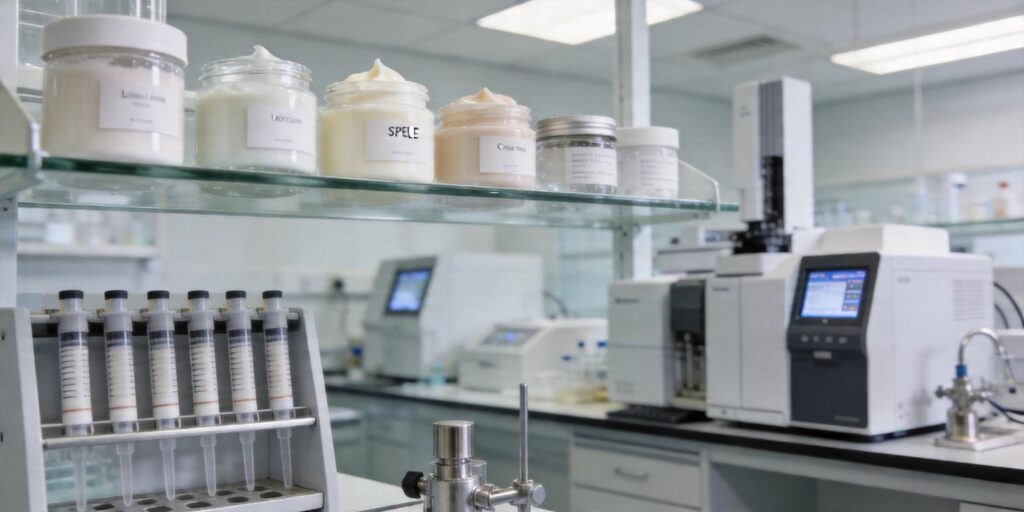
Cosmetic products present unique analytical hurdles due to their heterogeneous composition and complex matrices. Creams, lotions, and gels contain emulsifying agents, surfactants, lipids, and various excipients that can interfere with preservative detection. As noted in pharmaceutical cream analysis studies, these formulations contain “hydrophobic and hydrophilic compounds, emulsifying agents and preservatives” dispersed in complex emulsions.
Key challenges include:
- Matrix interference: Excipients can co-elute with target preservatives during chromatographic analysis
- Sample heterogeneity: Inconsistent distribution of preservatives within emulsions
- Low concentration levels: Preservatives are typically present at ppm levels requiring sensitive detection methods
- Chemical stability: Some preservatives degrade during sample preparation or analysis
- Multiple preservative systems: Products often contain preservative combinations with different chemical properties
Research demonstrates that direct UV spectrophotometric analysis of cosmetic samples without proper clean-up yields inflated assay results due to matrix interference, highlighting the necessity for effective sample preparation techniques.
SPE Sorbent Selection for Preservative Extraction
Solid-phase extraction sorbent selection is critical for successful preservative isolation from cosmetic matrices. The choice depends on preservative chemical properties, including polarity, pKa values, and functional groups. Based on documented applications in pharmaceutical and cosmetic analysis, several sorbent strategies prove effective:
Reversed-Phase Sorbents (C18, C8, HLB)
Hydrophobic preservatives like parabens respond well to reversed-phase extraction. Studies show that C18 sorbents effectively retain hydrophobic parabens while allowing more polar analytes to pass through. For instance, in fluorouracil cream analysis, C18 sorbents completely retained methyl- and propyl-parabens while fluorouracil passed through the column. Modern hydrophilic-lipophilic balanced (HLB) sorbents offer advantages for broader preservative classes with their water-wettable surfaces and dual retention mechanisms.
Ion-Exchange Sorbents (SAX, SCX, MAX, MCX)
Ionizable preservatives benefit from mixed-mode or pure ion-exchange sorbents. Strong anion exchange (SAX) sorbents effectively retain acidic preservatives like benzoic acid when ionized at appropriate pH. Research demonstrates that SAX methodology allows elimination of neutral components such as parabens that could interfere with spectrophotometric determination. Similarly, strong cation exchange (SCX) sorbents work well for basic preservatives when properly protonated.
Mixed-Mode Sorbents
Mixed-mode sorbents combining reversed-phase and ion-exchange mechanisms provide superior selectivity for complex preservative mixtures. The Waters Oasis 2×4 strategy utilizes only two protocols and four sorbents (MCX, MAX, WCX, WAX) to analyze all types of compounds including acids, bases, and neutrals. This approach offers cleaner extracts, better reduction of matrix effects, and higher sensitivity compared to single-mechanism sorbents.
Normal-Phase Sorbents (Diol, Silica)
For lipophilic cosmetic matrices, normal-phase sorbents like diol-modified silica prove effective. Studies show diol sorbents successfully clean up cream samples containing neutral or acidic drugs of different polarity. The cream sample is dissolved in appropriate dichloromethane-n-hexane mixtures, where the solvent ratio is adjusted to favor sorbent-analyte interactions over matrix-analyte interactions.
Example Purification Workflow for Cosmetic Samples
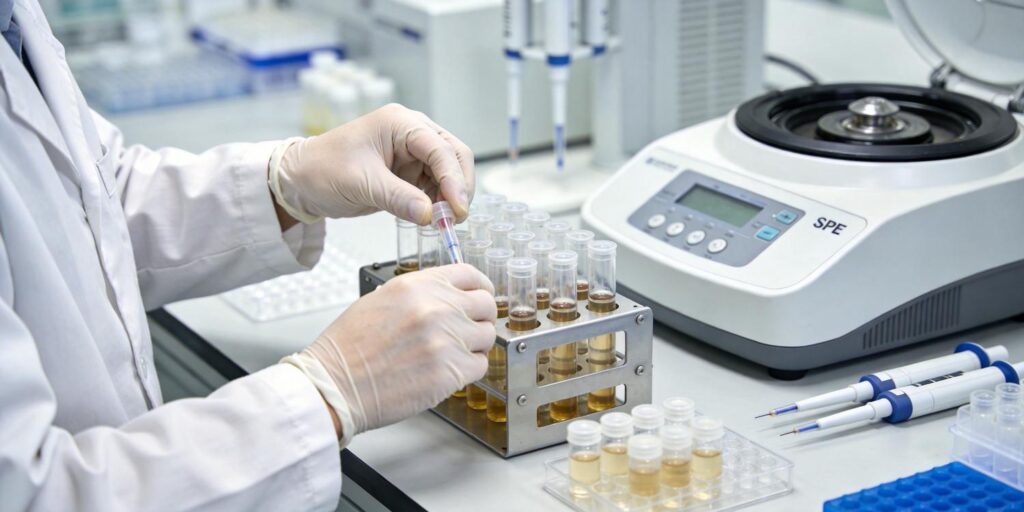
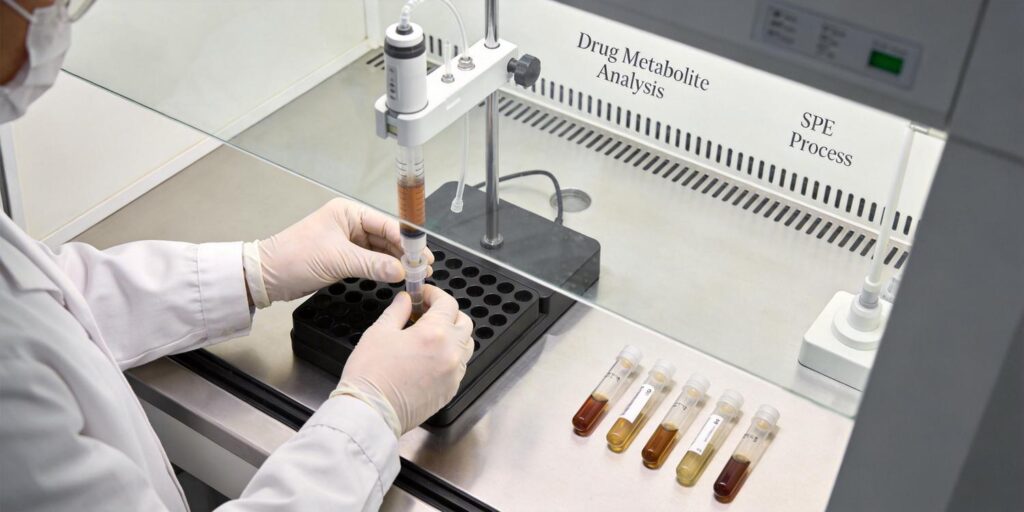
A systematic SPE workflow ensures reproducible preservative extraction from cosmetic matrices. Based on established protocols from pharmaceutical cream analysis, the following procedure demonstrates effective sample preparation:
Sample Preparation
1. Sample dissolution: Accurately weigh cosmetic sample (typically 0.5-5.0 mg equivalent of preservative) and dissolve in appropriate solvent. For aqueous-based products, use water-methanol mixtures (e.g., 80:20 v/v). For oil-based products, use n-hexane-dichloromethane mixtures (e.g., 7:3 v/v).
2. Solvent selection: Choose solvents that maintain preservative stability while effectively dissolving the matrix. Phosphate buffer solutions at appropriate pH (4.5, 7.4, or 8.0) help maintain ionization states for ionizable preservatives.
SPE Procedure
1. Cartridge conditioning: Condition sorbent with appropriate solvents. For C18 sorbents, rinse with 6 mL methanol followed by water or buffer. For ion-exchange sorbents, condition with methanol then equilibration buffer. For diol sorbents, condition with dichloromethane followed by n-hexane.
2. Sample loading: Apply 3.0 mL aliquot of sample solution to conditioned SPE column at controlled flow rate (1-3 drops/second for optimal recovery).
3. Washing: Remove interfering matrix components with appropriate wash solvents. For C18 extractions, wash with sample solvent or slightly stronger solvent that doesn’t elute target preservatives. For ion-exchange methods, wash with buffer at loading pH.
4. Elution: Recover preservatives with minimal solvent volume. Typical elution solvents include methanol, methanol-buffer mixtures, or dichloromethane-methanol combinations. For mixed-mode sorbents, sequential elution with acidic and basic methanol may be required.
Example: Paraben Extraction from Cream
A documented procedure for methyl- and propyl-paraben removal from fluorouracil cream involves dissolving the sample in water-methanol (80:20 v/v), loading onto C18 sorbent, and washing with the same solvent system. The hydrophobic parabens are completely retained while the drug passes through, demonstrating effective preservative isolation.
LC-MS Analysis of Preservatives
Liquid chromatography-mass spectrometry provides the sensitivity and selectivity required for preservative analysis in complex cosmetic matrices. Following SPE clean-up, LC-MS analysis enables accurate quantification at regulatory limits.
Chromatographic Conditions
Reverse-phase chromatography using C18 or C8 columns with water-acetonitrile or water-methanol gradients effectively separates preservative classes. Mobile phase modifiers like formic acid or ammonium acetate enhance ionization for MS detection. Typical gradient programs run from 5-95% organic over 10-20 minutes, with column temperatures maintained at 30-40°C.
Mass Spectrometric Detection
Electrospray ionization (ESI) in negative or positive mode depending on preservative properties provides optimal sensitivity. Multiple reaction monitoring (MRM) transitions offer specific detection even in complex matrices. Common preservatives and their typical transitions include:
- Methylparaben: m/z 151→92 (negative ESI)
- Propylparaben: m/z 179→92 (negative ESI)
- Benzoic acid: m/z 121→77 (negative ESI)
- Sorbic acid: m/z 111→67 (negative ESI)
- Phenoxyethanol: m/z 139→94 (positive ESI)
Method Validation
Validated methods should demonstrate linearity (typically 0.01-10 μg/mL), precision (RSD < 15%), accuracy (85-115% recovery), and limits of detection/quantification appropriate for regulatory requirements. Matrix-matched calibration compensates for residual matrix effects post-SPE.
Applications in Cosmetic Safety Testing
SPE-based preservative analysis supports critical safety testing applications throughout cosmetic product development and quality control.
Regulatory Compliance
Global regulations (EU Cosmetic Regulation 1223/2009, FDA guidelines) establish maximum concentration limits for preservatives. SPE-LC-MS methods enable compliance verification at required sensitivity levels. The European Commission’s Scientific Committee on Consumer Safety (SCCS) regularly updates preservative restrictions, necessitating robust analytical methods.
Preservative Efficacy Testing
Challenge tests evaluate preservative system effectiveness against specified microorganisms. SPE methods quantify preservative concentrations throughout product shelf life, ensuring maintained efficacy. Studies track preservative degradation or interaction with other formulation components that might reduce antimicrobial activity.
Migration and Exposure Assessment
For products with potential dermal absorption, SPE methods quantify preservative migration through skin models. These studies support safety assessments and exposure calculations for risk evaluation.
Alternative Preservative Screening
As regulatory pressures increase on traditional preservatives, manufacturers seek alternative systems. SPE methods facilitate screening of new preservative candidates by enabling rapid analysis of stability, compatibility, and efficacy in various formulations.
Quality Control and Batch Release
Routine SPE-LC-MS analysis ensures batch-to-batch consistency and confirms preservative concentrations within specification limits. Automated SPE systems in 96-well plate format support high-throughput quality control laboratories.
Conclusion
Solid-phase extraction represents a critical sample preparation technology for preservative analysis in personal care products. By selecting appropriate sorbents based on preservative chemistry and cosmetic matrix characteristics, analysts can achieve the clean extracts necessary for accurate LC-MS quantification. The documented success of SPE in pharmaceutical cream analysis provides a strong foundation for cosmetic applications, where similar matrix challenges exist. As cosmetic formulations evolve and regulatory requirements tighten, robust SPE methods will continue to play an essential role in ensuring product safety and compliance.
For laboratories seeking SPE solutions for cosmetic analysis, Poseidon Scientific offers a comprehensive range of HLB SPE cartridges, MAX SPE cartridges, MCX SPE cartridges, WAX SPE cartridges, WCX SPE cartridges, and 96-well SPE plates suitable for preservative extraction from diverse cosmetic matrices.