Common Contaminants Found in Grains
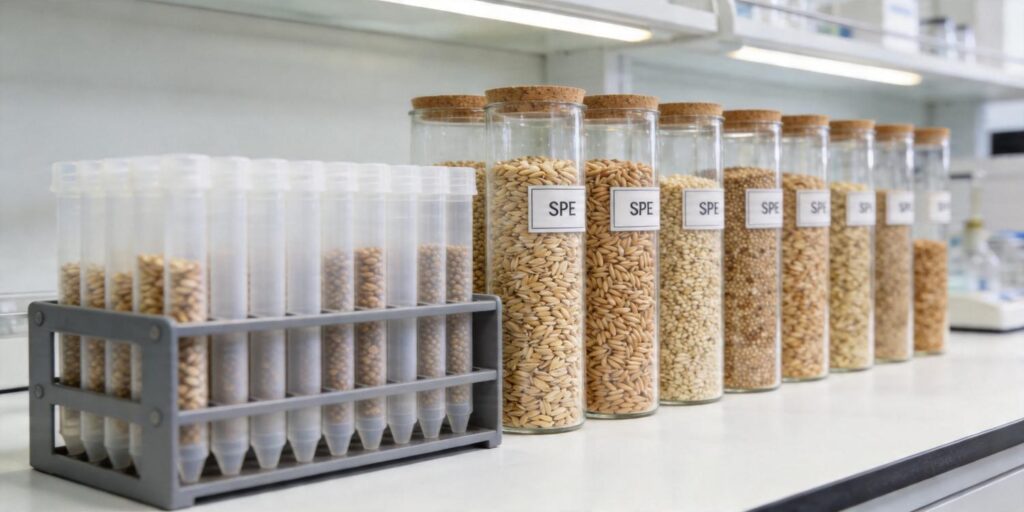
Grain products represent one of the most challenging matrices for food safety monitoring due to their susceptibility to multiple classes of contaminants. The primary contaminants of concern fall into three major categories: mycotoxins, pesticide residues, and heavy metals.
Mycotoxins
Mycotoxins are toxic secondary metabolites produced by fungi that commonly contaminate cereals during growth, harvest, storage, and processing. The most significant mycotoxins in grains include:
- Aflatoxins (B1, B2, G1, G2): Produced by Aspergillus species, these are potent carcinogens classified by IARC as Group 1 human carcinogens. European Union regulations mandate maximum limits of 5 μg/kg for AFLA B1 and 10 μg/kg for total aflatoxins in maize products.
- Fumonisins: Primarily produced by Fusarium species, these mycotoxins are associated with esophageal cancer and neural tube defects.
- Zearalenone: An estrogenic mycotoxin produced by Fusarium species that affects reproductive systems.
- Ochratoxin A: A nephrotoxic compound produced by Aspergillus and Penicillium species.
Pesticide Residues
Modern agricultural practices involve the use of various pesticides that can persist as residues in grain products. These include:
- Organochlorine pesticides: Persistent compounds like DDT, aldrin, dieldrin, and endosulfan
- Organophosphorus pesticides: Compounds such as chlorpyrifos and malathion
- Synthetic pyrethroids: Cypermethrin and deltamethrin
- Herbicides: Atrazine, simazine, and their degradation products
- Fungicides: Benzimidazole compounds and triazoles
Heavy Metals
Heavy metals can accumulate in grains through contaminated soil, water, or atmospheric deposition:
- Lead (Pb): Neurotoxic effects, especially in children
- Cadmium (Cd): Renal damage and bone demineralization
- Arsenic (As): Carcinogenic effects, particularly inorganic forms
- Mercury (Hg): Neurological and developmental toxicity
Matrix Complexity in Grain Extracts
Grain matrices present significant analytical challenges due to their complex composition. Cornmeal, for example, contains proteins (zein being the major corn protein), carbohydrates (starch and sugars), lipids, fiber, and various micronutrients. This complexity necessitates sophisticated sample preparation to isolate target analytes from interfering components.
The granulometric profile of cornmeals varies significantly, with particle sizes ranging from coarse (>0.71 mm) to fine (<0.147 mm). This particle size distribution affects extraction efficiency, as demonstrated in studies where fine cornmeal showed different extraction characteristics compared to medium and coarse grinds. The matrix effect (ME) in grain analysis can range from 11% to 20% for different aflatoxins, necessitating careful method optimization and validation.
Multivariate correlation analysis has identified proteins and sugars as the main interferers in mycotoxin determination in fine cornmeal, with correlation coefficients (r) of -0.99 for both components affecting aflatoxin G2 and G1 recovery. This highlights the importance of understanding matrix-analyte interactions during method development.
SPE Sorbent Selection for Contaminant Classes
Selecting the appropriate SPE sorbent is critical for successful contaminant isolation from grain matrices. The choice depends on analyte polarity, chemical properties, and the potential co-extracted components of the matrix.
Mycotoxin Extraction
For mycotoxin analysis, C18 sorbents are most commonly used due to their lipophilic characteristics, which allow good disruption, dispersion, and retention of lipophilic species. Studies have shown that C18 provides excellent recovery for aflatoxins in cereals, with recoveries ranging from 85.7% to 114.8% when optimized conditions are used.
Alternative approaches include:
- Matrix Solid-Phase Dispersion (MSPD): This technique combines sample preparation and cleaning in one step using small amounts of solid support and solvent. C18 remains the preferred solid support for mycotoxin MSPD extraction.
- Immunoaffinity columns: Provide highly selective extraction but at higher cost
- Mixed-mode sorbents: Combine reversed-phase and ion-exchange properties for broader analyte coverage
Pesticide Residue Cleanup
For pesticide analysis in grain products, several sorbent options are available:
- Florisil: A very polar, highly active, weakly basic sorbent specifically designed for pesticide adsorption using official AOAC, EPA, and JPMHLW regulated methods
- Carbon black/aminopropyl silica: Two-layer sorbent beds used for pesticide cleanup in food matrices prior to GC analysis
- Carbon black/PSA (primary-secondary amine): Alternative selectivity compared to aminopropyl for pesticide cleanup
- Alumina: Available in acidic, basic, and neutral forms for specific applications
Certified Sep-Pak Florisil cartridges have demonstrated superior performance in organochlorine pesticide analysis compared to competitor products, with quantitative removal of polar probes like trichlorophenol (TCP) and minimal extraction of interfering compounds such as BHA, BHT, and unknown fatty esters.
Heavy Metal Preconcentration
For heavy metal analysis, specialized SPE approaches are employed:
- Ion-exchange sorbents: Strong cation exchangers (SCX) for cationic metals
- Chelating sorbents: Immobilized complexing agents for selective metal extraction
- Mixed-mode approaches: Combination of C18 with ion-pairing reagents for metal complex extraction
Studies have demonstrated successful extraction of arsenic using C18 cartridges with an ion-pairing mechanism between cetyl trimethyl ammonium and pyrrolidene dithiocarbamate ions, followed by hydride generation atomic absorption spectroscopy.
Example Extraction and Purification Workflow
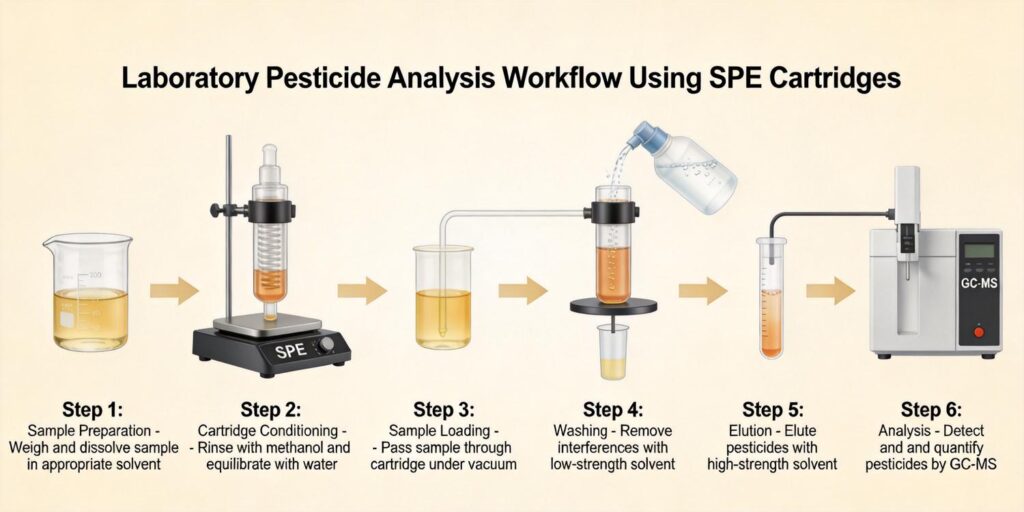
A comprehensive SPE workflow for multi-contaminant analysis in grain products typically involves the following steps:
Sample Preparation
- Homogenization: Grind grain samples to consistent particle size (typically <1 mm)
- Extraction: Use appropriate solvent systems based on target analytes:
- Mycotoxins: Acetonitrile/water or methanol/water mixtures
- Pesticides: Acetonitrile with or without acidification
- Heavy metals: Acid digestion or aqueous extraction
- Filtration/Centrifugation: Remove particulate matter
SPE Procedure
- Conditioning: Activate sorbent with appropriate solvents (typically methanol followed by water or buffer)
- Loading: Apply sample extract at controlled flow rates (1-5 mL/min)
- Washing: Remove interfering matrix components with optimized wash solvents
- For reversed-phase sorbents: Water or low-percentage organic solvents
- For ion-exchange sorbents: Appropriate pH buffers
- Drying: Remove residual water (optional, depending on elution solvent)
- Elution: Recover analytes with strong solvents:
- Mycotoxins: Acetonitrile, methanol, or acetone
- Pesticides: Hexane/acetone mixtures or ethyl acetate
- Heavy metals: Acidic solutions or complexing agents
- Concentration: Evaporate eluate to appropriate volume for analysis
- Reconstitution: Redissolve in compatible mobile phase
Optimized MSPD Method for Aflatoxins
An optimized vortex-assisted MSPD method for aflatoxins in cornmeal demonstrates efficient extraction with minimal solvent consumption:
- Sample amount: 1 g cornmeal
- Solid support: 25 mg C18
- Elution solvent: 10 mL MeCN/MeOH (50:50, v/v)
- Recoveries: 85.7-114.8% for aflatoxins G2, G1, B2, B1
- LOD/LOQ: 0.01-0.04 ng/g and 0.02-0.1 ng/g respectively
This method shows advantages over standard immunoaffinity column cleanup in terms of sample amount, solvent volume consumption, and cost-effectiveness while maintaining acceptable performance characteristics.
LC-MS/MS Detection of Contaminants
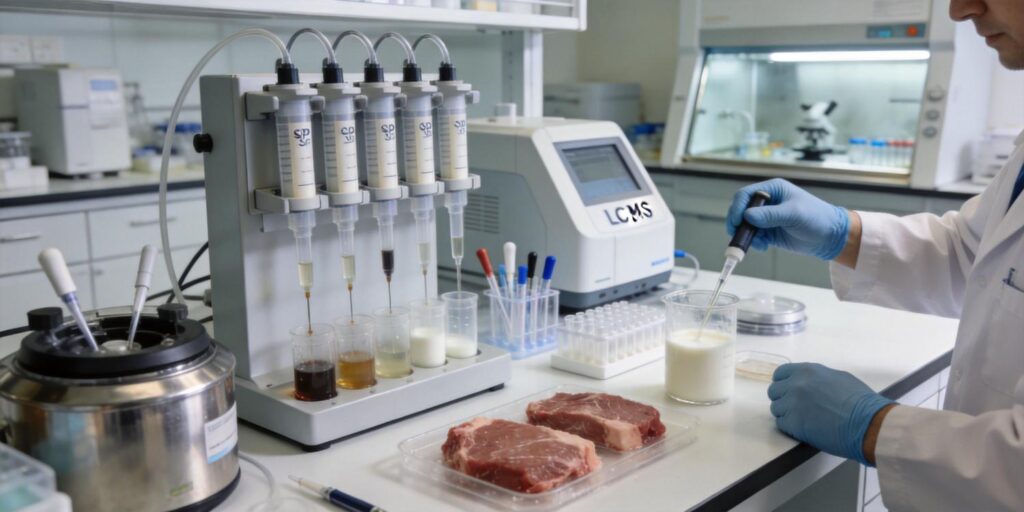
Liquid chromatography coupled with tandem mass spectrometry (LC-MS/MS) has become the gold standard for multi-contaminant analysis in grain products due to its high sensitivity, selectivity, and ability to analyze multiple compound classes in a single run.
Chromatographic Conditions
Optimal separation of contaminants requires careful mobile phase selection:
- Mycotoxins: Water/acetonitrile/methanol mixtures in gradient or isocratic modes
- Pesticides: Water/methanol or water/acetonitrile with formic acid or ammonium acetate additives
- Column selection: C18 columns (e.g., Kromasil C18, 150 × 4.6 mm, 5 μm) provide good separation for most contaminants
For aflatoxin separation, a mobile phase of H₂O/MeCN/MeOH (62:14:24, v/v/v) provides excellent separation with retention factors (k) of 2.44-4.75 and separation factors (α) of 1.18-1.29 between adjacent peaks.
Mass Spectrometric Detection
Modern LC-MS/MS systems offer several advantages for grain contaminant analysis:
- Multiple Reaction Monitoring (MRM): Enables simultaneous detection of hundreds of compounds with high specificity
- High-resolution mass spectrometry: Provides accurate mass measurements for compound identification
- Matrix-matched calibration: Compensates for matrix effects (typically 11-20% for mycotoxins)
Studies have demonstrated successful detection of 402 pesticide residues at 10 ppb levels in less than 10 minutes using UPLC-MS/MS with DisQuE sample preparation technology.
Method Validation
Comprehensive method validation according to guidelines such as SANTE/11945/2015 ensures reliable results:
- Linearity: Correlation coefficients >0.999 for calibration curves
- Accuracy: Recoveries of 70-120% for concentrations <1 μg/kg and 70-110% for 1-10 μg/kg (European Commission criteria)
- Precision: Relative standard deviations <20% for repeatability tests
- LOD/LOQ: Typically 0.01-0.04 ng/g and 0.02-0.1 ng/g for mycotoxins
- Matrix effects: Evaluation and compensation through matrix-matched calibration
Food Safety Monitoring Programs
Effective food safety monitoring requires integrated approaches combining analytical methods with regulatory frameworks and quality assurance systems.
Regulatory Frameworks
Major regulatory bodies have established maximum limits for contaminants in grain products:
- European Union: Commission Regulation (EC) No 1881/2006 sets maximum levels for mycotoxins, heavy metals, and other contaminants
- United States: FDA action levels for aflatoxins and other mycotoxins
- Brazil: ANVISA RDC No 7/2011 establishes maximum tolerated limits for mycotoxins
- Codex Alimentarius: International food standards providing guidance for member countries
Monitoring Strategies
Effective monitoring programs incorporate several key elements:
- Risk-based sampling: Focus on high-risk products, regions, and production periods
- Multi-residue methods: Enable cost-effective screening of multiple contaminant classes
- Proficiency testing: Ensure laboratory competence through inter-laboratory comparisons
- Data management: Systematic collection, analysis, and reporting of monitoring results
- Rapid alert systems: Timely communication of contamination incidents
Quality Assurance
Robust quality assurance systems are essential for reliable monitoring results:
- Method validation: Following international guidelines (AOAC, ISO, SANTE)
- Reference materials: Certified reference materials for method verification
- Internal quality control: Regular analysis of control samples and spikes
- Equipment maintenance: Regular calibration and performance verification
- Staff training: Continuous education on new methods and regulations
Emerging Trends
The field of grain contaminant monitoring continues to evolve with several emerging trends:
- High-throughput methods: 96-well SPE plates and automated systems for increased efficiency
- Green chemistry approaches: Reduced solvent consumption and waste generation
- Non-targeted screening: High-resolution mass spectrometry for unknown contaminant identification
- On-site testing: Rapid screening methods for field applications
- Data integration: Combining monitoring data with production and supply chain information
Proper SPE sample preparation remains fundamental to all these approaches, providing the necessary clean-up and concentration for reliable contaminant detection. By selecting appropriate sorbents and optimizing extraction conditions, laboratories can achieve the sensitivity, accuracy, and precision required for effective food safety monitoring in grain products.
For laboratories seeking reliable SPE solutions for grain contaminant analysis, Poseidon Scientific’s HLB SPE cartridges offer excellent performance for a wide range of contaminants, while our 96-well SPE plates provide high-throughput capabilities for monitoring programs requiring analysis of large sample numbers.