Sources of Pharmaceutical Metabolites in Aquatic Environments
Pharmaceutical metabolites enter surface water systems through multiple pathways, creating complex environmental challenges. The primary sources include wastewater treatment plant (WWTP) effluents, agricultural runoff from livestock operations, and direct discharge from pharmaceutical manufacturing facilities. According to environmental monitoring studies, conventional WWTPs often fail to completely remove pharmaceutical compounds and their metabolites, allowing these biologically active substances to enter aquatic ecosystems.
Human excretion represents a significant pathway, with metabolites from drugs like antibiotics, antidepressants, beta-blockers, and analgesics passing through sewage systems. Veterinary pharmaceuticals administered to livestock also contribute substantially, particularly antibiotics and growth promoters that enter waterways through manure application and runoff. The persistence of these metabolites varies widely depending on their chemical structure, with some remaining stable in aquatic environments for extended periods.
Key Pharmaceutical Classes in Surface Water
- Antibiotics: Fluoroquinolones, sulfonamides, and tetracyclines
- Analgesics: NSAIDs like ibuprofen, diclofenac, and naproxen
- Psychiatric drugs: Antidepressants and anticonvulsants
- Beta-blockers: Metoprolol, atenolol, and propranolol
- Lipid regulators: Clofibric acid and bezafibrate
Analytical Challenges in Trace Detection
Detecting pharmaceutical metabolites at environmentally relevant concentrations (typically ng/L to μg/L) presents significant analytical hurdles. The complexity of surface water matrices, containing natural organic matter, suspended solids, and various inorganic ions, creates substantial matrix effects that can suppress analyte signals or cause false positives. As noted in SPE literature, “the presence of humics and other species present” in environmental water samples requires sophisticated cleanup strategies to achieve reliable detection.
Matrix suppression effects are particularly problematic in LC-MS/MS analysis, where co-extracted compounds can interfere with ionization processes. The high polarity of many pharmaceutical metabolites further complicates extraction, as traditional hydrophobic interaction mechanisms may not provide adequate retention. Additionally, metabolites often exist at concentrations several orders of magnitude lower than their parent compounds, necessitating effective enrichment strategies.
Primary Analytical Challenges
- Low concentration levels: Typically 0.1-100 ng/L in surface water
- Matrix complexity: Humic acids, suspended solids, and inorganic salts
- Structural diversity: Wide range of polarities and functional groups
- Ion suppression: Particularly in electrospray ionization MS
- Method sensitivity: Need for detection limits below environmental impact thresholds
SPE Enrichment Methods for Surface Water Monitoring
Solid-phase extraction has emerged as the gold standard for concentrating pharmaceutical metabolites from large-volume water samples. The technique offers several advantages over traditional liquid-liquid extraction, including reduced solvent consumption, higher throughput capabilities, and improved reproducibility. As research demonstrates, SPE provides “matrix removal and concentration of the target analytes” essential for trace-level detection.
The selection of appropriate SPE sorbents depends on the target metabolite characteristics. Mixed-mode sorbents combining hydrophobic and ion-exchange interactions have proven particularly effective for pharmaceutical metabolites, which often contain both hydrophobic regions and ionizable functional groups. These sorbents allow selective retention based on both reversed-phase and ion-exchange mechanisms, providing cleaner extracts with higher recoveries.
SPE Sorbent Selection Guide
| Analyte Characteristics | Recommended Sorbent | Mechanism |
|---|---|---|
| Basic metabolites (pKa > 7) | MCX (Mixed-mode Cation Exchange) | Cation exchange + reversed-phase |
| Acidic metabolites (pKa < 7) | MAX (Mixed-mode Anion Exchange) | Anion exchange + reversed-phase |
| Neutral/polar metabolites | HLB (Hydrophilic-Lipophilic Balance) | Reversed-phase with hydrophilic retention |
| Zwitterionic metabolites | WAX/WCX (Weak Anion/Cation Exchange) | pH-dependent ion exchange |
For comprehensive monitoring programs, HLB sorbents often serve as a good starting point due to their ability to retain compounds across a wide polarity range. However, for targeted analysis of specific metabolite classes, mixed-mode sorbents provide superior selectivity and cleaner extracts.
Example Extraction Workflow for 1 L Water Samples
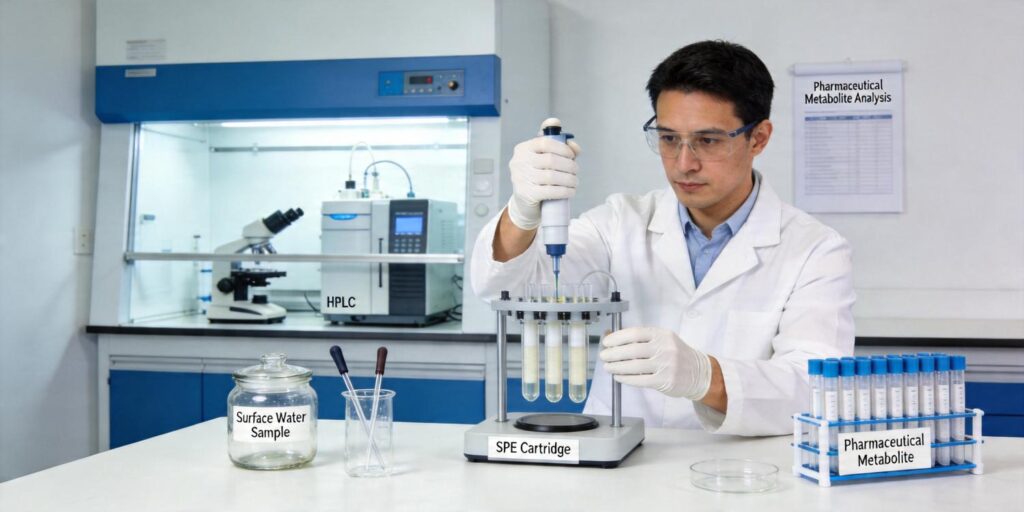
A robust SPE workflow for pharmaceutical metabolite analysis from surface water typically involves several critical steps optimized for maximum recovery and minimal matrix interference. The following protocol has been validated for multi-class metabolite analysis:
Sample Preparation and SPE Procedure
- Sample collection and preservation: Collect 1 L surface water samples in amber glass bottles, adjust to pH 3 with formic acid, and store at 4°C until extraction (within 48 hours).
- Filtration: Filter through 0.45 μm glass fiber filters to remove suspended solids.
- SPE cartridge conditioning: Condition 200 mg HLB or mixed-mode cartridges with 6 mL methanol followed by 6 mL acidified water (pH 3).
- Sample loading: Load 1 L sample at controlled flow rate of 5-10 mL/min using vacuum manifold.
- Cartridge washing: Wash with 6 mL 5% methanol in water to remove weakly retained interferences.
- Cartridge drying: Apply vacuum for 30 minutes to remove residual water.
- Analyte elution: Elute with 2 × 4 mL methanol or methanol with 2% formic acid/ammonium hydroxide (depending on sorbent type).
- Concentration and reconstitution: Evaporate eluate to dryness under gentle nitrogen stream and reconstitute in 200 μL initial mobile phase for LC-MS/MS analysis.
Critical Method Parameters
- pH optimization: Sample pH significantly affects ionization state and retention of ionizable metabolites
- Flow rate control: Loading at 5-10 mL/min balances throughput with retention efficiency
- Elution solvent selection: Methanol often provides better recovery than acetonitrile for polar metabolites
- Internal standards: Use isotopically labeled analogs for each metabolite class to correct for recovery variations
LC-MS/MS Detection of Metabolites
Liquid chromatography coupled with tandem mass spectrometry represents the most powerful analytical platform for pharmaceutical metabolite detection in environmental samples. The combination of chromatographic separation with selective mass detection provides the sensitivity and specificity required for trace-level analysis. As noted in SPE integration studies, “the ability of the MS to select out from a complex mixture only a single species” enables detection at environmentally relevant concentrations.
Modern LC-MS/MS systems typically employ electrospray ionization (ESI) in positive or negative mode, depending on the metabolite’s ionization characteristics. Multiple reaction monitoring (MRM) provides the necessary selectivity, monitoring specific precursor-to-product ion transitions for each metabolite. The use of scheduled MRM further enhances method performance by optimizing dwell times across expected retention windows.
LC-MS/MS Method Optimization
- Chromatographic separation: Use C18 or polar-embedded stationary phases with gradient elution from aqueous to organic mobile phases
- Ion source parameters: Optimize source temperature, gas flows, and voltages for maximum sensitivity
- MRM transitions: Select two transitions per metabolite for confirmation (quantifier and qualifier)
- Collision energy: Optimize individually for each metabolite to maximize product ion formation
- Matrix effects evaluation: Use post-column infusion or standard addition to assess and compensate for suppression/enhancement
Recent advances in high-resolution mass spectrometry (HRMS) using Q-TOF or Orbitrap instruments offer additional capabilities for non-target screening and metabolite identification. These platforms can detect metabolites not included in targeted methods and provide structural information for unknown compounds.
Environmental Monitoring Implications
The ability to detect pharmaceutical metabolites at trace levels in surface water has profound implications for environmental monitoring and regulatory frameworks. As analytical methods improve, previously undetected compounds are being identified in aquatic ecosystems worldwide, raising concerns about potential ecological effects. Chronic exposure to low concentrations of pharmaceutical metabolites may affect aquatic organisms through various mechanisms, including endocrine disruption, antibiotic resistance development, and behavioral changes.
Regulatory agencies are increasingly incorporating pharmaceutical metabolites into monitoring programs and developing environmental quality standards. The European Union’s Water Framework Directive and the US Environmental Protection Agency’s Contaminant Candidate List both include pharmaceutical compounds and their transformation products. Effective SPE-LC-MS/MS methods provide the analytical foundation for these regulatory initiatives.
Future Directions in Environmental Monitoring
- High-throughput screening: Implementation of 96-well SPE plates for large-scale monitoring programs
- Passive sampling integration: Combining SPE with passive sampling devices for time-integrated concentration measurements
- Effect-directed analysis: Linking chemical analysis with biological assays to identify compounds of concern
- Advanced treatment monitoring: Assessing metabolite removal efficiency in advanced wastewater treatment processes
- Ecological risk assessment: Developing more comprehensive risk assessment frameworks incorporating metabolite data
The continued development of SPE methodologies for pharmaceutical metabolite analysis will play a crucial role in understanding the environmental fate and effects of these emerging contaminants. As analytical capabilities advance, so too will our ability to protect aquatic ecosystems from potential pharmaceutical impacts.
For laboratories implementing pharmaceutical metabolite monitoring programs, selecting appropriate HLB SPE cartridges or mixed-mode SPE cartridges represents a critical first step in method development. The availability of 96-well SPE plates further enables high-throughput analysis essential for comprehensive environmental monitoring programs.