Introduction
Food preservatives such as benzoates and sorbates are widely used to inhibit microbial growth in processed foods. Reliable detection of these preservatives is essential for regulatory compliance and quality control. Solid-phase extraction (SPE) provides a robust cleanup and preconcentration step before chromatographic analysis. This blog outlines a streamlined SPE workflow for detecting benzoic acid and sorbic acid (and their salts) in processed food samples.
Common Preservatives: Benzoate and Sorbate
Benzoic acid (E210) and sorbic acid (E200) are among the most common preservatives found in beverages, sauces, dairy products, and baked goods. They are typically added as sodium or potassium salts. Regulatory limits vary by region but are often in the range of 0.05–0.2% by weight. Effective extraction and cleanup are critical because these preservatives can co-elute with matrix interferents.
Extraction of Preservatives from Food Matrices
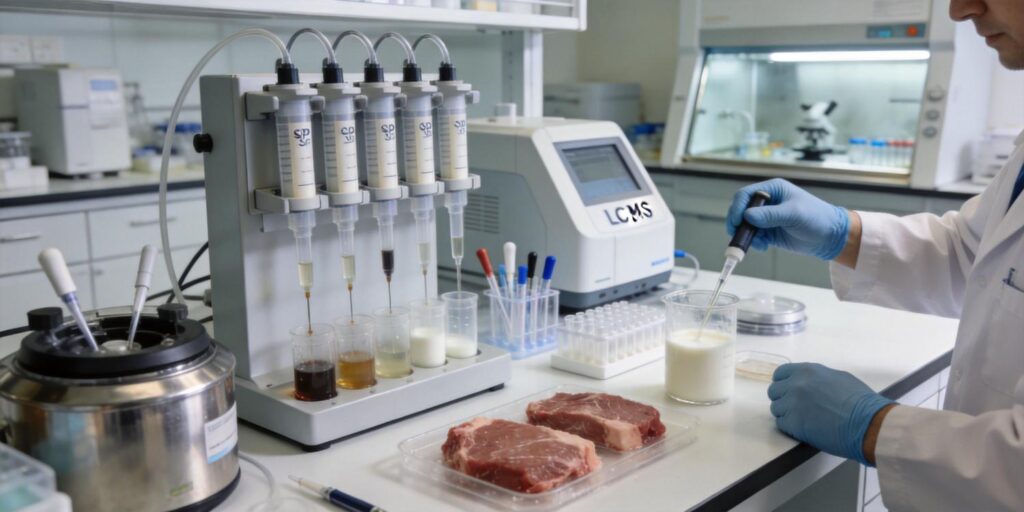
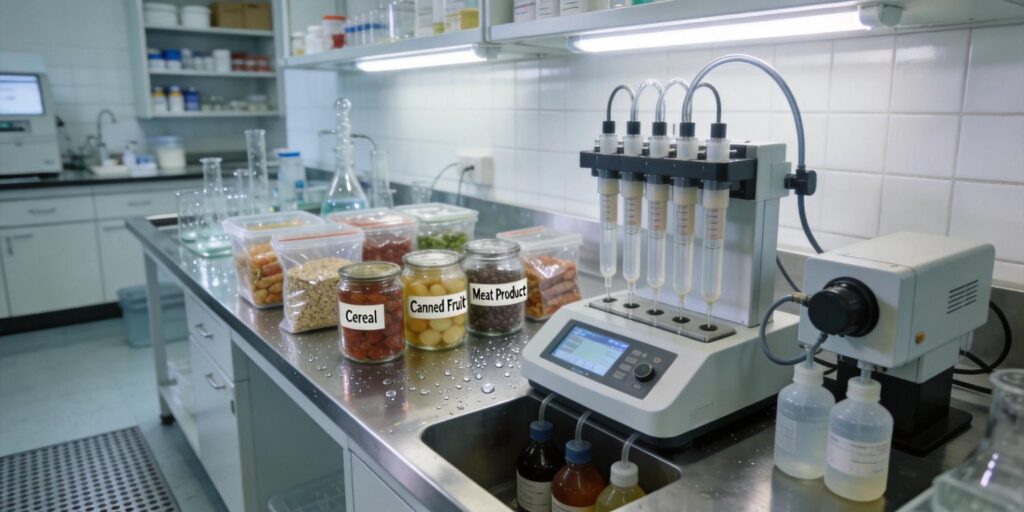
Sample preparation begins with homogenization and liquid extraction. A typical procedure:
- Homogenize 5 g of solid food (e.g., cheese, jam) or 5 mL of liquid sample (e.g., soft drink).
- Add 20 mL of water or a methanol/water mixture (e.g., 20:80 v/v).
- Adjust pH to 4–5 with dilute HCl or formic acid to ensure the preservatives are in their non‑ionized forms.
- Centrifuge or filter to remove particulates.
For fatty foods, additional defatting with hexane may be needed before SPE.
Selection of WAX or HLB Cartridges
The choice of SPE sorbent depends on the sample matrix and target analytes:
- HLB (Hydrophilic-Lipophilic Balanced): A universal reversed‑phase sorbent suitable for acidic, basic, and neutral compounds. It is ideal for complex matrices because it retains both polar and non‑polar analytes. Our HLB SPE Cartridges offer high capacity and reproducibility.
- WAX (Weak Anion Exchange): Selectively retains acidic compounds such as benzoic and sorbic acids under low pH conditions. Recommended when targeting preservatives in high‑sugar or high‑lipid samples. Explore our WAX SPE Cartridges for strong retention and clean extracts.
For most processed foods, HLB provides a balanced approach; for challenging fatty or sugary matrices, WAX offers better specificity.
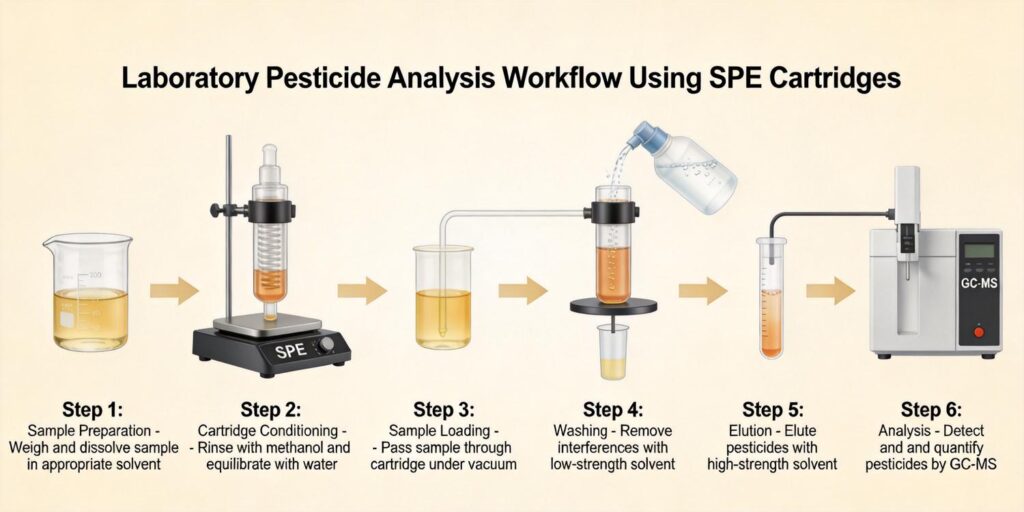
SPE Cleanup Protocol
A generic SPE method for preservatives using WAX cartridges (60 mg/3 mL) is described below. The same protocol can be adapted to HLB by substituting the conditioning and wash solvents.
Conditioning
- 3 mL methanol
- 3 mL water (pH adjusted to 4.5 with formic acid)
Loading
Pass the filtered extract (pH 4–5) through the cartridge at 1–2 mL/min. Preservatives are retained via anion‑exchange and reversed‑phase interactions.
Wash
- 3 mL water (pH 4.5) to remove sugars and polar interferences.
- Optional: 3 mL hexane to remove lipids (if using HLB, use 5% methanol in water for defatting).
Elution
Elute preservatives with 3 mL of 2% formic acid in methanol (for HLB) or 3 mL of 5% NH₄OH in methanol (for WAX). Collect the eluate.
Removing Fats and Sugars
Fats and sugars are major interferences. The wash step with hexane (for fats) and water at pH 4.5 (for sugars) effectively removes these without losing the target analytes. For HLB, using a 5% methanol/water wash further helps elute sugars while retaining preservatives.
Elution and Concentration
After elution, evaporate the solvent under a gentle nitrogen stream at 40°C. Reconstitute the residue in 1 mL of mobile phase (e.g., 20 mM ammonium acetate, pH 4.5 / methanol). Filter through a 0.22 µm nylon syringe filter before injection.
HPLC or LC-MS Detection
HPLC‑UV: C18 column (150 × 4.6 mm, 5 µm), mobile phase of 20 mM ammonium acetate (pH 4.5) and methanol (70:30), flow 1.0 mL/min, detection at 230 nm for sorbate and 254 nm for benzoate.
LC‑MS/MS: Use negative electrospray ionization (ESI−), monitoring transitions m/z 121→77 (benzoate) and m/z 111→67 (sorbate). The SPE cleanup ensures minimal ion suppression.
Method Performance Metrics
- Recovery: Typically 85–105% for both preservatives in a range of matrices (juice, yogurt, sauce).
- Precision (RSD): <10% for intra‑day and inter‑day assays.
- LOD: 0.1 mg/kg (HPLC‑UV) and 0.02 mg/kg (LC‑MS/MS).
- LOQ: 0.5 mg/kg (HPLC‑UV) and 0.05 mg/kg (LC‑MS/MS).
- Linearity: R² > 0.999 over 0.5–100 mg/L.
These metrics demonstrate the robustness of the SPE method for routine monitoring.
Conclusion
Selecting the appropriate SPE sorbent—HLB or WAX—is key to achieving clean extracts for preservative analysis in processed foods. The protocol described here efficiently removes fats and sugars, providing high recoveries and low detection limits. For dependable results, explore our full line of HLB and WAX cartridges. For high‑throughput needs, consider our 96‑well SPE plates.