Why Profile Organic Acid Metabolites in Urine?
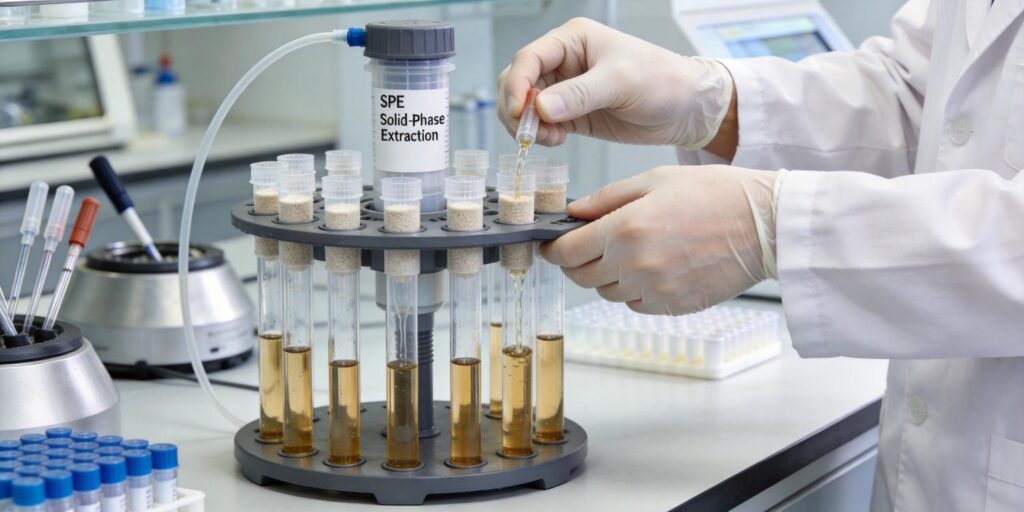
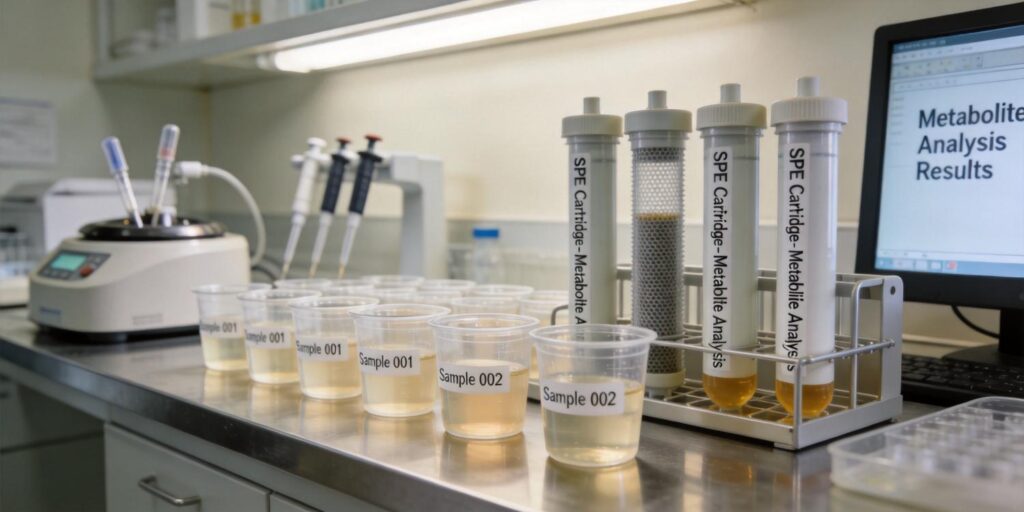
Organic acid metabolites are intermediates of amino acid, fatty acid, and carbohydrate metabolism, and their urinary levels serve as critical biomarkers for inherited metabolic disorders, mitochondrial dysfunction, and nutritional status. Accurate profiling using weak anion exchange (WAX) SPE enables sensitive, selective detection of these acidic compounds.
Characteristics of Weak Acids in Urine
Urinary organic acids typically exhibit pKa values between 3 and 5. At physiological pH (≈6), they exist partially ionized. Weakly acidic functional groups (e.g., carboxylic acids) interact with WAX sorbents primarily through anion exchange, but hydrophobic interactions also contribute, especially for more lipophilic metabolites.
Sample Preparation: Dilution and pH Adjustment
To prevent column overload and matrix effects, urine samples are diluted 1:1 to 1:5 with water. pH is adjusted to 6–7 using ammonium hydroxide or phosphate buffer, ensuring the organic acids are deprotonated for optimal retention on the WAX sorbent.
How WAX SPE Retains Organic Acids
Weak anion exchange SPE utilizes a sorbent with tertiary amine functional groups (pKa ≈ 10). At pH 6–7, the sorbent is positively charged, while organic acids are negatively charged, enabling strong ionic retention. This mechanism simultaneously excludes neutral and basic compounds, reducing interferences.
Washing Steps to Remove Salts and Neutral Interferents
After sample loading, the cartridge is washed with 5% methanol in water (pH 6) to elute salts, urea, and neutral metabolites. A second wash with 100% methanol removes hydrophobic neutrals while retaining acids via ionic interactions.
Acidified Elution for Maximum Recovery
Target analytes are eluted with 2% formic acid in methanol (or 50 mM ammonium acetate in methanol, pH 3). The acidic eluent protonates the tertiary amines, neutralizing the sorbent charge, and releases organic acids. Typical elution volume is 1–2 mL.
LC-MS/MS Detection Parameters
Separate extracts using a reversed-phase C18 column (e.g., 2.1 × 100 mm, 1.7 μm) with a gradient of water and acetonitrile containing 0.1% formic acid. MS/MS detection in negative electrospray ionization (ESI−) with multiple reaction monitoring (MRM) provides specificity. Common transitions include m/z 117→73 for succinate, m/z 129→85 for pyruvate, and m/z 191→87 for citrate.
Clinical Interpretation of Metabolite Levels
Elevated levels of specific organic acids indicate enzyme deficiencies or metabolic blocks. For example, increased methylmalonic acid suggests vitamin B12 deficiency or methylmalonic aciduria, while elevated orotic acid points to urea cycle disorders. Always compare against established reference ranges adjusted for age and diet.
For robust, high-throughput analysis, Poseidon’s WAX SPE cartridges offer consistent lot-to-lot performance. For method development, also consider HLB and MAX options. For high-throughput clinical labs, explore 96-well SPE plates.