Extraction of Veterinary Drug Residues from Milk Using HLB SPE
1. Regulatory Importance of Veterinary Drug Monitoring
Veterinary drugs are widely used in dairy production to prevent and treat diseases, but their residues in milk pose potential health risks to consumers, including allergic reactions, antimicrobial resistance, and endocrine disruption. Regulatory agencies such as the FDA, EU Commission, and Codex Alimentarius have established maximum residue limits (MRLs) for various veterinary drugs in milk. Compliance with these limits requires robust, sensitive, and reliable analytical methods. Solid-phase extraction (SPE) using hydrophilic-lipophilic balance (HLB) sorbents has become a gold standard for sample preparation in veterinary drug residue analysis due to its ability to extract a broad range of polar and non-polar compounds with high recovery and reproducibility.
2. Matrix Challenges in Milk Analysis
Milk is a complex biological matrix containing approximately 87% water, 3.5% fat, 3.2% protein, and 4.8% lactose, along with vitamins and minerals. These components can interfere with the extraction and detection of veterinary drug residues. Proteins can precipitate and clog SPE cartridges, while lipids can co-extract with target analytes and cause ion suppression or enhancement in LC-MS/MS analysis. Lactose and other sugars may also contribute to matrix effects. Therefore, a sample preparation protocol must effectively remove these interferents while preserving the integrity of the analytes. HLB SPE cartridges, such as those offered by Poseidon Scientific, are designed to handle these challenges through a balanced retention mechanism that captures both polar and non-polar analytes.
3. Protein Precipitation and Defatting
Before SPE, milk samples typically undergo protein precipitation and defatting steps. A common approach involves adding acetonitrile or acidified acetonitrile (e.g., 1% formic acid) to the milk sample at a ratio of 1:1 or 2:1 (v/v). The mixture is vortexed and centrifuged at high speed (e.g., 10,000 rpm for 10 minutes) to pellet precipitated proteins. The supernatant is then collected and may be further defatted by liquid-liquid extraction with hexane or by passing through a C18 cleanup cartridge. Alternatively, samples can be diluted with water or buffer to reduce viscosity and protein concentration before loading onto the HLB cartridge. For multi-residue methods targeting both polar and non-polar drugs, a simple dilution with 0.1% formic acid in water (1:2 dilution) often suffices, as the HLB sorbent can tolerate some protein content.
4. HLB Cartridge Conditioning
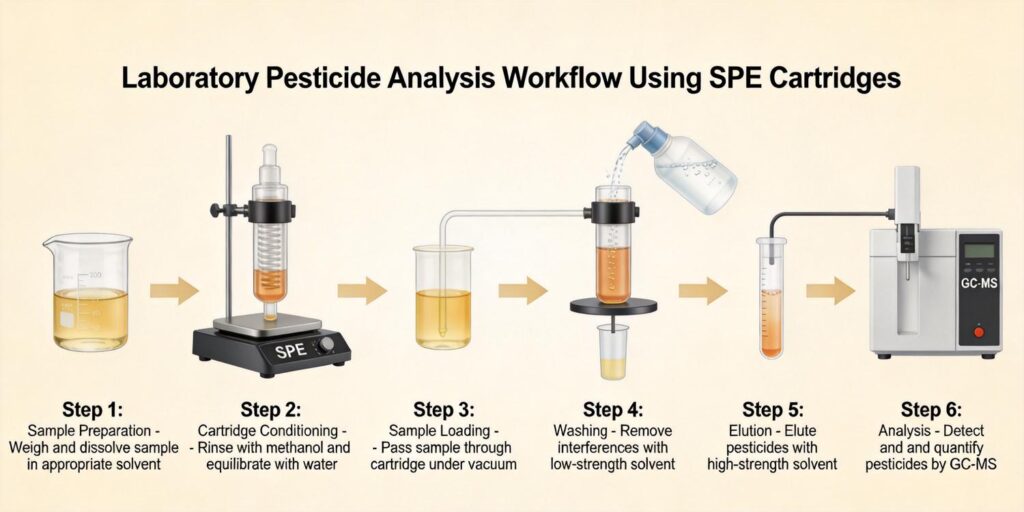
Proper conditioning of the HLB cartridge is critical for reproducible retention and recovery. The generic protocol involves: (a) 1-2 cartridge volumes (e.g., 3 mL for a 200 mg cartridge) of methanol to wet the sorbent and activate the hydrophilic and lipophilic sites; (b) 1-2 cartridge volumes of water or buffer (e.g., 0.1% formic acid in water) to equilibrate the sorbent. The cartridge should not be allowed to dry out between conditioning and sample loading. Using Poseidon Scientific HLB cartridges, which feature high-purity, low-bleed sorbent, ensures minimal background interference and consistent bed volume.
5. Loading Diluted Milk Extract
The prepared milk extract (after protein precipitation and dilution) is loaded onto the conditioned HLB cartridge at a flow rate of approximately 1-2 mL/min. For a typical 200 mg/6 mL cartridge, the recommended loading volume is up to 10 mL of sample. The sample can be applied under gravity or using a vacuum manifold. After loading, the cartridge is washed to remove weakly retained matrix components. To maximize recovery of analytes with a range of polarities (e.g., tetracyclines, sulfonamides, quinolones, and beta-lactams), the loading pH should be adjusted to 2-3 by adding acid, as most veterinary drugs are neutral or basic compounds that are better retained under acidic conditions.
6. Washing to Remove Lipids and Proteins
After sample loading, a washing step removes residual proteins, lipids, salts, and sugars. A typical wash solution is 5% methanol in water (v/v) or 0.1% formic acid in 5% methanol. One to two cartridge volumes (e.g., 5-10 mL) are passed through the bed. For fatty milk samples, a wash with hexane or a hexane:ethyl acetate mixture (e.g., 90:10) can be applied to remove non-polar lipids without eluting target analytes. However, if the analytes are highly non-polar, such as some avermectins, hexane wash should be avoided. The HLB sorbent’s balanced retention allows the use of a high percentage of organic solvent (up to 50% methanol) in the wash without significant loss of moderately polar drugs.
7. Elution with Methanol
Target analytes are eluted with a polar organic solvent, typically methanol or acetonitrile. For multi-class veterinary drug residues, elution with 2-3 cartridge volumes of methanol (e.g., 6 mL) is recommended. Adding 0.1% formic acid to the elution solvent can improve recovery for basic compounds. The eluate is collected and evaporated under a gentle stream of nitrogen at 40°C to near dryness, then reconstituted in a suitable mobile phase (e.g., 0.1% formic acid in water:methanol 90:10) for LC-MS/MS analysis. For methods requiring higher sensitivity, the eluate can be evaporated to a smaller volume (e.g., 200 µL) to achieve concentration factors of up to 50x.
8. LC-MS/MS Validation Results
Validation of the HLB SPE-LC-MS/MS method typically assesses linearity, precision, accuracy, recovery, matrix effects, and limits of quantification (LOQ). For a panel of 30 veterinary drugs from different classes (e.g., sulfonamides, tetracyclines, quinolones, macrolides, and beta-lactams), recoveries range from 70% to 120% with relative standard deviations below 20% at three spiking levels (0.5x, 1x, and 2x MRL). LOQs are typically 0.1-1.0 µg/L, well below regulatory MRLs (e.g., 100 µg/L for sulfonamides in milk). Matrix effects are minimized to less than 10% signal suppression or enhancement for most analytes, thanks to efficient cleanup. The method has been successfully applied to raw cow milk, goat milk, and even powdered milk reconstituted in water. For laboratories seeking high-throughput options, 96-well SPE plates with HLB sorbent can process up to 96 samples in parallel, dramatically increasing productivity.
For more information on HLB SPE products and custom method development, visit Poseidon Scientific’s HLB SPE Cartridges page.