Herbal Matrices: A Unique Analytical Challenge
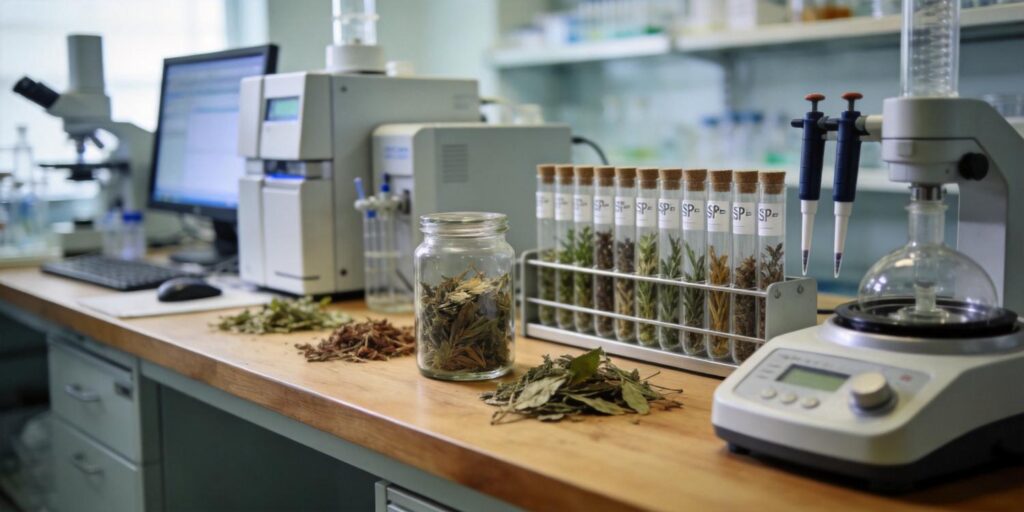
Herbal medicines contain complex chemical mixtures, including alkaloids, flavonoids, tannins, pigments, and other secondary metabolites. This complexity poses significant challenges for targeted analysis. The matrix effect in LC-MS can suppress or enhance ionization of target analytes, leading to inaccurate quantification. Developing a robust solid-phase extraction (SPE) cleanup protocol is critical for isolating alkaloids while removing interfering compounds. Here we present a systematic approach using mixed-mode cation exchange (MCX) sorbents tailored for basic alkaloids.
Understanding Alkaloid Chemistry and Ionization Behavior
Alkaloids are nitrogen-containing basic compounds that exist in protonated (cationic) form at low pH. Their pKa values typically range from 6 to 10. Below pH 5, most alkaloids are fully protonated and positively charged. This pH-dependent ionization allows selective retention on cation exchange sorbents. Weak bases may require acidic conditions to ensure complete protonation. Understanding the specific alkaloid profile in your herbal material is essential for optimizing pH throughout the SPE workflow.
Why Choose MCX Sorbents?
Mixed-mode cation exchange sorbents (e.g., Poseidon MCX SPE Cartridges) combine reversed-phase and strong cation exchange interactions. The sulfonic acid groups provide strong cation exchange capacity, while the C18 or polymeric backbone offers reversed-phase retention. This dual retention mechanism is ideal for trapping protonated alkaloids while allowing neutral and acidic interferents to pass through. Compared to weak cation exchange (WCX), MCX provides stronger retention and better reproducibility, especially for multiresidue alkaloid analysis.
Step 1: Extraction of Plant Material with Acidified Solvent
Start by grinding dried herbal material to a fine powder. Accurately weigh 0.5–1.0 g and extract with 10 mL of acetonitrile:water (80:20, v/v) acidified with 0.1% formic acid (pH ~2.5). Vortex for 1 min, sonicate for 15 min, then centrifuge at 4000 rpm for 10 min. The acidic environment ensures alkaloids are protonated and stable. For highly pigmented samples, a preliminary defatting step with hexane may be beneficial.
Step 2: SPE Cleanup to Remove Pigments and Tannins
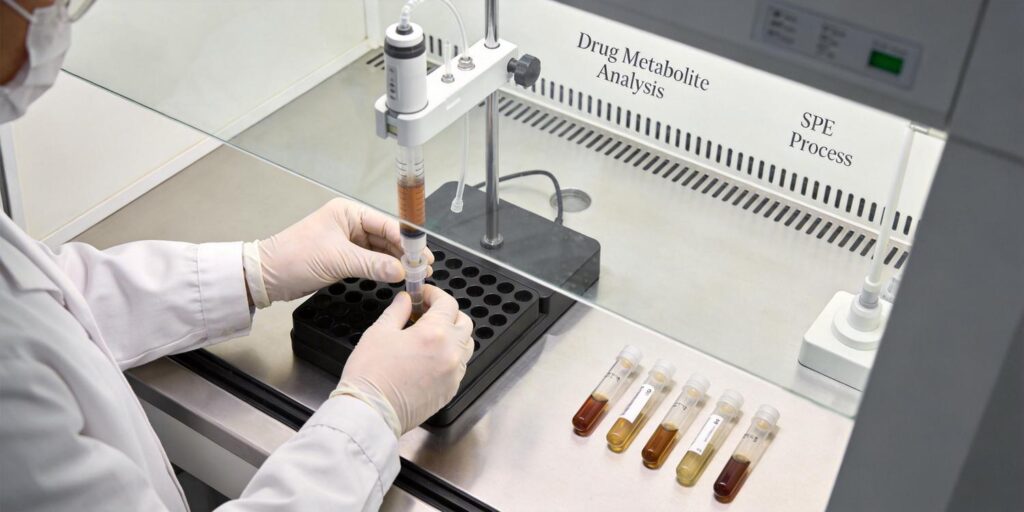
Condition a 200 mg/6 mL MCX cartridge with 3 mL methanol, followed by 3 mL 0.1% formic acid in water. Load 2 mL of the acidified extract supernatant. Wash sequentially:
- Wash 1: 3 mL of 0.1% formic acid in water (removes salts and polar interferents).
- Wash 2: 3 mL of methanol (removes pigments, tannins, and weakly retained neutrals).
The methanol wash effectively elutes chlorophyll and polyphenolic compounds while alkaloids remain tightly bound via cation exchange. Monitor wash fractions by color: a green/yellow wash indicates pigment removal.
Step 3: Elution Strategy Using Basic Organic Solvent
To elute alkaloids, disrupt both ion exchange and reversed-phase interactions. Use 3 mL of methanol containing 5% ammonium hydroxide (NH₄OH). The basic pH deprotonates alkaloids, neutralizing the charge, while methanol reverses C18 retention. Collect eluate and evaporate under nitrogen at 40°C. Reconstitute in 200 µL of initial mobile phase (e.g., 0.1% formic acid in water/acetonitrile, 95:5). Filter through a 0.22 µm PTFE syringe filter before injection.
LC-MS Quantification
Separate alkaloids on a C18 column (2.1 × 100 mm, 1.7 µm) with a gradient of 0.1% formic acid in water (A) and acetonitrile (B). Typical gradient: 5% B at 0 min, 30% B at 5 min, 60% B at 8 min, 95% B at 10 min, hold 2 min. MS detection in positive ESI mode with MRM transitions specific to each alkaloid. Use isotopically labeled internal standards (e.g., berberine-d3) for matrix-matched calibration.
Quality Control Considerations
Include at least one matrix blank (herbal material known to be free of target alkaloids), a solvent blank, and quality control (QC) samples at low, mid, and high concentrations. Recoveries should be 70–120% with RSD ≤ 20%. Check for carryover by injecting a blank after the highest standard. Assess matrix effects by comparing post-extraction spiked samples vs. neat standards. If suppression > 25%, consider further cleanup or using matrix-matched calibration.
For more complex matrices, a double SPE cleanup using WCX or MAX sorbents in series may be explored. Alternatively, 96-well SPE plates can be used for high-throughput method.
By following this protocol, analysts can achieve clean extracts suitable for sensitive LC-MS analysis, even from notoriously difficult herbal matrices.