Introduction to PFAS Contamination Issues
Per- and polyfluoroalkyl substances (PFAS) are a group of synthetic chemicals widely used in industrial and consumer products due to their unique water- and oil-repellent properties. However, their extreme persistence in the environment and potential adverse health effects—including immune suppression, thyroid disruption, and certain cancers—have made them a top priority for regulatory agencies worldwide. The U.S. Environmental Protection Agency (EPA) has established health advisories for PFOA and PFOS at near-zero levels, while the European Union is moving toward banning the entire PFAS class. Consequently, accurate and reliable PFAS analysis in water, soil, and biological matrices is critical for environmental monitoring and public health protection.
Analytical Challenges in PFAS Detection
PFAS analysis presents unique challenges. These compounds are amphiphilic, existing at trace concentrations (parts per trillion) in complex matrices. They can adsorb to various surfaces, and background contamination from fluorinated materials in laboratory equipment is common. Additionally, linear and branched isomers of PFAS require high-resolution chromatography and sensitive detection. Therefore, a robust sample preparation strategy using solid-phase extraction (SPE) is essential to achieve low detection limits and reliable quantification.
Choice of Weak Anion Exchange SPE
The most widely adopted SPE sorbent for PFAS is weak anion exchange (WAX). WAX sorbents contain a mixed-mode phase with both reversed-phase (e.g., C18) and weak anion exchange functionalities. This dual mechanism allows effective retention of both neutral and anionic PFAS species. For example, Poseidon Scientific’s WAX SPE cartridges provide high capacity and selectivity for PFAS from aqueous samples. The tertiary amine groups on WAX sorbents are protonated at low pH, enabling strong electrostatic interaction with the negatively charged carboxylate or sulfonate groups of PFAS. After sample loading, the neutral PFAS (e.g., fluorotelomer alcohols) are retained by reversed-phase interactions, while anionic PFAS are trapped via anion exchange.
Alternative SPE phases like HLB (hydrophilic-lipophilic balanced) can also retain PFAS but lack the ion-exchange selectivity, often resulting in co‑extraction of matrix interferences. For complex matrices such as serum or wastewater, WAX offers superior cleanup. Our HLB SPE cartridges may be suitable for screening, but for regulatory compliance, WAX is recommended.
Avoiding Fluoropolymer Contamination
PTFE (Teflon) and other fluoropolymers are common in laboratory consumables but must be avoided in PFAS analysis. These materials can leach PFAS or cause adsorption losses. Use polypropylene (PP) or glass vials, PP SPE cartridges, and PTFE-free tubing. Ensure that all SPE components—cartridge frits, tubing, and collection vessels—are fluoropolymer-free. Poseidon Scientific’s SPE products are manufactured using non-fluorinated materials to minimize background contamination.
SPE Workflow Optimized for PFAS Retention
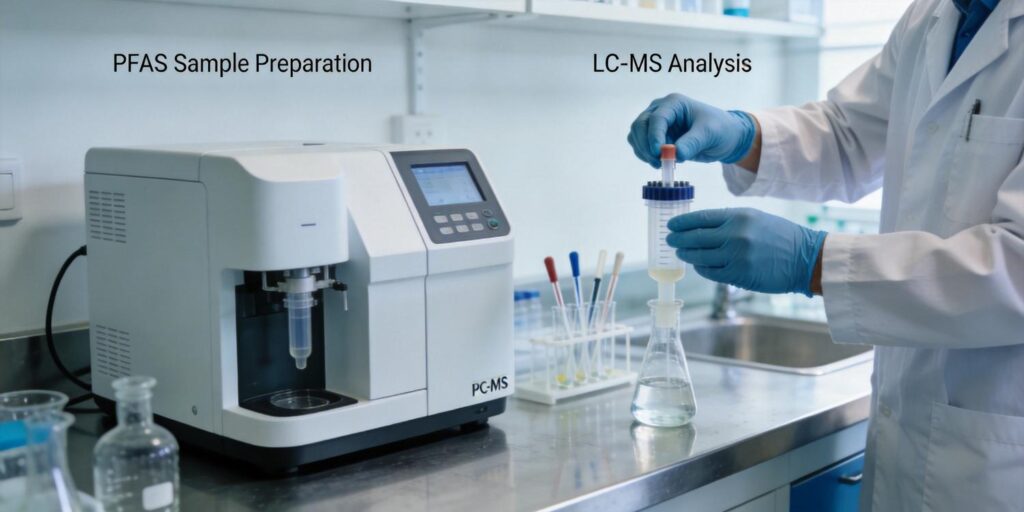
A typical PFAS SPE protocol using WAX cartridges involves the following steps:
- Conditioning: Pass 3 mL of methanol followed by 3 mL of HPLC-grade water through the cartridge at 1–2 mL/min.
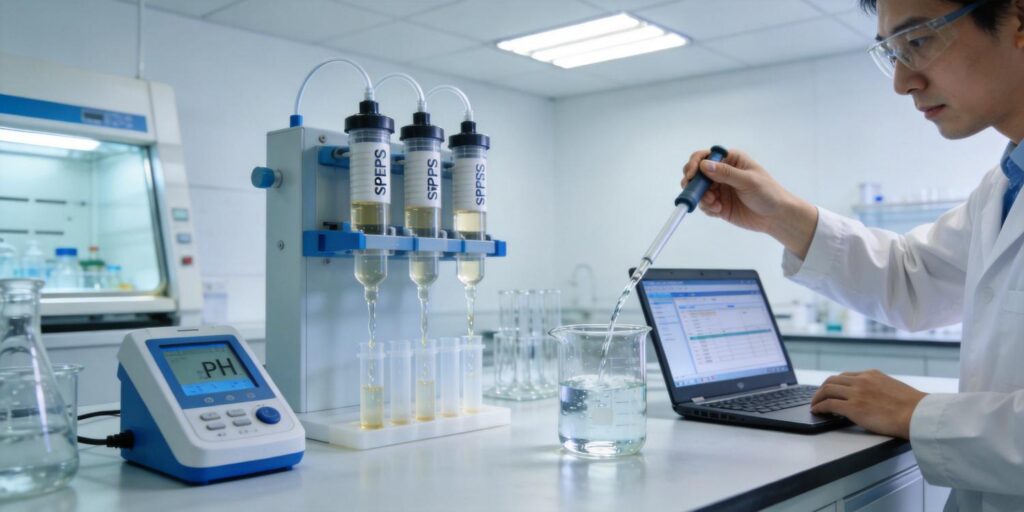
- Sample Loading: Adjust sample pH to ~3 using formic acid to protonate the WAX sorbent. Load water samples (100–500 mL) under vacuum at 5–10 mL/min. For soil or tissue, perform liquid extraction with methanol before dilution and loading.
- Washing: Wash with 3 mL of 25% methanol in water (v/v) to remove neutral interferences while retaining anionic PFAS.
- Elution: Elute PFAS with 2 × 2 mL of 0.1% ammonium hydroxide in methanol. This deprotonates the sorbent, releasing the ionically bound PFAS.
- Concentration: Evaporate eluate under a gentle nitrogen stream to ~0.5 mL, then reconstitute to 1 mL with 2 mM ammonium acetate in methanol/water (50:50).
Washing with Methanol/Water Mixtures
The wash step is critical for removing hydrophobic matrix components (humic acids, lipids) without eluting target PFAS. A methanol concentration between 20–30% (v/v) is optimal. Higher methanol content may cause premature elution of short-chain PFAS. Using a 25% methanol solution effectively removes non‑polar interferences while retaining even perfluorobutanoic acid (PFBA) and perfluorobutane sulfonate (PFBS).
Elution and Concentration Steps
Elution is performed using a basic methanol solution. Ammonium hydroxide at 0.1–0.5% in methanol dissociates the ion-pair between PFAS and the WAX sorbent. Collect the eluate in polypropylene tubes and concentrate under nitrogen at 40°C. Avoid complete dryness to prevent loss of volatile PFAS; concentrate to a final volume of ~500 μL. Reconstitute with a solvent compatible with LC-MS/MS, typically 2 mM ammonium acetate in 50:50 methanol/water.
LC-MS/MS Sensitivity Considerations
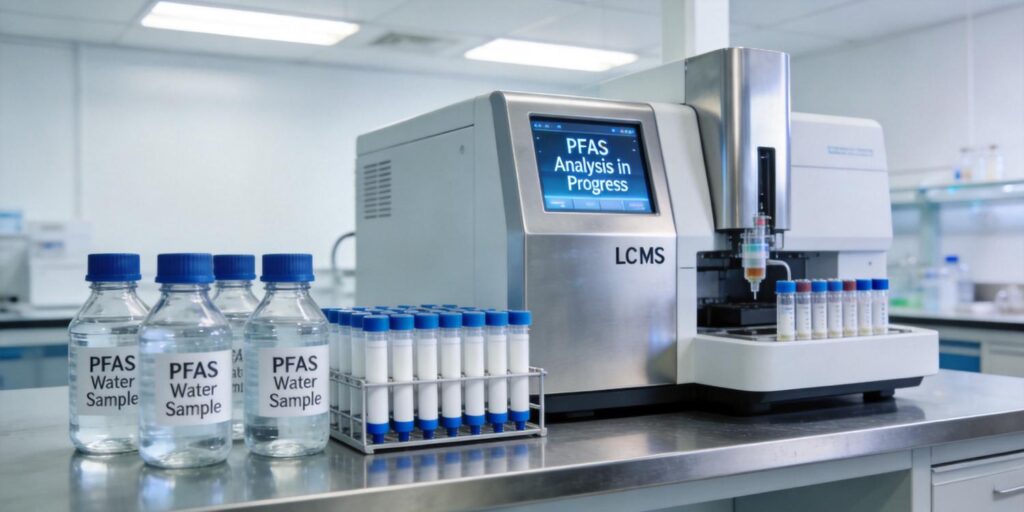
To achieve sub‑parts-per-trillion detection limits, the SPE extract must be concentrated 100–1000×. Use a divergent flow nitrogen evaporator to minimize sample loss. For LC-MS/MS analysis, employ a C18 reversed-phase column (e.g., 2.1 × 100 mm, 1.7 μm) with a gradient of water and methanol both containing 2 mM ammonium acetate. Monitor multiple reaction monitoring (MRM) transitions for both linear and branched isomers. Quantify using isotope dilution with 13C-labeled internal standards added before SPE extraction. Regular system blanks (injecting pure methanol) are essential to monitor carryover and background contamination.
For high-throughput needs, consider 96-well SPE plates available from Poseidon Scientific, which enable parallel processing of multiple samples with consistent flow rates and reduced solvent consumption.
Conclusion
A well-designed SPE method using weak anion exchange sorbents is fundamental for reliable PFAS analysis. By choosing appropriate materials, optimizing wash and elution steps, and taking care to avoid fluoropolymer contamination, laboratories can achieve the sensitivity and accuracy required for regulatory compliance. Poseidon Scientific provides a comprehensive range of SPE products—including WAX, HLB, MCX, and mixed-mode cartridges—to support your PFAS analysis workflow.