Environmental Occurrence of Artificial Sweeteners
Artificial sweeteners, such as sucralose, acesulfame-K, and saccharin, are widely used as sugar substitutes in food, beverages, and pharmaceuticals. Due to their high water solubility, chemical stability, and resistance to biodegradation, these compounds pass largely unchanged through wastewater treatment plants and have been detected in surface waters, groundwater, and even drinking water worldwide. Their persistence makes them ideal tracers for anthropogenic contamination, serving as chemical markers to assess wastewater influence in aquatic environments. Monitoring these sweeteners requires robust analytical methods, and solid‑phase extraction (SPE) with hydrophilic‑lipophilic balance (HLB) sorbents has become the gold standard for their extraction from complex water matrices.
Target Compounds: Sucralose, Acesulfame-K, and Saccharin
The three most commonly monitored artificial sweeteners in wastewater are:
- Sucralose (C12H19Cl3O8): A chlorinated sucrose derivative, extremely stable, not metabolized by humans, and excreted almost entirely unchanged. It has a log Kow of approximately –1.0, indicating very high water solubility.
- Acesulfame-K (C4H4KNO4S): A potassium salt of 6-methyl-1,2,3-oxathiazin-4(3H)-one 2,2-dioxide. It is also highly persistent and has been detected in the ng/L to μg/L range in wastewater effluents.
- Saccharin (C7H5NO3S): The oldest artificial sweetener, now less commonly used but still present in some products. It is more readily biodegradable than sucralose and acesulfame-K, yet still frequently detected in wastewater.
All three compounds are highly polar and anionic or neutral under typical environmental pH, necessitating a reversed‑phase/weak anion exchange mixed‑mode sorbent like HLB for efficient retention.
Wastewater Sample Filtration and pH Adjustment
Raw wastewater contains suspended solids, colloids, and organic matter that can clog SPE cartridges and interfere with extraction. Filtration through 0.45 μm or 0.7 μm glass fiber filters is recommended. To improve retention of ionizable sweeteners, the sample pH should be adjusted to 2–3 using hydrochloric acid. At low pH, acesulfame-K (pKa ≈ 2.0) and saccharin (pKa ≈ 1.6) are in their neutral, protonated forms, maximizing their interaction with the HLB sorbent. Sucralose remains neutral across a wide pH range, so acidification does not hinder its extraction.
HLB Cartridge Conditioning and Loading Large Volumes
Poseidon Scientific’s HLB SPE cartridges feature a balanced hydrophilic‑lipophilic copolymer that provides excellent wettability and high capacity for polar analytes. The conditioning protocol is:
- 3 mL methanol
- 3 mL deionized water (pH 2–3)
Do not allow the cartridge to dry between conditioning steps. Load the acidified sample (typically 100–500 mL for wastewater influent, up to 1 L for effluent) at a flow rate of 5–10 mL/min. The high surface area and pore volume of the HLB sorbent (particle size 30–60 μm, 60 Å pores) allows handling of large volumes without breakthrough for these low‑molecular‑weight polar analytes.
Washing Protocol to Remove Organic Matter
After sample loading, a washing step is essential to remove co‑extracted humic and fulvic acids, lipids, and other organic interferences. Wash with 5 mL of 5% methanol in water (pH 2–3). This weak organic solvent mixture helps elute moderately polar interferences while retaining the target sweeteners. For samples with exceptionally high organic load, a second wash with 2 mL of 10% methanol may be applied, but careful monitoring ensures no premature elution of saccharin or acesulfame-K.
Elution Solvent Selection
The choice of elution solvent is critical for quantitative recovery. A two‑step elution is often recommended:
- Step 1: 4 mL of methanol (for sucralose and neutral compounds)
- Step 2: 4 mL of 5% ammonia in methanol (for anionic sweeteners acesulfame-K and saccharin)
Alternatively, a single elution with 4 mL of methanol containing 0.1% formic acid can be used if all three analytes are to be collected together. The eluate is then evaporated under a gentle nitrogen stream at 40 °C and reconstituted in 0.5–1.0 mL of 90:10 water/methanol prior to LC-MS/MS analysis.
LC-MS/MS Detection
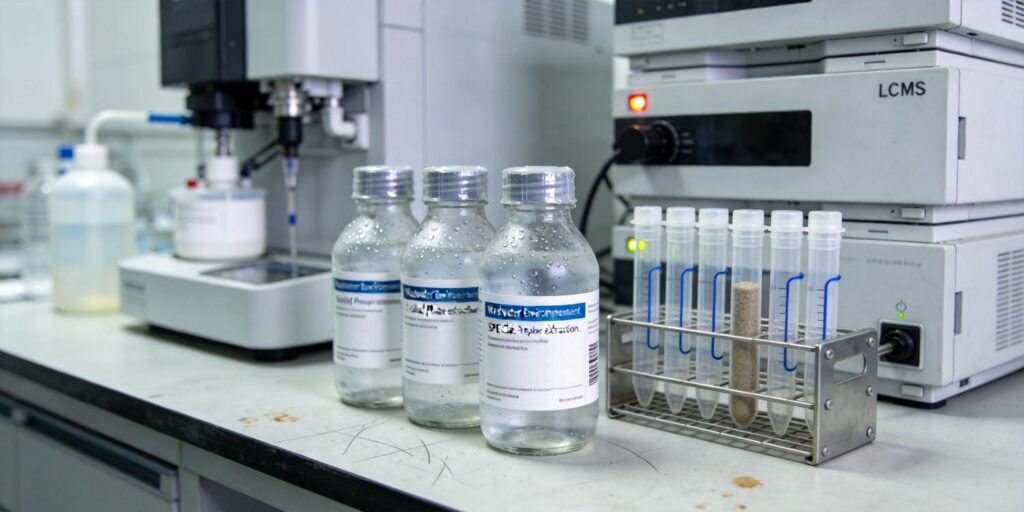
Separation is typically performed on a C18 reversed‑phase column (e.g., 2.1 × 100 mm, 1.7 μm) with a gradient of water (0.1% formic acid) and methanol. MS/MS detection in negative electrospray ionization mode using multiple reaction monitoring (MRM) provides high sensitivity and selectivity. Representative MRM transitions are:
- Sucralose: m/z 395 → 359 and 395 → 143
- Acesulfame-K: m/z 162 → 82 and 162 → 78
- Saccharin: m/z 182 → 42 and 182 → 106
Limits of quantification typically range from 1 to 10 ng/L for wastewater effluents, sufficient for environmental monitoring.
Data Interpretation for Environmental Monitoring
Concentrations of artificial sweeteners provide insight into wastewater treatment efficiency and potential contamination of receiving waters. For example, sucralose concentrations in treated effluent often exceed 1 μg/L, while acesulfame-K and saccharin vary with treatment type. Acesulfame-K is more persistent than saccharin, which is readily degraded in activated sludge systems. Comparing influent vs. effluent loads allows calculation of removal efficiencies. Furthermore, the presence of these sweeteners in surface water indicates recent wastewater impact, supporting source tracking studies. When combined with other tracers like caffeine or pharmaceuticals, a comprehensive picture of anthropogenic influence on aquatic ecosystems can be built.
For laboratories seeking to implement or optimize this method, the Poseidon Scientific HLB SPE cartridges offer consistent lot‑to‑lot reproducibility and low background levels, ensuring reliable data for long‑term monitoring programs. Also explore our 96‑well SPE plates for high‑throughput applications.