Sources of Industrial Pollutants in Wastewater
Industrial wastewater is a major source of organic and inorganic contaminants that pose significant risks to ecosystems and human health. Common pollutants include polycyclic aromatic hydrocarbons (PAHs), polychlorinated biphenyls (PCBs), phthalates, pesticides, and volatile organic compounds (VOCs). These originate from manufacturing processes, chemical spills, cooling water discharges, and cleaning operations. The complex matrix of wastewater, which often contains high levels of suspended solids, dissolved salts, and natural organic matter, makes sample preparation critical for accurate analysis.
Sample Collection and Filtration
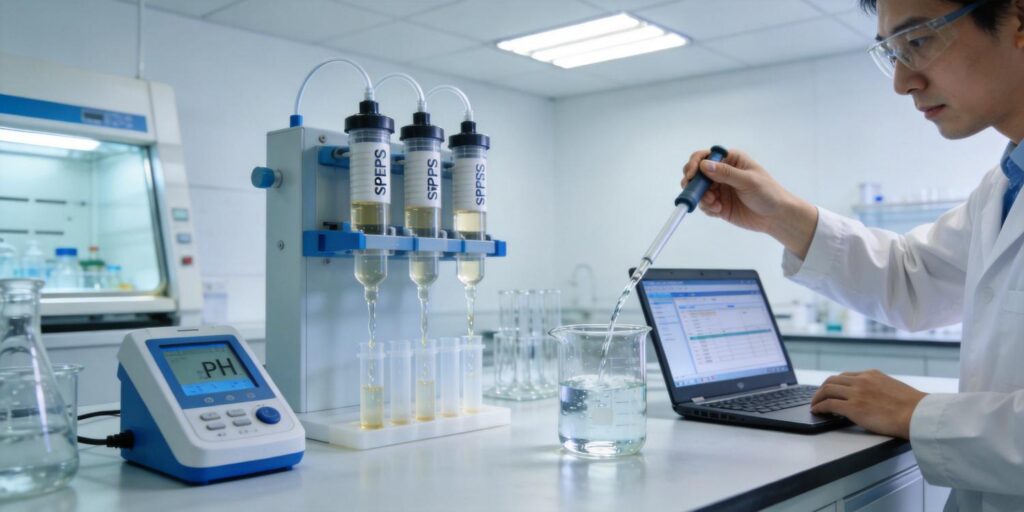
Proper sample collection is the first step toward reliable SPE results. Collect representative wastewater samples using pre-cleaned amber glass bottles to prevent photodegradation of target analytes. For industrial effluents, grab samples or composite samples may be used, depending on regulatory requirements. Immediate filtration through 0.45 µm or 1.0 µm glass fiber filters is essential to remove particulates that can clog SPE cartridges. Adjust the sample pH to 2–3 for acidic analytes (e.g., phenolic compounds) or to 7–8 for neutral compounds to optimize retention on the sorbent.
SPE Sorbent Selection for Organic Contaminants
Choosing the right SPE sorbent is the most critical decision for extracting industrial pollutants. For nonpolar to moderately polar organic contaminants, HLB SPE cartridges (hydrophilic-lipophilic balanced) are the gold standard due to their ability to retain a wide range of compounds at various pH levels. For acidic compounds like phenols and carboxylic acids, MAX SPE cartridges (mixed-mode anion exchange) provide excellent retention. Cationic contaminants such as basic drugs and amines are best extracted using MCX SPE cartridges (mixed-mode cation exchange). For highly hydrophobic compounds, WAX SPE cartridges (weak anion exchange) or WCX SPE cartridges (weak cation exchange) offer selective cleanup.
Conditioning Cartridges for Large-Volume Extraction
For wastewater samples, which are often large-volume (typically 0.5–2 L), proper cartridge conditioning ensures reproducible results. For HLB cartridges, follow a three-step conditioning protocol: rinse with 3–5 mL of methanol to wet the sorbent, then 3–5 mL of deionized water, and finally 3–5 mL of water adjusted to the same pH as the sample. Do not let the cartridge dry out between conditioning steps. For mixed-mode cartridges like MAX, MCX, WAX, or WCX, use the appropriate buffer to activate the ion-exchange groups as specified by the manufacturer.
Loading Wastewater Samples Through Cartridges
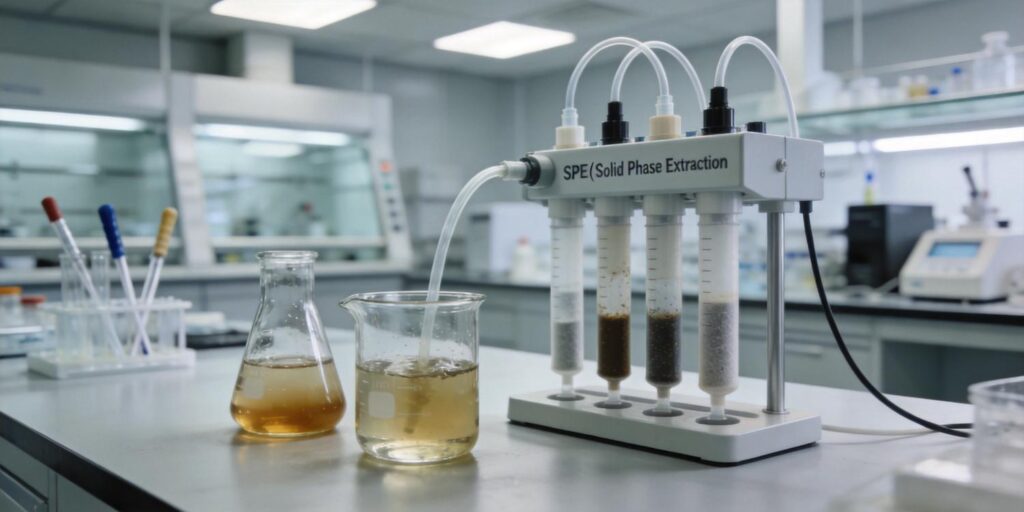
Load the filtered wastewater onto the conditioned cartridge at a controlled flow rate of 2–10 mL/min to ensure optimal contact time for analyte retention. For large-volume samples, use a pump or a vacuum manifold to maintain consistent flow. Overloading the cartridge can cause breakthrough of analytes, so the sample volume should be adjusted based on the sorbent mass and the expected concentration of pollutants. Typically, 200–500 mL of wastewater is used for 200 mg cartridges, while 1–2 L is suitable for 500 mg or 1 g cartridges.
Washing Steps to Remove Salts and Particulate Matter
After loading, a washing step removes matrix interferences without eluting target analytes. For most organic pollutants, wash with 5–10 mL of 5% methanol in water or a weak buffer solution. This effectively removes inorganic salts, polar humic substances, and residual particulates. For ion-exchange sorbents, use a pH-adjusted wash that does not neutralize the charge on the sorbent. If the cartridge appears discolored after loading, a more aggressive wash with 10–20% methanol may be used, but ensure it does not cause premature elution.
Elution and Concentration of Pollutants
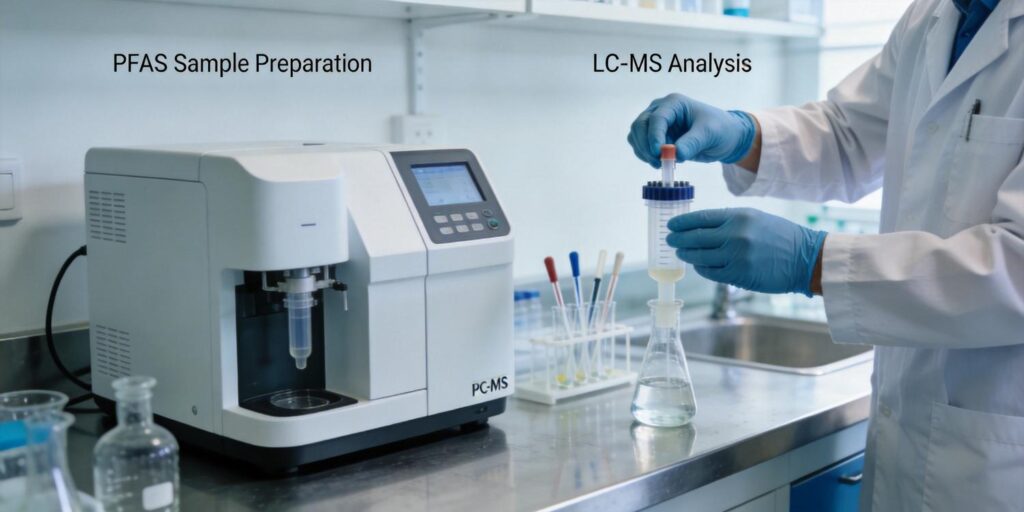
Elute the retained pollutants using a small volume (2–5 mL) of a suitable organic solvent. For nonpolar analytes on HLB, use methanol, acetonitrile, or ethyl acetate. For acidic compounds on MAX, use acidified methanol (e.g., 2% formic acid). For basic compounds on MCX, use ammoniated methanol (e.g., 5% ammonium hydroxide). Collect the eluate in a clean glass tube and evaporate to near dryness under a gentle stream of nitrogen. Reconstitute in 0.5–1 mL of solvent compatible with the analytical method (e.g., LC-MS or GC-MS). If higher throughput is needed, consider using 96-well SPE plates for parallel processing of multiple samples.
Environmental Regulatory Monitoring
SPE extraction of industrial pollutants from wastewater is integral to compliance with environmental regulations such as the US EPA Clean Water Act, EU Water Framework Directive, and China’s GB standards. Methods like EPA 525.2 for semivolatile organics, EPA 608 for organochlorine pesticides, and EPA 1668 for PCBs rely on SPE for sample cleanup and concentration. Regular monitoring of effluents for PAHs, phthalates, and phenols is mandatory in many jurisdictions. By adopting standardized SPE protocols using high-quality sorbents, laboratories can achieve detection limits in the parts-per-trillion range, ensuring that discharged water meets safety standards. For a complete range of SPE solutions tailored to industrial wastewater analysis, explore Poseidon Scientific’s product line at Poseidon Scientific.