Synthetic Dye Usage in Food Processing
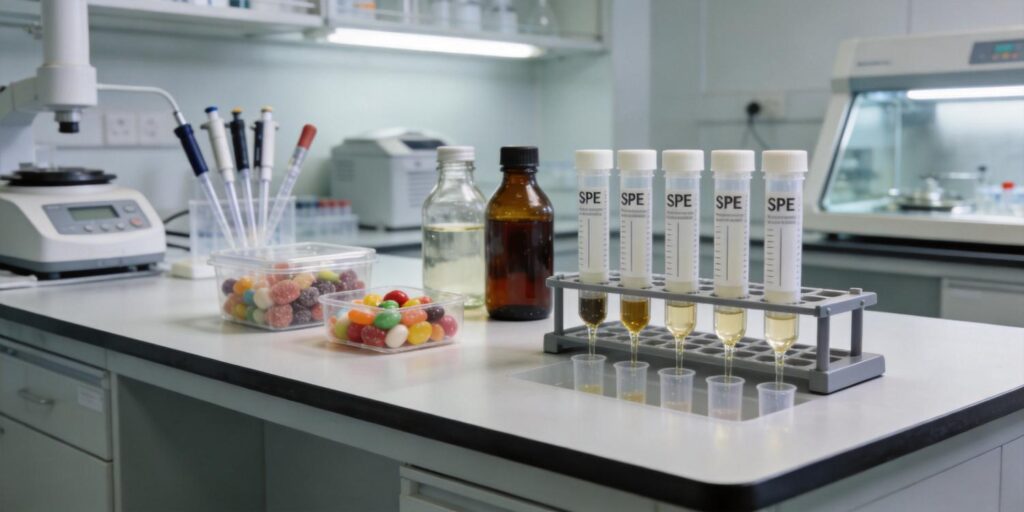
Synthetic dyes are widely used in the food industry to enhance visual appeal, offset color loss during processing, and ensure batch-to-batch consistency. Common dyes such as Tartrazine (Yellow #5), Sunset Yellow (Yellow #6), Allura Red (Red #40), and Brilliant Blue (Blue #1) are added to candies, beverages, baked goods, and dairy products. However, these compounds are subject to strict regulatory scrutiny due to potential health risks, including allergic reactions and behavioral effects in children. Reliable analysis of dye residues is critical for compliance with maximum allowable levels set by agencies like the FDA and EFSA.
Food Matrix Complexity in Dye Analysis
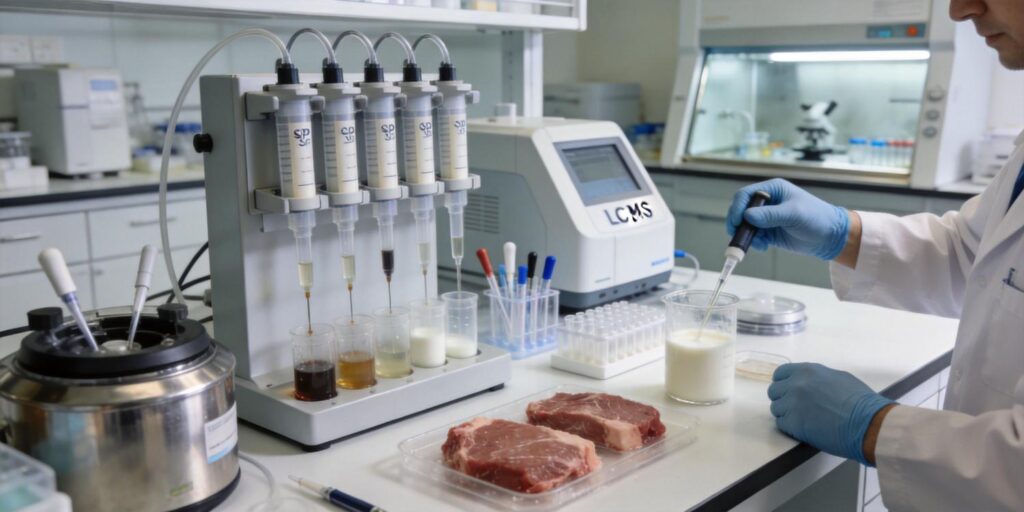
Food matrices are inherently complex, containing sugars, proteins, fats, natural pigments, and preservatives that can interfere with dye quantification. For example, high sugar content in candies and beverages can suppress ionization in mass spectrometry or cause retention time shifts in HPLC. Pigments like anthocyanins in fruit juices may co-elute with synthetic dyes, leading to false positives. Effective sample cleanup is therefore essential to isolate target dyes from matrix interferents while maintaining high recovery rates.
Extraction of Dyes Using Aqueous Solvents
Synthetic food dyes are generally water-soluble sulfonated azo compounds or triarylmethane derivatives. Aqueous extraction using a mixture of water and a small percentage of organic solvent (e.g., 80:20 water/methanol or water/acetonitrile) is typically employed to dissolve the dyes while leaving hydrophobic matrix components behind. Acidification (e.g., with formic acid or acetic acid) can improve extraction efficiency for certain dyes by maintaining their ionic state. For fatty foods, a defatting step with hexane prior to aqueous extraction is recommended.
SPE Sorbent Selection for Dye Compounds
Choosing the right solid-phase extraction (SPE) sorbent is critical for selective dye retention. Mixed-mode ion exchange sorbents like Poseidon WAX (Weak Anion Exchange) and Poseidon WCX (Weak Cation Exchange) are well-suited for synthetic dyes due to their charged functional groups.
WAX for Anionic Dyes
Most synthetic food dyes (e.g., Tartrazine, Sunset Yellow) are anionic sulfonates. WAX sorbents retain these compounds via anion exchange at pH > pKa of the stationary phase, providing excellent cleanup from neutral interferents.
WCX for Cationic Dyes
For dyes like Rhodamine B (a cationic dye banned in foods), WCX sorbents offer selective retention. If the method targets both anionic and cationic dyes, a mixed-mode RP/ion exchange or a universal polymeric sorbent like Poseidon HLB can be used, though selectivity may be reduced.
Conditioning Cartridges and Loading Extracts
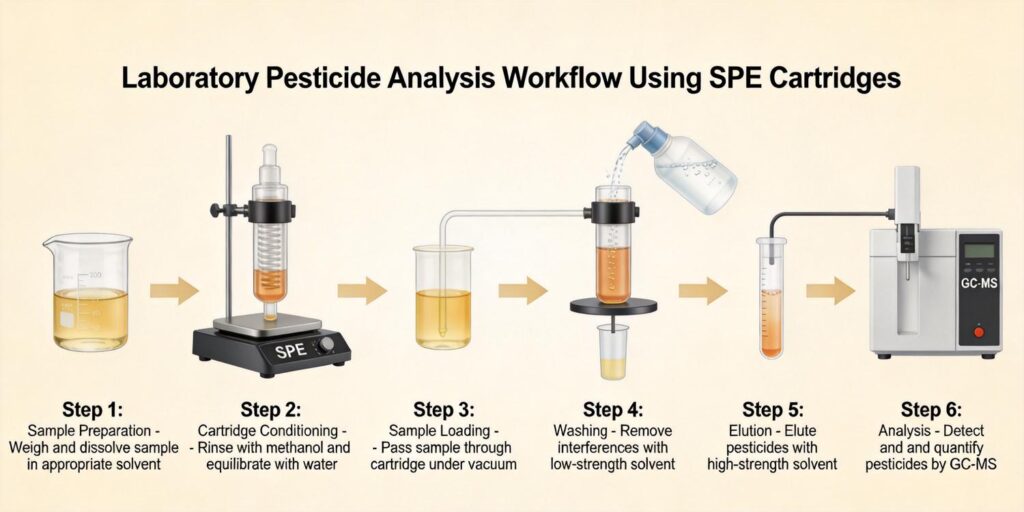
Proper cartridge conditioning is essential for reproducible results. For WAX or WCX sorbents, conditioning typically involves passing 3-5 mL of methanol followed by 3-5 mL of deionized water (or buffer at the loading pH). The aqueous extract containing the dyes is then loaded onto the cartridge at a slow, controlled flow rate (1-2 mL/min) to ensure efficient binding. For HLB sorbents, conditioning with methanol and water is standard, and the sample should be adjusted to <5% organic content to avoid breakthrough.
Washing Steps Removing Sugars and Pigments
After sample loading, a washing step removes weakly retained matrix components. For WAX and WCX, a wash with 5% methanol in water (or a low-pH buffer for WAX to suppress unwanted interactions) effectively flushes sugars, organic acids, and polar pigments without eluting the dyes. For HLB sorbents, a wash with 10-20% methanol in water can remove proteins and carbohydrates. An additional wash with hexane or dichloromethane may be used for fatty matrices, but ensure compatibility with the sorbent.
Elution Solvents Optimized for HPLC Detection
Elution of retained dyes is achieved by disrupting the ionic or hydrophobic interactions. For WAX sorbents, an alkaline elution solvent (e.g., 5% ammonium hydroxide in methanol) effectively displaces anionic dyes. For WCX, an acidic elution (e.g., 5% formic acid in methanol) is used. For HLB, methanol or acetonitrile is sufficient. The elution volume (2-5 mL) should be optimized to ensure complete recovery; typical recoveries exceed 85% for most dyes. After elution, the solvent may be evaporated and reconstituted in mobile phase for HPLC-UV or LC-MS/MS analysis.
Regulatory Monitoring of Food Dyes
Authorities such as the FDA (21 CFR Part 74) and EFSA (Regulation (EC) No 1333/2008) mandate maximum levels of synthetic dyes in food products. SPE-based cleanup methods are widely adopted in regulatory labs for routine monitoring. For high-throughput screening, 96-well SPE plates from Poseidon Scientific enable parallel processing of up to 96 samples, significantly increasing lab productivity while maintaining the selectivity required for complex food matrices.
By following the optimized SPE workflow outlined above, analysts can achieve robust, reproducible quantification of dye residues in food products, ensuring both consumer safety and regulatory compliance.