Introduction
Pesticide degradation products, often referred to as metabolites or transformation products, are increasingly recognized as critical environmental contaminants. While parent pesticides are routinely monitored, many degradation products exhibit higher mobility, persistence, and in some cases, greater toxicity than their precursors. Monitoring these compounds in surface water is essential for a comprehensive risk assessment of pesticide use. Solid-phase extraction (SPE) has become the method of choice for sample preparation due to its efficiency, reproducibility, and compatibility with modern analytical techniques. This blog provides a step-by-step guide for developing a robust SPE method for pesticide metabolites in surface water, from sample collection to LC-MS/MS analysis.
1. Environmental Significance of Pesticide Metabolites
Pesticide metabolites are formed through abiotic (hydrolysis, photolysis) and biotic (microbial degradation) processes after application. These compounds often persist longer in the environment than the parent molecules and can leach into groundwater or runoff into surface water bodies. For instance, the herbicide atrazine degrades to desethylatrazine and desisopropylatrazine, both of which are frequently detected in rivers and lakes. Regulatory agencies, such as the US EPA and the European Commission, now require monitoring of relevant metabolites in water quality assessments. Understanding the environmental fate and transport of these compounds is crucial for protecting drinking water sources and aquatic ecosystems.
2. Target Analytes and Chemical Properties
A typical list of target degradation products includes:
- Desethylatrazine (DEA)
- Desisopropylatrazine (DIA)
- Hydroxyatrazine (HA)
- 3,4-Dichloroaniline (from diuron)
- 4-Nitrophenol (from parathion)
- Aminomethylphosphonic acid (AMPA, from glyphosate)
These compounds span a wide range of polarities (log Kow from -1.5 to 2.5) and acid-base properties (pKa from 2 to 10). Accurate pH control during SPE is critical to achieve adequate retention on the sorbent. For example, acidic metabolites like AMPA require a low pH to suppress ionization, while basic metabolites like DEA require a high pH to ensure neutral form.
3. Sample Filtration and pH Control
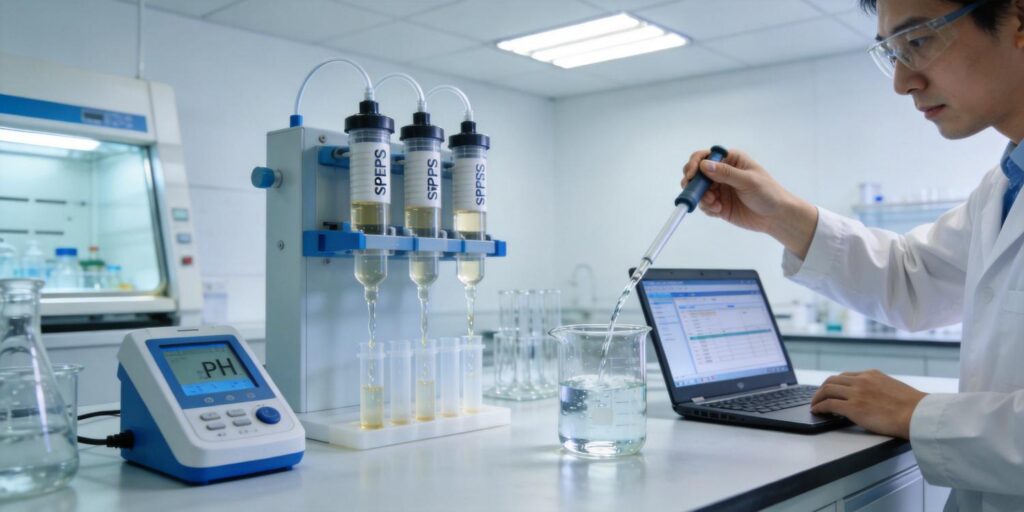
Surface water samples should be filtered through 0.45 μm glass fiber filters to remove suspended solids that could clog the SPE cartridge or interfere with analysis. The filtration step must be performed immediately after collection to minimize microbial degradation. After filtration, the pH of the sample is adjusted to the desired value using hydrochloric acid (HCl) or ammonium hydroxide (NH₄OH). For a mixed-mode method targeting both acidic and basic metabolites, a compromise pH of 6–7 is often used, but individual optimization for each class improves recovery.
4. SPE Cartridge Selection: HLB
For comprehensive extraction of pesticide metabolites, HLB SPE cartridges from Poseidon Scientific are highly recommended. HLB (Hydrophilic-Lipophilic Balanced) sorbent is a macroporous copolymer that provides reversed-phase retention for a broad range of polar and nonpolar compounds. It offers excellent wetting properties and high capacity, making it ideal for large-volume water samples. Compared to traditional C18, HLB retains more polar metabolites without breakthrough. For a detailed comparison of SPE sorbents, refer to our 96-well SPE plate product page.
5. Large-Volume Loading Strategies
Pesticide metabolites are often present at trace levels (ng/L), so large sample volumes (250–1000 mL) are required to achieve low detection limits. The following loading strategy is recommended:
- Condition the HLB cartridge with 5 mL methanol, then 5 mL deionized water.
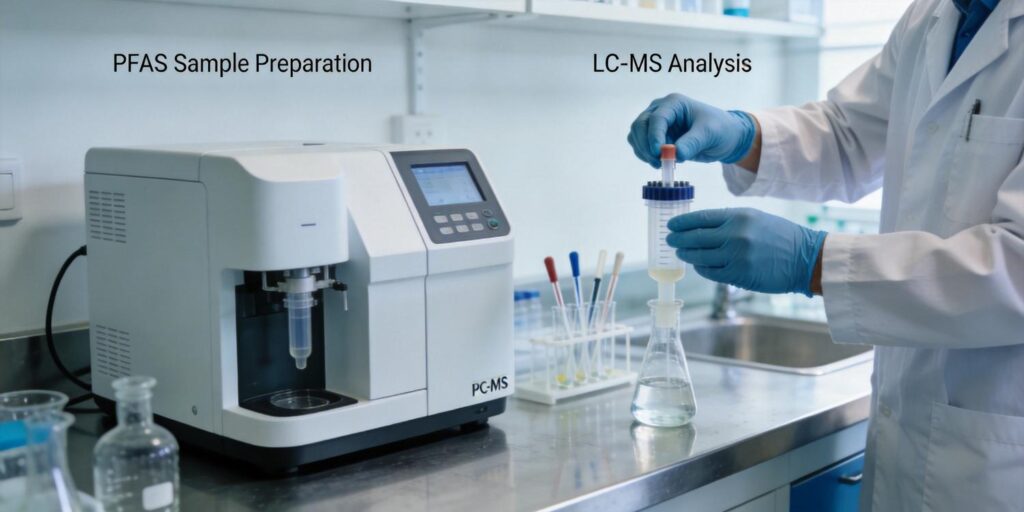
- Load the sample at a flow rate of 10–15 mL/min using a vacuum manifold or positive pressure. Higher flow rates may cause channeling and reduced recovery.
- After loading, wash the cartridge with 5 mL of 5% methanol in water to remove interfering matrix components.
For very dirty samples, a pre-wash with 2% formic acid in water can help remove metal ions and humic acids.
6. Washing and Elution Conditions
A washing step using 5 mL of 5% methanol in water effectively removes salts and highly polar interferences without eluting target analytes. For elution, 5 mL of methanol is sufficient for most metabolites. However, for highly retained compounds like AMPA, a elution solvent with 2% NH₄OH in methanol improves recovery. The eluate is then evaporated to dryness under a gentle nitrogen stream and reconstituted in 200 μL of mobile phase (e.g., 10% methanol in water).
7. LC-MS/MS Analysis
Analysis is performed using reversed-phase liquid chromatography coupled with tandem mass spectrometry (LC-MS/MS). A C18 column (2.1 × 100 mm, 1.8 μm) with a gradient of 0.1% formic acid in water (mobile phase A) and acetonitrile (mobile phase B) is typical. The mass spectrometer is operated in positive/negative switching multiple reaction monitoring (MRM) mode. Retention times and MRM transitions for each analyte are optimized using standards. For example, DEA: m/z 188 → 146 (quantifier), 188 → 104 (qualifier); DIA: m/z 174 → 132, 174 → 104.
8. Environmental Data Interpretation
Quantification is performed using isotope-labeled internal standards (e.g., atrazine-d5) to correct for matrix effects. Method detection limits (MDLs) typically range from 0.5 to 5 ng/L for 500 mL samples. Recoveries should be between 70–120% with RSD < 20%. When interpreting environmental data, compare metabolite concentrations to relevant water quality guidelines (e.g., US EPA aquatic life benchmarks). Elevated levels of transformation products may indicate recent pesticide applications or ongoing degradation in the watershed. Additionally, computing the ratio of metabolite to parent concentration can help differentiate between fresh inputs and aged residues.
Conclusion
Monitoring pesticide degradation products in surface water requires a carefully optimized SPE method that accounts for the diverse physicochemical properties of these compounds. Using HLB SPE cartridges from Poseidon Scientific, analysts can achieve high recoveries and low detection limits. For alternative sorbent chemistries, consider our MAX, MCX, WAX, or WCX cartridges, which offer mixed-mode selectivity for challenging analytes. Regular monitoring of metabolites provides critical data for assessing the environmental impact of pesticide use and ensuring the safety of water resources.