Why Mycotoxin Cleanup Matters in Grain Analysis
Mycotoxins are toxic secondary metabolites produced by fungi such as Aspergillus, Penicillium, and Fusarium species. Common mycotoxins in grains include aflatoxins, ochratoxin A, deoxynivalenol (DON), zearalenone, and fumonisins. These contaminants pose serious health risks and are regulated by agencies such as the FDA and EFSA. Accurate detection requires rigorous sample preparation to remove interfering matrix components.
Grain Extraction Procedures
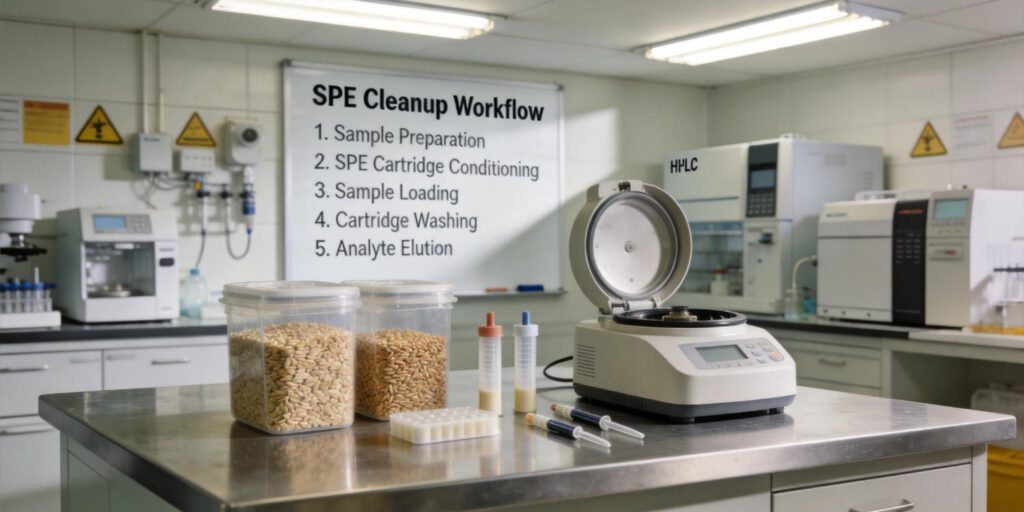
Typical extraction uses acetonitrile/water or methanol/water mixtures (e.g., 80:20 v/v) with mechanical shaking or homogenization. After centrifugation, the supernatant contains mycotoxins along with co-extracted pigments, lipids, and proteins. Direct injection of crude extract can foul LC columns and suppress ionization, making cleanup essential.
SPE Cleanup Advantages Over Traditional Methods
Traditional cleanup methods like liquid-liquid extraction (LLE) or immunoaffinity columns (IAC) have drawbacks: LLE is time-consuming and uses large solvent volumes, while IAC is costly and antibody-specific. Solid-phase extraction (SPE) offers faster processing, lower solvent consumption, higher reproducibility, and the ability to target multiple mycotoxins simultaneously. SPE cartridges from Poseidon Scientific provide robust, cost-effective alternatives.
Cartridge Selection and Conditioning
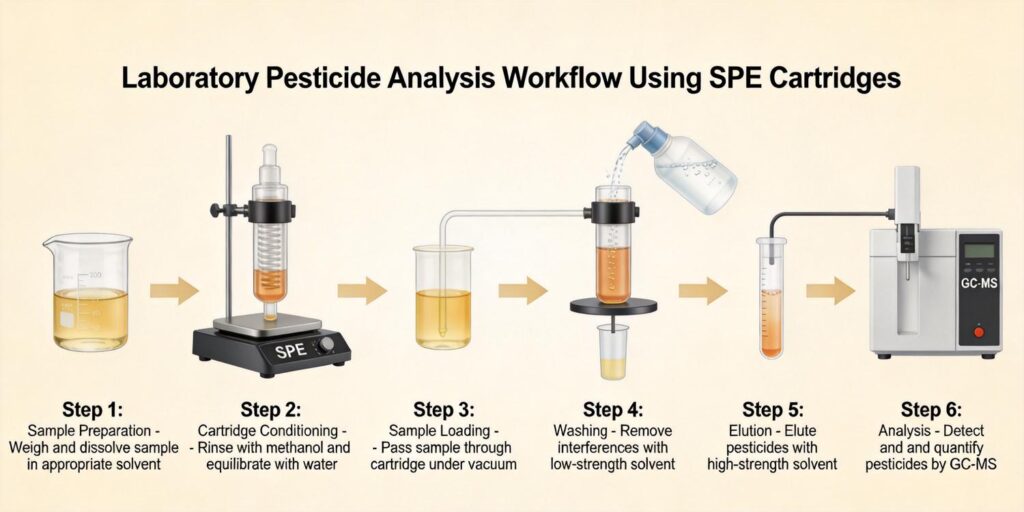
For multi-mycotoxin methods, HLB (hydrophilic-lipophilic balance) cartridges (see HLB SPE Cartridges) are widely used due to their reversed-phase retention. For acidic mycotoxins like fumonisins, MAX (mixed-mode anion exchange) or WAX (weak anion exchange) can be applied. Conditioning typically involves 1-2 mL methanol followed by 1-2 mL water to activate the sorbent bed. Do not let the bed run dry between steps.
Washing to Remove Pigments and Fats
After sample loading, a wash step using 5% methanol in water or 5% acetonitrile in water removes polar interferences. For fatty matrices like corn, a nonpolar wash with hexane or cyclohexane can eliminate lipids. This step significantly reduces matrix effects in LC-MS.
Elution and Concentration
Mycotoxins are eluted with 1-2 mL of methanol or acetonitrile containing 0.1-1% formic acid (for acidic analytes). The eluate is evaporated under nitrogen at 40°C and reconstituted in mobile phase. For enhanced recovery, use MCX (mixed-mode cation exchange) cartridges (MCX SPE Cartridges) for basic mycotoxins like DON.
LC-MS Detection
Reconstituted samples are analyzed by LC-MS/MS using a C18 column and gradient elution with 0.1% formic acid in water/methanol. Multiple reaction monitoring (MRM) transitions ensure specificity. SPE cleanup typically yields recoveries of 70–120% with RSD < 15%.
Food Safety Validation Requirements
Regulatory guidelines (e.g., EC 401/2006, FDA CVM) mandate method validation including linearity (R² > 0.99), LOD/LOQ, accuracy (recovery 70–120%), and precision (RSD ≤ 20%). SPE methods must demonstrate matrix-matched calibration to correct for ion suppression. Our 96-well SPE plates allow high-throughput validation for routine monitoring.
For further details on cartridge specifications and application notes, visit our product pages for MAX, WAX, and WCX SPE cartridges. Choose Poseidon Scientific for reproducible, low-cost mycotoxin cleanup solutions.