Flavor Additives Used in Confectionery Products
Confectionery products rely on a diverse array of flavor additives to create their distinctive taste profiles. These compounds can be broadly categorized into several chemical classes, each with unique properties that influence both flavor and analytical challenges. Common flavor additives include esters (such as ethyl butyrate for fruity notes), aldehydes (like benzaldehyde for almond flavor), ketones (including diacetyl for buttery taste), terpenes (limonene for citrus), and various phenolic compounds. Many of these additives are present at trace levels (ppm to ppb range) within a complex matrix of sugars, fats, and other confectionery ingredients.
As noted in food analysis literature, “SPE applications for food and beverages are usually developed either for quality control purposes… or for the detection or identification of drug and pesticide residues or microbial toxins. The goal is to ensure the safety of the consumer” (Simpson & Wynne, 2000). This principle extends directly to flavor additive analysis, where accurate quantification ensures both product consistency and regulatory compliance.
Analytical Challenges of Sugary Matrices
The high sugar content in candy products presents significant analytical challenges that must be addressed through effective sample preparation. Sugars like sucrose, glucose, and fructose create viscous solutions that can interfere with extraction efficiency, cause column overloading, and generate matrix effects during detection. These carbohydrates can also form complexes with flavor compounds or undergo caramelization during extraction, potentially altering analyte recovery.
Research has shown that “beverages, provided the alcohol or sugar/syrup content is not high or variable, are simpler still to process by SPE” (Simpson & Wynne, 2000). This highlights the importance of proper sample pretreatment for high-sugar matrices. The variable water and sugar content in different candy formulations can present capacity problems for SPE sorbents, necessitating careful method development and validation.
SPE Sorbent Selection for Flavor Compounds
Selecting the appropriate SPE sorbent is critical for successful flavor additive analysis. The choice depends on the chemical properties of target analytes and the specific matrix interferences present in candy products.
Reversed-Phase Sorbents (C18, C8, HLB)
For hydrophobic flavor compounds like esters and terpenes, reversed-phase sorbents offer excellent retention. C18 sorbents with high carbon loads (typically 7-10%) provide strong hydrophobic interactions for compounds like limonene and ethyl esters. The HLB (Hydrophilic-Lipophilic Balance) sorbent, with its unique copolymer structure, is particularly effective for a broad range of flavor compounds with varying polarities.
Mixed-Mode and Ion-Exchange Sorbents
For flavor additives with ionizable functional groups, mixed-mode sorbents combining reversed-phase and ion-exchange mechanisms provide superior selectivity. As demonstrated in pharmaceutical applications, “ion-exchange methodology also proved to be suitable for the clean-up of cream samples containing hydrophobic, acidic drugs” (Bonazzi et al., 1995). Similarly, acidic flavor compounds like certain phenolic additives can be effectively retained on anion-exchange sorbents (SAX), while basic compounds might require cation-exchange sorbents (SCX, MCX).
Normal Phase and Specialized Sorbents
For particularly polar flavor compounds or when analyzing non-aqueous candy extracts, normal phase sorbents like silica, diol, or amino phases may be appropriate. Diol sorbents have shown effectiveness in sample clean-up for formulations containing neutral or acidic drugs of different polarity (Bonazzi et al., 1995), suggesting similar utility for polar flavor additives.
Example Candy Extract Purification Workflow
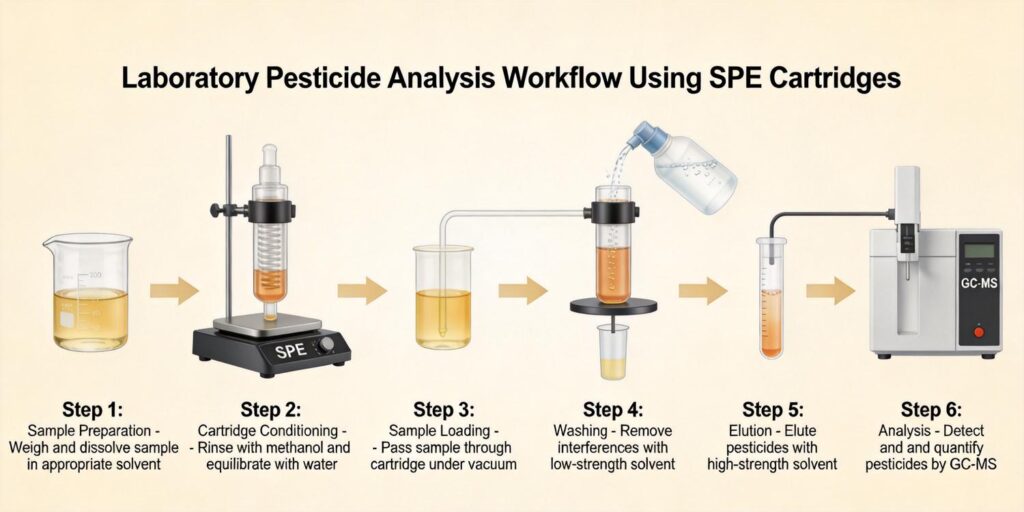
A comprehensive SPE workflow for candy flavor analysis typically involves the following steps:
- Sample Preparation: Homogenize candy sample and extract with appropriate solvent (water, methanol-water mixtures, or hexane for fat-soluble compounds). For hard candies, dissolution in warm water followed by filtration may be necessary.
- SPE Cartridge Conditioning: Condition the selected sorbent with appropriate solvents. For reversed-phase sorbents, this typically involves methanol followed by water or buffer. As noted in analytical protocols, “Before use, the SPE columns were properly conditioned as follows: C-18 sorbent by rinsing with 6 ml of methanol” (Bonazzi et al., 1995).
- Sample Loading: Apply the candy extract to the conditioned cartridge at controlled flow rates (1-5 mL/min). For high-sugar samples, dilution may be necessary to prevent sorbent overloading.
- Wash Steps: Remove matrix interferences using appropriate wash solvents. For reversed-phase applications, 5-10% methanol in water often effectively removes sugars while retaining hydrophobic flavor compounds. As observed in food analysis, “The advantage of using SPE is that class fractionation into acid, base, and neutral fractions is simple and the opportunity to concentrate the target analytes offers enhanced sensitivity” (Simpson & Wynne, 2000).
- Elution: Recover target analytes using optimized elution solvents. For reversed-phase sorbents, methanol, acetonitrile, or ethyl acetate typically provide efficient elution. The eluate can then be concentrated if necessary before analysis.
GC-MS or LC-MS Detection Strategies
The choice between GC-MS and LC-MS detection depends on the volatility and thermal stability of target flavor compounds.
GC-MS Analysis
Gas chromatography-mass spectrometry is ideal for volatile flavor compounds like esters, aldehydes, and terpenes. Following SPE cleanup, extracts may require derivatization for certain compound classes. As documented in analytical chemistry, “Chemical derivatization… includes OH, SH, and NH and the products for these reactions are esters, thioesters, and amides” (Forensic and Clinical Applications of Solid Phase Extraction). Common derivatization reagents for flavor analysis include BSTFA (N,O-bis(trimethylsilyl)trifluoroacetamide) for hydroxyl groups and various acylating agents for amine-containing compounds.
LC-MS Analysis
Liquid chromatography-mass spectrometry offers advantages for less volatile or thermally labile flavor additives. Reversed-phase HPLC columns (C18, C8) coupled with mass spectrometry provide excellent separation and identification capabilities. As demonstrated in food additive analysis, “Nova-Pak C18 columns have been successfully applied to the analysis of soft drink additives including sweeteners and preservatives” (Waters Chromatography Guide). Electrospray ionization (ESI) and atmospheric pressure chemical ionization (APCI) are commonly used ionization techniques.
Applications in Food Quality Assurance
SPE-based flavor additive analysis plays crucial roles in multiple aspects of food quality assurance:
Regulatory Compliance
Many countries have strict regulations governing the use of flavor additives in food products. SPE methods enable accurate quantification to ensure compliance with maximum permitted levels. The methodology allows detection at the low ppm to ppb levels often required by regulatory agencies.
Product Consistency and Authentication
Batch-to-batch consistency is essential in confectionery manufacturing. SPE cleanup followed by chromatographic analysis provides precise quantification of flavor profiles, ensuring product uniformity. Additionally, these methods can help authenticate premium products by verifying the presence of declared natural flavor compounds.
Contaminant Screening
Beyond intentional additives, SPE methods can screen for unintended contaminants that might affect flavor quality. As noted in environmental analysis, “SPE allows extraction under mild conditions of pH, thereby limiting the incidence of decomposition or rearrangement of labile compounds” (Simpson & Wynne, 2000). This gentle extraction preserves analyte integrity while removing interfering matrix components.
Troubleshooting and Development
When flavor-related quality issues arise, SPE methods enable rapid identification of problems such as incorrect additive concentrations, degradation products, or unexpected interactions between flavor compounds and candy matrices.
For laboratories seeking reliable SPE solutions for candy flavor analysis, Poseidon Scientific’s HLB SPE cartridges offer excellent performance for a wide range of flavor compounds. Our MCX cartridges provide superior cleanup for basic flavor additives, while the WAX cartridges are ideal for acidic compounds. For high-throughput applications, consider our 96-well SPE plates that maintain the same performance characteristics in automated formats.
Proper method development, including sorbent selection, conditioning optimization, and elution scheme design, is essential for successful flavor additive analysis in candy products. By addressing the unique challenges of sugary matrices and leveraging appropriate SPE technologies, laboratories can achieve reliable, accurate results that support both quality control and regulatory compliance in the confectionery industry.